

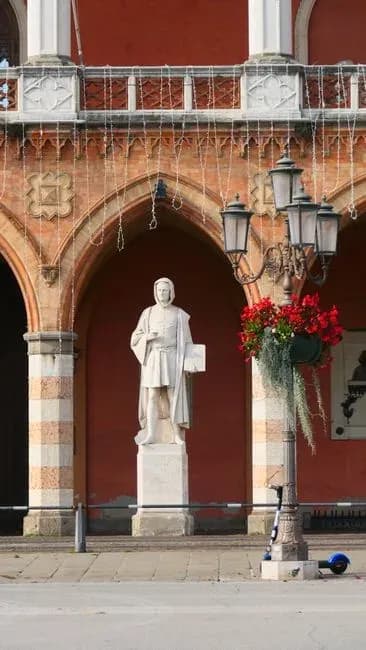
Visiting Padova means embracing an urban layout tailored for pedestrians and an unhurried rhythm. The historic centre is a large limited traffic zone bounded by ancient squares and threaded by over 12 km of porticoes, which provide practical shelter whether walking under the June sun or dodging autumn rain showers. There is no need to dash from place to place or plan lengthy urban journeys: distances are easily covered on foot, and virtually all major historic sights sit within a 2 or 3 km radius.
The best months to plan this weekend in Padova are during spring, from April to June, and the start of autumn, particularly September and October. During these weeks, mild temperatures make it a delight to be outdoors all day without feeling weary, and visitor numbers remain far more manageable than during the sultry peak of summer.
How to organise your days in the city
Day 1 — From the Middle Ages to the University
Morning
Friday morning begins north of the centre at Giardini dell'Arena. Here stands the Cappella degli Scrovegni, a masterpiece by Giotto recognised as a UNESCO World Heritage Site. Entry rules are extremely strict and demand promptness: the protocol involves a mandatory 15-minute wait in a climate-controlled room for thermal stabilisation, followed by exactly 15 minutes inside the frescoed chapel. Just outside, the same combined ticket grants entry to the rooms of the Musei Civici agli Eremitani e Palazzo Zuckermann, displaying the city's archaeological collections alongside medieval and modern art galleries.
Afternoon
For lunch, head over towards Piazza della Frutta. On Via Pietro D'Abano, pop into All'Ombra della Piazza, a wine bar tailored for a light bite of quality Venetian cicchetti paired with an extensive wine list. The afternoon is dedicated to historic civic and academic landmarks. Start with the Palazzo della Ragione e Sotto il Salone: the upper floor houses an imposing frescoed suspended hall once used as a medieval courtroom, while the ground floor is occupied by the historic covered food market, still bustling today. A short walk away stands Palazzo del Bo e Teatro Anatomico, the historic seat of the university where Galileo Galilei once taught. Inside the academic complex, you will see the world's first permanent anatomical theatre, built in 1594.
Evening
In the evening, head to Via Cristofori for dinner at A Banda del Buso. This rustic osteria is a favourite with locals: the menu revolves around bold, hearty Venetian classics, such as their renowned horsemeat trio served with polenta and traditional tortellini in brodo.
Day 2 — Grand squares and the Ghetto Ebraico
Morning
It is best to devote the first part of Saturday to the city's spiritual heart. Arriving at the Basilica di Sant'Antonio (Il Santo) early in the morning is a smart move to admire the magnificent cloisters and Donatello's works before the aisles fill with pilgrim groups. Leaving the basilica, you are just steps away from Prato della Valle. Renowned as one of Europe's largest elliptical squares, its centre features the green island of Isola Memmia, encircled by a canal and watched over by 78 historic statues arranged in a ring.
Afternoon
For lunch, stop at Antica Trattoria Dei Paccagnella on Via del Santo, just moments from the basilica. The kitchen serves regional cornerstones, from baccalà mantecato to traditional Paduan hen, alongside freshly made homemade pasta. Re-energised, begin the afternoon at the Orto Botanico dell'Università di Padova. Founded in 1545 and now a UNESCO World Heritage Site, it holds the title of the world's oldest university botanical garden still on its original site. In the late afternoon, wander towards Piazza dei Signori e Torre dell'Orologio. Dominated by a 14th-century astronomical clock, this Renaissance square fills up quickly for aperitivo. Before dinner, take a seat at Caffè Pedrocchi, a 19th-century cafe famous for having originally been 'without doors' and for hosting Risorgimento intellectuals and patriots. Order the house speciality coffee, served with a thick mint cream.
Evening
Round off the day in the charming network of streets of the Ghetto Ebraico di Padova. On Via dei Soncin you will find Osteria L'Anfora, an informal, unpretentious spot serving time-honoured Venetian dishes like beef stew with polenta, bigoli with duck ragù, and sarde in saor.
Day 3 — Duomo frescoes and thermal waters
Morning
Sunday morning brings you back to the western edge of the historic quarter. In Piazza Duomo, step into the Battistero della Cattedrale di Padova. The interior walls preserve a spectacular 14th-century fresco cycle by Giusto de' Menabuoi, officially protected as part of the UNESCO-listed Padova Urbs Picta circuit. From here, delve back into the maze of alleys that makes up the Ghetto Ebraico di Padova, seeing it in the morning light. The narrow streets and tall palazzi are home to artisan workshops, small wine bars, the city synagogue, and the Jewish Museum.
Afternoon
Sunday lunch is enjoyed near the cathedral at Osteria Dal Capo. The atmosphere is intimate, with a focus on hearty pasta courses and homestyle cooking crafted purely from fresh, seasonal Venetian ingredients. In the afternoon, leave the pedestrian centre and head towards the Colli Euganei. A 10 to 15-minute train ride or drive takes you to the Piscine Termali di Abano e Montegrotto Terme. This is Europe's largest thermal spa area, purpose-built to harness warm, mineral-rich saline waters. Swapping city streets for steaming pools is the perfect way to wrap up the three days in pure relaxation before collecting your bags and heading home.
Evening
Spend the evening in the thermal area of the Comprensorio Euganeo. After a relaxing afternoon soaking in the saline waters of Abano and Montegrotto, take a leisurely trip back to the railway station or your car, ready to bring your weekend to a restful close.
Top tips for a smooth trip
- Book your visit to the Cappella degli Scrovegni well in advance: entry is strictly timed for small groups and includes a mandatory 15-minute stay in a climate-controlled room before spending 15 minutes before the frescoes.
- To get around effortlessly, simply stick to walking: most of the historic centre is an extensive ZTL spanning 2 or 3 km, sheltered by 12 km of continuous porticoes keeping off the sun and rain.
- If driving to Padova by car or camper van, take care around the electronic ZTL access gates. A convenient parking option is Park Piazza Rabin, right next to Prato della Valle, or the park-and-ride car parks along the tram line.
- For on-the-ground spending, allow an average budget of €180 to €220 per person, excluding accommodation. This comfortably covers meals in traditional osterie, evening spritzes, combined museum passes, and a relaxing half-day at the thermal baths.
- The shoulder seasons offer the most pleasant weather: planning your trip between April and June, or September and October, ensures mild walking temperatures and lets you bypass the heavy summer crowds.
Recommended hotels and B&Bs
Located right opposite the Basilica di Sant'Antonio, in a supremely practical spot for exploring the city's spiritual quarter.
View on Booking →Set right inside the Ghetto Ebraico, just a short stroll from Piazza delle Erbe and the historic food markets.
View on Booking →Housed in a Liberty-style building opposite the railway station, ideal if you plan to head by train to the thermal baths.
View on Booking →