

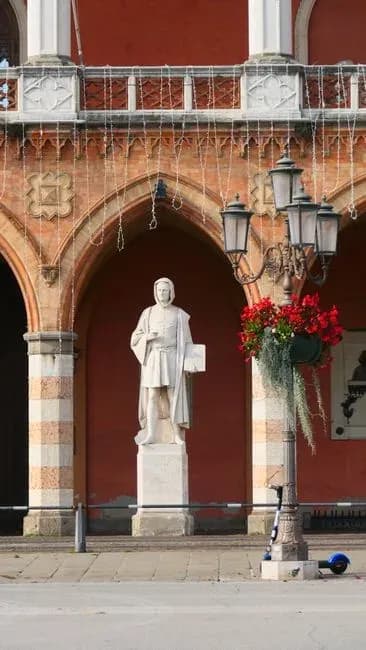
Organising a weekend in Padova requires a little planning, especially around the opening hours of the main sights, but the city is wonderfully easy to explore entirely on foot. Most of the historic centre is a limited traffic zone (ZTL), and distances between stops are short: walking from the northern edge right down to the southern tip takes around 20-25 minutes. Alternatively, there is the fast SIR1 tram, which cuts straight through the centre along the route running from the railway station through Ponti Romani, down to il Santo and finishing in the south.
The best time to plan these two days is either in spring, from April to June, or in early autumn, between September and October. In these months, mild weather makes strolling between cloisters and piazzas a pleasure, and lets you enjoy the blooms in the historic gardens. By contrast, July and August often bring muggy, humid heat, making outdoor sightseeing tiring in the middle of the day.
Logistically, it pays to stay within the pedestrian heart: Hotel Majestic Toscanelli puts the market squares right on your doorstep, while choosing Hotel Casa del Pellegrino or Hotel Giotto places you strategically in the southern quarter, midway between the basilicas and the university gardens.
How to plan your days in the city
Day 1 — Frescoes, the university and historic piazzas
Morning
The first part of the day begins in the northern part of the centre, around Piazza Eremitani. Your starting point is Cappella degli Scrovegni, famous for Giotto's fresco cycle. Booking well in advance is mandatory and the rules are strict: entry is restricted to groups of no more than 25 people and the visit lasts 30 minutes in total. You must turn up 5 minutes before your time slot at the climate-controlled waiting room, where you wait for 15 minutes before spending the actual quarter of an hour inside the chapel. Just a short walk away stands Chiesa degli Eremitani, a 13th-century church that houses Cappella Ovetari, renowned for its frescoes by Andrea Mantegna, partially reconstructed after wartime bombing. Once you have finished here, head south along Via VIII Febbraio to reach Palazzo Bo, seat of the Università di Padova. Here you can join the scheduled 45-minute guided tour known as the 'Giro Storico', which takes you to see Galileo Galilei's lectern and the permanent anatomical theatre dating from 1594.
Afternoon
After your academic tour, the natural stop on Via VIII Febbraio is Caffè Pedrocchi. This 19th-century establishment is known as 'the café without doors', where you can enjoy their signature mint espresso topped with milk cream, either at the counter or in the historic rooms. From here, dive into the bustling market squares. Between Piazza delle Erbe and Piazza della Frutta stands Palazzo della Ragione e Sotto il Salone. The upper floor houses the ancient town court with a gigantic wooden horse and a suspended hall decorated with an astrological fresco cycle. The visit takes between 30 and 60 minutes. The ground floor, meanwhile, is occupied by the historic medieval covered market, packed with food stalls and delicatessens. Heading out towards the west, you arrive in Piazza dei Signori, dominated by Palazzo del Capitanio and the Torre dell'Orologio with its 14th-century astronomical clock face.
Evening
Piazza dei Signori and the surrounding streets are the place to be by late afternoon. From 17:30, in Piazza della Frutta, La Folperia opens—a street food kiosk specialising in seafood. The local custom is to order a paper cone of warm boiled 'folpetti' (baby octopus) with salsa verde and assorted seafood spuncioni, eating them on your feet or leaning against the low stone walls. Just behind the squares lies the Ghetto Ebraico di Padova, a maze of medieval pedestrian alleys lined with tower-houses and artisan workshops. In the heart of this area, on Via dei Soncin, head for dinner to Osteria L'Anfora, a bustling spot serving classic Venetian dishes such as sarde in saor and pasta e fagioli, paired with wines by the glass.
Day 2 — Domes, basilicas and botanic gardens
Morning
Your second day begins in Piazza Duomo with a visit to Battistero del Duomo. This Romanesque building is covered from floor to dome in a dense 14th-century fresco cycle by Giusto de' Menabuoi, and forms part of the Padova Urbs Picta circuit. From the piazza, make your way south through the central streets until you reach Piazza del Santo. Here stands Basilica di Sant'Antonio di Padova, known locally simply as 'il Santo'. The building displays an eclectic mix of architectural styles alongside a series of open internal cloisters. Out on the piazza in front of the basilica stands Donatello's equestrian monument to Gattamelata.
Afternoon
A short walk from the Basilica along Via Orto Botanico brings you to the Orto Botanico dell'Università di Padova. Founded in 1545, it is the world's oldest academic botanic garden still on its original site. Exploring the various sectors and greenhouses takes between 60 and 90 minutes. Leaving the garden, the route continues just a few metres down to Prato della Valle, one of the largest squares in Europe. Its layout features a central elliptical island, Isola Memmia, encircled by a canal and lined with a double ring of 78 historic statues. In the late afternoon, this is where locals gather to sit along the grassy banks of the water.
Evening
For your final dinner, remain in the southern quarter of the centre. On Via del Santo you will find Antica Trattoria Dei Paccagnella, a traditional restaurant near the Basilica serving classic local dishes, including bigoli in a rich hen ragù and baccalà mantecato. Alternatively, wandering back through the central streets, stop off at Osteria A Banda del Buso, an informal spot where the menu revolves around meat and seafood spuncetti alongside other classic Venetian recipes.
Practical tips for your trip
- Entry to Cappella degli Scrovegni must be booked well in advance: visits are capped at 25 people with strict time slots, and you must arrive at the climate-controlled waiting room at least 5 minutes beforehand.
- It is well worth considering the Padova Card (or Urbs Picta Card): it includes admission to Cappella degli Scrovegni, Battistero del Duomo, Palazzo della Ragione and other civic museums, saving money compared with buying individual tickets.
- The historic centre is easily explored on foot or by hopping on the fast SIR1 tram. A car is completely unnecessary, as the central area is strictly regulated by the ZTL system.
Where to stay
Located in the pedestrian area close to Piazza delle Erbe and the Duomo, ideal for heading out on foot in the evening.
View on Booking →Positioned right opposite Basilica di Sant'Antonio, making it just a short stroll from the Orto Botanico.
View on Booking →A property in the south, halfway between the piazzas of il Santo and the statues of Prato della Valle.
View on Booking →