
Autumn transforms the Calabrian mountains into a rich palette, where the red of the beech trees mixes with the dark green of ancient silver firs. It is the best time to head inland, when temperatures drop and the morning mist envelops the woods of the Serre. Serra San Bruno isn't your usual coastal tourist destination: here you'll find carved granite, isolated hermitages and paths trodden for centuries.
The best time to plan your trip is from May to October. During the summer, the mountains offer shelter from the heat of the coast, but it is the months of October and November that reveal the true face of these places, coinciding with the autumn foliage and the porcini mushroom season. Much of the area revolves around Carthusian traditions and wood and stone working, crafts that have left clear traces in the alleys of the town centre.
You will need a car to visit this part of Calabria. Public transport in the mountains is rare and distances take time: moving between villages means driving on winding roads for 15 or 40 minutes each way. Choosing central accommodation as your base, such as the Hotel Conte Ruggero or the Magno B&B, helps you better organise your daily explorations.
How to organise your day-by-day itinerary
Day 1 — Granite, churches and cloister
Morning
Your day begins by walking along Corso Umberto I, the main axis of the historic centre. The building facades and portals reveal the skill of ancient local stonemasons. Your first stop is the Chiesa Matrice di San Biagio, dedicated to the town's patron saint, which boasts a granite stone portal. A short distance away, the Chiesa dell'Addolorata showcases Calabrian baroque with its complex facade. A detour through the alleys lets you cross paths with the Fontana di Bonsignuri, also in carved granite, useful for a short break. Exploring the historic districts, you reach the Chiesa Maria Santissima Assunta di Terravecchia, in the village's original core, and the Chiesa dell'Assunta di Spinetto, the religious centre of the district of the same name.
Afternoon
Moving to Contrada Certosa, the atmosphere changes. Here stands the Certosa di Santo Stefano e San Bruno, founded in 1091. As it is a cloistered monastery, the building can only be viewed from the outside, by walking along the entrance avenue. To truly understand the life of the Carthusian monks, it is worth dedicating some time to the Museo della Certosa. The exhibition takes about 45-90 minutes, requires no booking for individual visitors and houses faithful reconstructions of the cells. You can easily park in the nearby areas, which are spacious and shaded.
Evening
For dinner, staying in the town centre, you can try the Ristorante La Lumera. The menu focuses on traditional dishes, offering fresh wild mushrooms, local cured meats and the typical rustic pitta.
Day 2 — Hermitage and slow footsteps in the woods
Morning
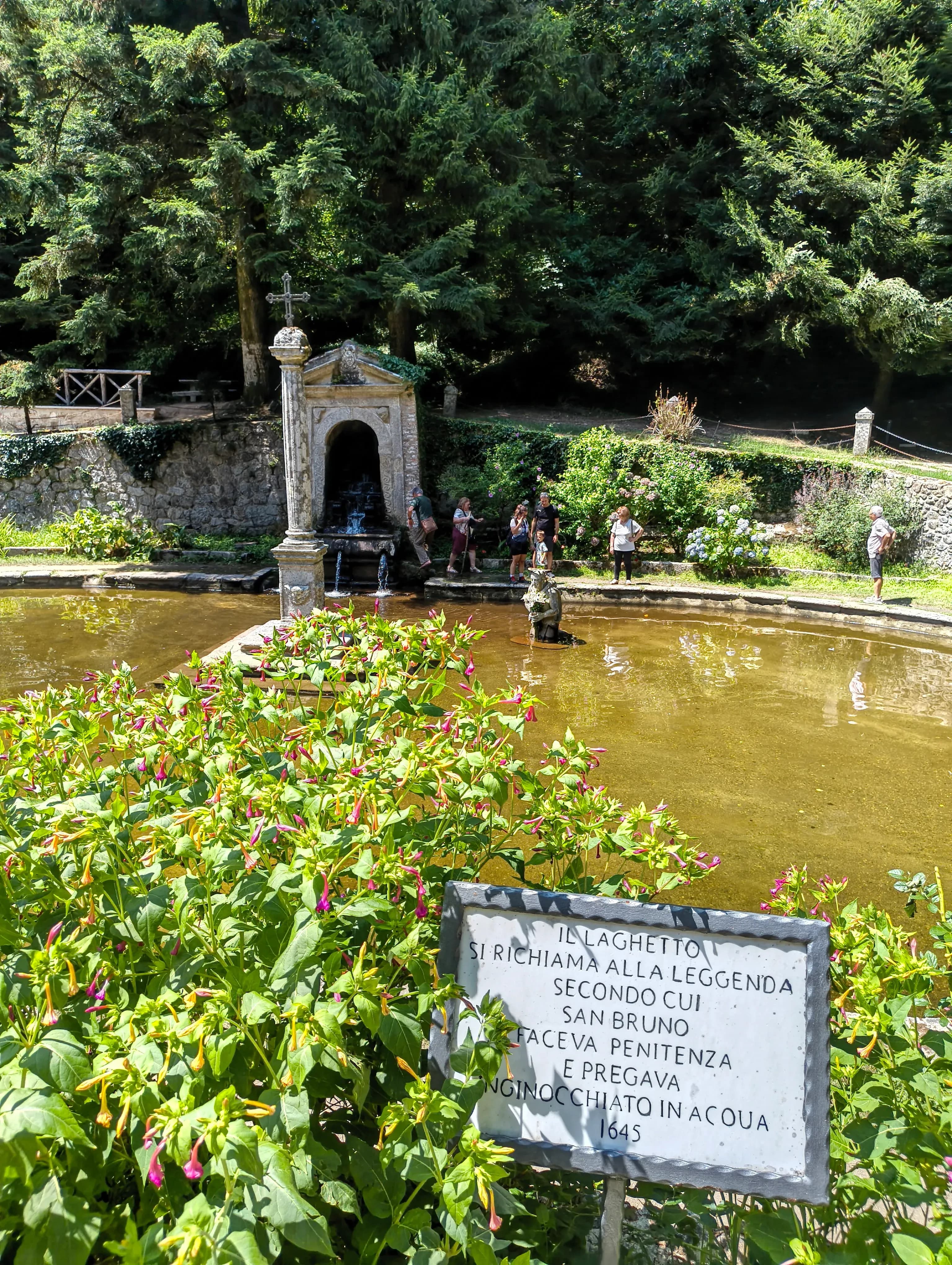
In Località Santa Maria del Bosco you enter the most isolated dimension of the area. The area has shaded car parks from which to set off on foot. You first come across the Santuario di Santa Maria del Bosco, a place of prayer founded by the saint among the silver firs, with its adjoining Dormitorio. A few steps away is the Laghetto di San Bruno, open and accessible at all hours: in the centre of the water you'll notice the statue depicting the saint in penance, a recurring image in local history.
Afternoon
Leaving the cars at the car park, you take the Sentiero Frassati delle Serre. This hiking trail winds through beech and fir trees, connecting the sanctuary area towards Mongiana. Walking along this path means crossing the Parco Naturale Regionale delle Serre without major changes in elevation, enjoying the silence and the half-light of the tall trees.
Evening
Heading back towards the town, for dinner you move to Località La Chiusa at the Agriturismo Fondo dei Baroni. The kitchen offers zero-mile dishes, homemade pasta starters with porcini mushrooms and meats from the inland area.
Day 3 — Industrial archaeology and suspended trails
Morning
You take the car and drive for about 15 minutes towards Mongiana. This small municipality houses the Fabbrica d'Armi e Reali Ferriere Borboniche, a hub of industrial archaeology linked to the Kingdom of the Two Sicilies, once a nerve centre of the southern Italian iron and steel industry. After the visit, still in Mongiana, it is worth exploring Villa Vittoria e Parco Botanico, a forest oasis managed by the Carabinieri forestali, equipped with educational routes and a geological path.
Afternoon
You head back to Località La Chiusa for a different kind of afternoon. The Parco Avventura Adrenalina Verde offers acrobatic courses suspended among the trees for various age groups. Those who prefer to take part in guided activities must book their slot in advance by contacting the managers directly.
Evening
You return to the historic centre in Serra San Bruno to have dinner at Zenzero - Il Ritrovo del Gusto, on Via Roma 12. The venue functions as a bistro and enoteca, offering Calabrian mountain ingredients in a more modern guise.
Day 4 — Monumental forests and falling water
Morning
The morning requires trekking boots. Reaching the Bosco di Archiforo, you immerse yourself in a forest populated by monumental silver firs, interspersed with outcropping granite formations. The loop trail takes anywhere from 3 and a half to 6 hours, depending on your pace and necessary breaks, proving to be one of the most substantial hikes in the Park.
Afternoon
Getting back in the car, you widen your range. Driving for 35-40 minutes you arrive in Stilo to observe the Cattolica di Stilo, a small 10th-century Byzantine temple whose five domes dominate the Stilaro valley. From here, or starting from Bivongi (about 40 minutes away by car and partly off-road or on foot), you continue towards the Cascata del Marmarico. With its 114 metres over three levels, it is the highest in the southern Apennines and forms a cold but swimmable lake at the base.
Evening
To conclude your trip to Serra San Bruno, the Ristorante Pizzeria Delle Serre offers mountain cuisine, game and wood-fired pizza, maintaining the homely flavours of the area.
Practical tips to organise your trip
- A car is essential: the bus lines to move between Serra San Bruno, Stilo and Mongiana are sparse and the mountain roads take time to cover a few kilometres.
- The actual Carthusian monastery is inaccessible to tourists. To learn about its history you should visit the Museo della Certosa, which requires a ticket of about €4.
- The mountain climate allows for hikes from May to October, but early autumn offers the foliage in the woods and the blooming of porcini mushrooms, central elements of these places.
- Near the Museo della Certosa and the Santa Maria del Bosco area you will find large shaded car parks. It is best to leave your car there to start the various hiking trails on foot.
- At the table, you should try the 'pasta alla serrese' with porcini mushrooms and the 'pitta china', a local focaccia filled with olives, peppers and elderflowers.
Where to sleep
It is centrally located, allowing you to easily walk to the main street and restaurants.
View on Booking →Located about two kilometres from the historic centre, it remains close to the Certosa and guarantees a peaceful environment.
View on Booking →Overlooking Piazza Tedeschi, it is very convenient for exploring the churches and alleys of the ancient village on foot.
View on Booking →