

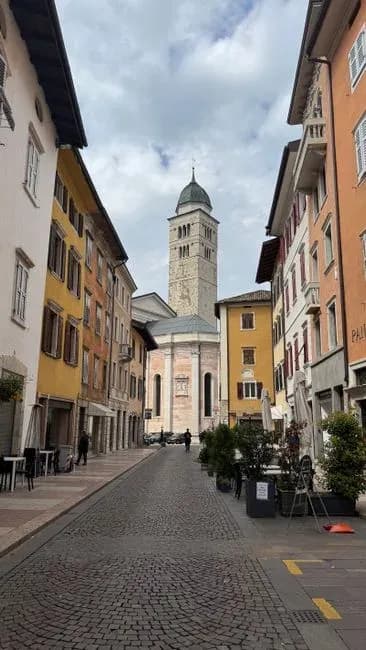
There is a singular atmosphere to this valley-floor city, where urban rhythms constantly brush against the silhouettes of the surrounding mountains. The pedestrianised streets of the centre let you wander freely, untouched by traffic, with most highlights clustered so conveniently together that you can cross eras in a simple ten- or fifteen-minute stroll. You won't need a car in the historic centre of Trento; it is best explored on foot or by bicycle, moving swiftly from subterranean Roman ruins to the striking contemporary lines of the district designed by Renzo Piano.
The pull of the high peaks is unmistakable the moment you look up or step outside the urban grid. A trip up to Monte Bondone e Giardino Botanico Alpino or a cable-car ride to the panoramic village above serves as a constant reminder of the provincial capital's Alpine soul. Distances are modest: the entire city centre and its immediate slopes can be explored over two days with remarkably straightforward logistics, particularly if you rely on the local and provincial transit network to tackle the steeper climbs without ever taking the wheel.
How to plan two days in the city
Day 1 — From the historic centre to the Piedicastello tunnels
Morning
Your introduction to the city begins in Piazza Duomo e Cattedrale di San Vigilio, the monumental heart of town that encompasses the Fontana del Nettuno and the Council's cathedral. Allow around an hour and a half to take in the central area, ideally in the morning when the squares are quieter. From here, follow Via Belenzani e Case Affrescate, the most elegant street in the centre, lined with Renaissance aristocratic palazzi boasting richly painted facades. Life slows down as you stroll over the worn paving stones. When lunchtime approaches, stay within the Centro Storico and make your way to Vicolo del Vò, where you'll find Ristorante Al Vò, one of the city's oldest osterie and the ideal spot for regional classics like canederli and carne salada.
Afternoon
In the early afternoon, head below the current pavement of Piazza Cesare Battisti to explore the S.A.S.S. Spazio Archeologico Sotterraneo del Sas. The visit takes around an hour and reveals a remarkably well-preserved underground section of Roman Tridentum, where ancient paved streets, sewers, and shop remnants are still visible. Stepping back into daylight, cross the river towards the Piedicastello district for a total change of perspective. Here stands the Doss Trento e Mausoleo di Cesare Battisti, a verdant hill perfect for an urban hike with elevated views over the historic monument. Just beneath it, still in Piedicastello, step inside Le Gallerie di Piedicastello, two repurposed road tunnels that now host an immersive exhibition space dedicated to local history and memory.
Evening
For dinner, an easy walk brings you back into the historic grid. On Via Paolo Oss-Mazzurana you'll find Forsterbräu Trento, a historic restaurant and beer hall right in the centre. The portions of hearty Trentino and Tyrolean fare are generous—a solid, satisfying meal to wrap up a day spent walking the city's squares and urban hills.
Day 2 — Cutting-edge science and sweeping views
Morning
Day two starts with an easy 10-15 minute walk from the centre towards the Quartiere Le Albere, a contemporary district home to the MUSE - Museo delle Scienze. Designed by Renzo Piano, this interactive science museum warrants at least half a day to explore properly. At weekends, it's wise to book your time slot in advance to avoid queues at the entrance. In the park adjoining the modern structure stands the striking contrast of Palazzo delle Albere, the Renaissance fortress-villa of the Madruzzo prince-bishops, which you can admire up close before heading back towards the ancient core. For lunch in the Centro Storico, stop at Ristorante Ca' dei Gobj on Via del Simonino, well known for traditional recipes like strangolapreti and tortel di patate.
Afternoon
The afternoon belongs to the Castello del Buonconsiglio e Torre Aquila, the former residence of the prince-bishops famed for its Ciclo dei Mesi frescoes. Plan on spending between 2 and 3 hours here; booking ahead is also recommended to access the tower. Once your visit is complete, head over to Lungadige Sanseverino to catch the Funivia Trento-Sardagna. The cable car scales the valley wall in just 4 minutes, pulling into the village of Sardagna for breathtaking views plunging down over the Adige valley. If you have extra time or a vehicle, you can opt instead for a 30-40 minute drive or bus ride along the provincial road up to Monte Bondone e Giardino Botanico Alpino in the Viote basin, for nature walks or a relaxing break among Alpine meadows.
Evening
Back down at river level, head to Antica Trattoria Due Mori on Via San Marco for your final dinner, not far from the Buonconsiglio area. It's a welcoming dining room celebrated for its local cooking—the perfect way to round off the weekend before returning to your hotel.
Practical travel tips
- Ask your hotel for the Trentino Guest Card before arriving; it offers free or discounted entry to major museums along with unlimited travel on provincial public transport, including local buses and the cable car.
- The centre is entirely pedestrianised and compact: walking from the historic core to the Le Albere district takes no more than 15 minutes, making a car redundant for getting around town.
- For entry to MUSE - Museo delle Scienze and to climb Torre Aquila at the castle, booking your time slot in advance is essential at weekends to avoid lengthy queues.
- If you plan to take the cable car to Sardagna, keep in mind that high winds can temporarily suspend the service, with replacement buses running in its place.
Where to stay
Located in the modern Le Albere district, within easy walking distance of MUSE and ideal for exploring on foot.
View on Booking →A four-star hotel offering a 500-sq m spa wellness centre, an indoor pool, and close proximity to the ski slopes.
View on Booking →A resort featuring a spacious wellness area and swimming pools, strategically placed for high-altitude hikes.
View on Booking →