

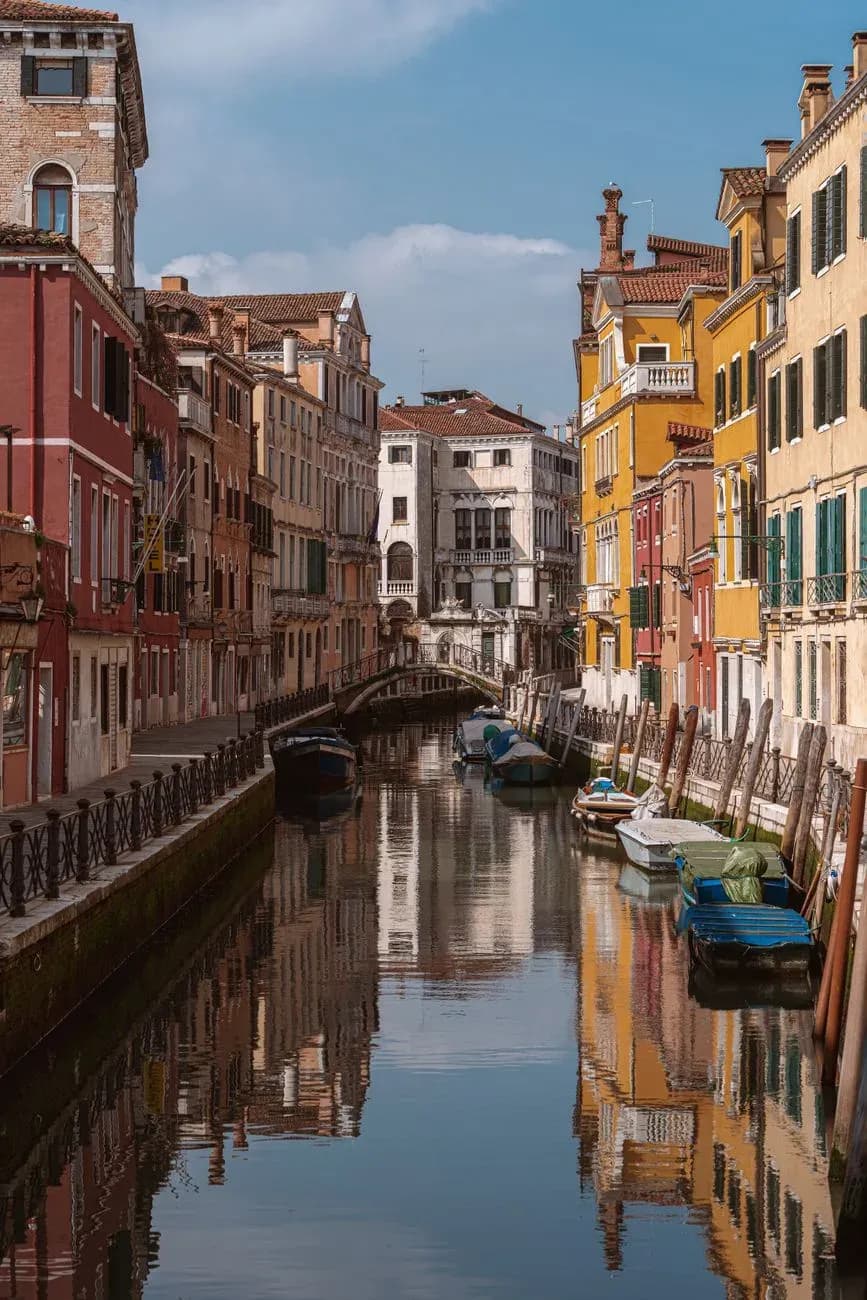
Stepping off the train at Stazione di Venezia Santa Lucia means your journey begins the very second your feet touch the stone steps, with the Canal Grande spread out before you. A weekend by train here is not just a practical choice to dodge the steep parking fees at Piazzale Roma or Tronchetto, but the most natural way to tune into the city's true rhythm right away. Here, you get around on foot, tackling steps and bridges, listening to the echo of your own footsteps in the quietest campielli.
The best time for these walking itineraries is between spring and autumn, when the air is mild and the weather suits long days of exploring, whereas summer heat makes the constant climbs over bridges exhausting. And during Carnevale, the atmosphere shifts alongside accommodation prices, which shoot up dramatically. Experience the city from ground level, embracing the ritual of the ombra: in historic bacari you drink standing at the counter, enjoying a Select spritz, seafood cicchetti and the chatter of locals. All without a single car in sight.
Four days through sestieri and canals
Day 1 — Arrival in Cannaregio
Morning
Exiting Stazione di Venezia Santa Lucia plunges you straight into the Venetian dimension. From here, set off on foot towards the sestiere of Cannaregio. Your first stop is the Ghetto Ebraico di Venezia, the oldest in Europe. Morning is the best time to wander its intimate campielli and historic synagogues, when the lack of crowds lets you take in the neighbourhood's quiet, suspended atmosphere.
Afternoon
Continuing on foot through the sestiere, you reach the Chiesa della Madonna dell'Orto, a Gothic church tucked away in an intimate, quiet area. Inside, it preserves major large-scale canvases by Tintoretto, as well as the painter's own tomb. It is a peaceful corner of the lagoon far from the heaviest tourist footfall, ideal if you appreciate a slower pace.
Evening
Stay in the neighbourhood for dinner. Antica Osteria alla Vedova (Ca' d'Oro) is renowned for traditional Venetian cooking and, above all, its iconic fried meatballs. Alternatively, if you prefer an informal evening gathering spot, Al Timon along Fondamenta dei Ormesini lets you sip glasses of wine and snack on cicchetti right by the canal edge.
Day 2 — Gothic art and bacari between San Polo and Dorsoduro
Morning
Start the day in the sestiere of San Polo at the Basilica dei Frari, a grand Gothic edifice housing Titian's celebrated Assunta altarpiece alongside several historic funerary monuments; allow about an hour for the visit. Just a short walk away stands the Scuola Grande di San Rocco, a confraternity building entirely adorned with a cycle of canvases by Tintoretto. Here too, the visit takes roughly an hour.
Afternoon
Cross into the sestiere of Dorsoduro to get an up-close look at living artisan history: the Squero di San Trovaso, one of the rare traditional boatyards where rowing gondolas are still built and repaired today. The area calls for a pit stop: Osteria Al Squero overlooks the boatyard itself, serving Venetian cicchetti and spritz. A short distance away, along Fondamenta Nani, lies Cantinone Già Schiavi, a historic wine shop famous for its wine selection and award-winning crostini.
Evening
The evening naturally unfolds in Campo Santa Margherita, a wide square in Dorsoduro always buzzing with students and locals. It is the go-to hub for an evening aperitivo, with spritz and cicchetti, in a relaxed setting that rounds off a full day of walking.
Day 3 — The monumental heart
Morning
Head to Piazza San Marco before 9:00 to see this monumental open-air drawing room before the midday crowds arrive. Admission to the Basilica di San Marco, a treasure chest of golden Byzantine mosaics, must be booked online to avoid getting stuck in long queues. Right next door, Palazzo Ducale – historic seat of the Doge – warrants at least two hours, again with tickets or passes secured in advance.
Afternoon
Stepping away from the square, track down Scala Contarini del Bovolo, a late-Gothic spiral staircase tucked between quiet calli, offering a quick 30-minute panoramic visit. Afterwards, head to Terrazza Fondaco dei Tedeschi: admission is free, but you must reserve roughly two weeks ahead to guarantee your 360° view over the Canal Grande.
Evening
Sunset is the perfect moment to cross the Ponte di Rialto, watching vaporetti and gondolas drift along the Canal Grande. Near the fish market nearby, two spots stand out for wrapping up the day: Cantina Do Mori, the city's oldest bacaro with 15th-century fittings and "postage-stamp" tramezzini, and the tiny All'Arco, serving made-to-order seafood cicchetti.
Day 4 — Art and sunsets in Dorsoduro
Morning
Your final day is dedicated to the atmosphere of Dorsoduro. Begin at the Peggy Guggenheim Collection, a modern art museum housed within Palazzo Venier dei Leoni. Between the artworks on display and the sculpture garden opening right onto the canal, a visit usually lasts around an hour and a half.
Afternoon
Strolling towards Punta della Dogana brings you to the Basilica di Santa Maria della Salute, an imposing Baroque structure built as a votive offering after the 17th-century plague subsided. The surrounding waterfront provides sweeping vistas across San Marco basin.
Evening
Before catching your train home, bid farewell to the city from the Ponte dell'Accademia. This wooden bridge offers the most iconic perspective over the Canal Grande, with the Basilica della Salute in the background. It is a view best enjoyed in the fading evening light.
Tips for getting around car-free
- Arriving by train at Stazione di Venezia Santa Lucia lets you skip the expense and queues of the car parks at Piazzale Roma and Tronchetto, stepping right into the historic centre from the very first moment.
- Walking is the most efficient and economical way to travel between the sestieri. If you plan to cover long distances or visit the islands, buy ACTV time-based passes or the Venezia Unica card to offset the price of single vaporetto tickets.
- To cross the Canal Grande without the cost of a private gondola ride, use the 'traghetto da parada': a large gondola rowed by two gondoliers that runs shuttles at historic crossing points.
- Entry to the Basilica di San Marco, Palazzo Ducale and Terrazza Fondaco dei Tedeschi requires advance online booking with a fixed time slot; arriving without a ticket often means facing gruelling queues.
Where to stay in Venezia
Overlooking the Canal Grande, this lets you check in within minutes of stepping off the train at Santa Lucia.
View on Booking →Boutique hotel close to Ponte delle Guglie, in a handy location for exploring on foot.
View on Booking →Atmospheric inn tucked into the quiet fabric of this artistic, university sestiere.
View on Booking →