

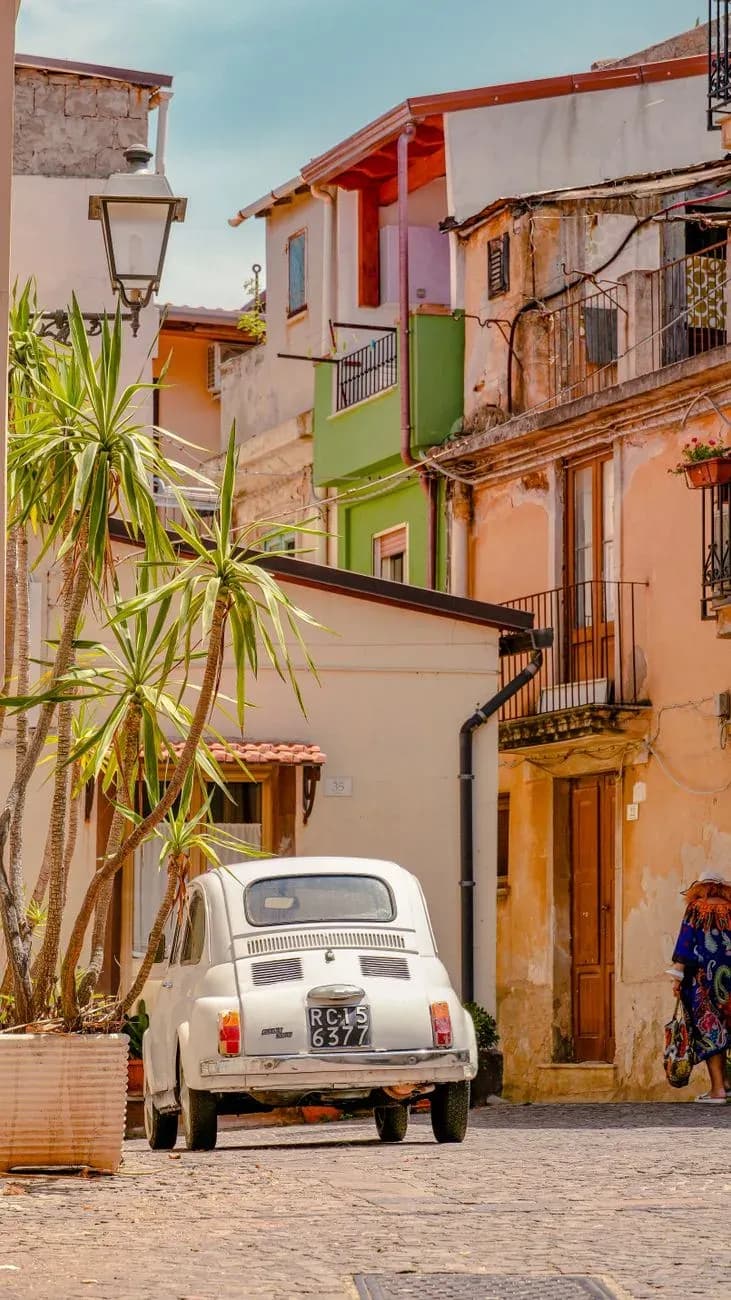
Calabria strictly requires your own vehicle to be explored from top to bottom. Mountain bus lines and inland rail connections are infrequent, with tricky connections that are hard to fit into a short weekend. Planning an itinerary between the peaks of the Pollino, the Sila plateau, and the extensive coastline means doing a lot of driving, tackling secondary roads that are often narrow and winding.
The best times to visit for hiking and exploring the villages are late spring, between May and June, and early autumn, between September and October. Choosing these months offers a two-fold advantage: you will avoid both the intense heat and summer crowds on the coast, as well as the winter frosts that hit the mountain passes hard.
Planning Your Weekend
Day 1 — From the Pollino to Morano Calabro
Morning
The northern part of the region centres around the Parco Nazionale del Pollino. The day kicks off at the palaeolithic site of the Grotta del Romito, located in Contrada Nuppolara in the municipality of Papasidero. The guided tour lasts between 30 and 45 minutes and lets you get a close look at the famous engraving of the Bos primigenius; groups should plan ahead and book their tickets in advance. Staying between Papasidero and Laino Borgo, take to the water with a Discesa Rafting nelle Gole del Fiume Lao. It is an outdoor adventure through the park's deep canyons: the trip takes between two and four hours depending on the stretch you choose, and booking is strictly required.
Afternoon
Leaving the river behind, continue south towards Morano Calabro. The village climbs vertically up the hillside, crowned at its highest point by the Castello Normanno-Svevo di Morano Calabro. The fortress offers panoramic views over the settlement below and the surrounding mountains: entry is open daily and you will need around 30 to 45 minutes to wander through the various levels of the structure.
Evening
Stay in the village for dinner. Ristorante L'Antico Borgo is located in Via Domenico Cappelli. A member of the Unione Ristoranti del Buon Ricordo, its menu is built around local produce and traditional recipes from the Pollino.
Day 2 — Civita's Heritage and the Sila Plateau
Morning
In Civita, a historic village with Arbëreshë roots, the architecture is famed for its Case Kodra. Strolling through the Borgo antico di Civita e Case Kodra, you will immediately notice these dwellings with their peculiar anthropomorphic facades and artisan chimneys on the roofs. A short walk from the village centre brings you to the Ponte del Diavolo e Gole del Raganello. This daring medieval stone structure hangs directly over the canyon carved by the stream; allow about an hour to take in the views and walk across the bridge.
Afternoon
Driving inland, you will climb up onto the Sila plateau. In Croce di Magara, a hamlet of Spezzano della Sila, lies the Riserva Naturale I Giganti della Sila. Managed by FAI, this monumental woodland is home to centuries-old Corsican pines reaching heights of up to 45 metres. The guided tour takes about an hour, and advance booking is mandatory during peak periods. Further south, at Lorica in the municipality of San Giovanni in Fiore, spreads Lago Arvo e Lungolago di Lorica. Ringed by dense pine forests, the lake serves as a base for kayak excursions and hiking routes.
Evening
Head to Ristorante La Fattoria for dinner, located in Località Campo San Lorenzo in Camigliatello Silano. The venue specialises in traditional Sila cuisine, serving up porcini mushrooms, platters of Calabrian cured meats, and charcoal-grilled meats.
Day 3 — The Ionian Coast and the Aspromonte
Morning
Your third day explores the Ionian side, starting at the Fortezza Aragonese di Le Castella, in the territory of Isola di Capo Rizzuto. This 15th-century military fortress is linked to the mainland solely by a narrow sand isthmus; exploring the interior rooms and outer ramparts takes about an hour and a half. Head inland towards Monte Consolino to reach the Cattolica di Stilo. This 10th-century Byzantine masterpiece is built on an inscribed Greek-cross plan; the church is open daily and a visit takes around half an hour.
Afternoon
Crossing the ridges of the Aspromonte brings you to Gerace. The Borgo Medievale di Gerace e Cattedrale Normanna retains an intact rock-hewn layout of Byzantine-Norman origin. The cathedral dominating the village is one of the largest and most significant sacred complexes in the entire region. Once you have finished exploring the village, cut across to the Tyrrhenian coast towards Scilla.
Evening
Spend the evening in the Borgo di Chianalea di Scilla, an ancient fishing quarter where the houses sit right on the rocks, lapped by the waters of the Strait. For dinner, head to Ristorante Glauco on Via Annunziata. The restaurant features a terrace overlooking the rocks and focuses its menu on swordfish and seafood dishes from the Costa Viola.
Day 4 — Reggio Calabria and Tyrrhenian Villages
Morning
The centre of Reggio Calabria is home to the Museo Archeologico Nazionale di Reggio Calabria (MArRC), set on Piazza De Nava. Allow roughly two hours to admire the Riace Bronzes up close along with the extensive Magna Graecia collections. If you are visiting at the weekend, booking your ticket in advance is strongly recommended to avoid long queues at the ticket office.
Afternoon
Heading back north onto the Promontorio Scillèo, the Castello Ruffo di Scilla physically divides the beach of Marina Grande from the Chianalea quarter. Its ramparts command open views across both the Calabrian coastline and the outline of Sicilia. Driving further up the Tyrrhenian coast, you will reach Fiumefreddo Bruzio. The Borgo Medievale e Castello di Fiumefreddo Bruzio features panoramic viewpoints in Largo Torretta; just steps away stand the castle ruins, with walls adorned with frescoes by Salvatore Fiume.
Evening
Wrap up your weekend by returning south for a final meal at Ristorante Il Casato. Set on Via Annunziata in the heart of Chianalea in Scilla, it specialises in seafood and features a scenic dining platform suspended directly over the sea.
Practical Tips for Your Trip
- A car or camper van is essential to cover the distances between the peaks of the Pollino, the Sila, and the coastal areas: local buses and trains will not allow you to make the most of a weekend.
- In Scilla, driving into the Chianalea quarter is prohibited for non-residents, with a ZTL in force year-round. Park in the paid car parks along the Marina Grande seafront or in the parking areas at the top of town, then walk down or take one of the traditional ape-calessino three-wheelers.
- If travelling by camper van, you will find dedicated sites on the Sila plateau, such as Camping Lago Arvo in Lorica or Area Sosta La Fattoria in Celico/Camigliatello Silano. In hilltop villages like Morano or Civita, you must look for parking down in the valley outside the historic centres.
- If you plan to go rafting on the Fiume Lao or take guided tours of the Grotta del Romito and the Giganti della Sila, book online well in advance. It is also wise to check local road maps beforehand, as mountain routes are often narrow and steep.
Where to Stay
Located just two minutes from the motorway junction, offering easy walking access to the Chianalea quarter.
View on Booking →Right in the centre of Camigliatello Silano, making it a strategic base for excursions into the Parco della Sila.
View on Booking →A complex about 3 km from Camigliatello Silano, featuring a restaurant serving traditional dishes and a camper van stopover.
View on Booking →