

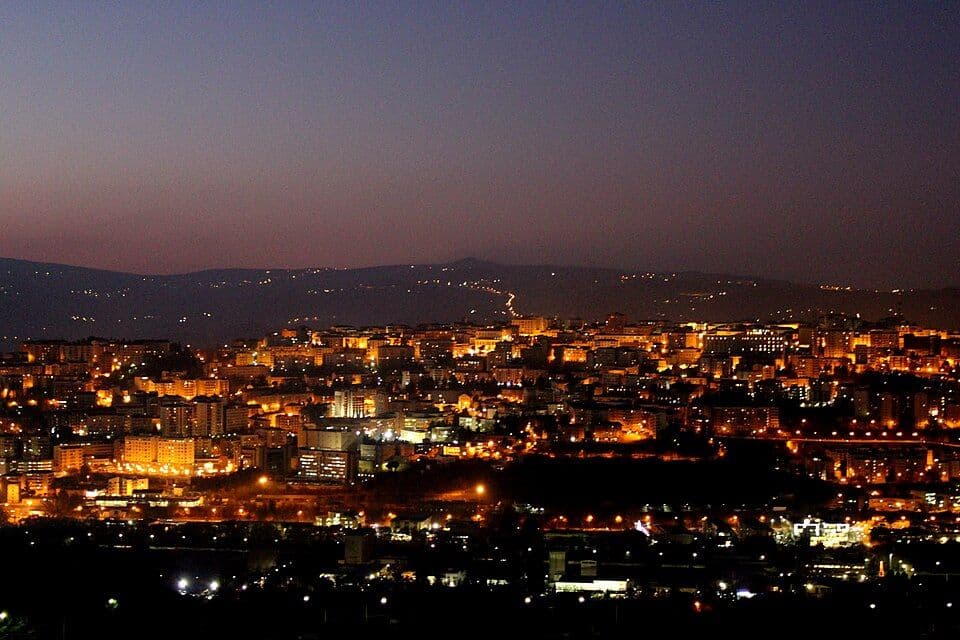
Potenza is a city that imposes its own geometric rhythms. Standing at more than 819 metres above sea level, it has always held the record as the highest regional capital in Italy. This pronounced altitude translates into a topography sharply split into two tiers, marked by steep drops, and a climate that pulls no punches: evenings are cold and constantly breezy even in late spring or deep autumn, making layered clothing essential. In winter, snowfall is a frequent occurrence, and winter equipment for your car is both a legal requirement and a physical necessity.
The complex lay of the land has physically separated urban development: you will find a modern lower section sprawling across the valley floor, and an ancient core perched tightly on the ridge. This sharp altitudinal divide allows you to feel the essence of the so-called "vertical city" first-hand. The historical fabric of the city is at its most vibrant at the end of spring. Planning a weekend in Potenza around 29 and 30 May lets you catch the Parata dei Turchi, a folk celebration linked to the festivities honouring the patron saint, San Gerardo.
For those staying overnight, places like B&B 85centro offer the practical and significant advantage of private barrier-controlled parking right by the old quarters, taking the hassle out of uphill parking. Conversely, B&B Potenza IT sits just a few minutes on foot from the mechanised lifts that ease your climb to the top. Choosing the right logistical base makes a world of difference to getting around each day.
Three Days in Potenza: A Practical Guide to the Neighbourhoods
Day 1 — Valley Engineering and Central Squares
Morning
Your initial take on the city's volumes begins comfortably down on the valley floor, descending into the Basento district where traffic flows quickly. Here you will find the Ponte Musmeci (also known as the Ponte sul Basento). This intricate feat of infrastructure, designed by architect Sergio Musmeci, is a pioneering and radical piece of 20th-century engineering. It is defined by a thick, continuous membrane of reinforced concrete, whose curves—calculated to distribute weight—earned it formal recognition as a contemporary work of art. After taking in the river area, head towards the Portasalza - Poggio Tre Galli area to make use of the public lifts up to the centre. The Scale Mobili Santa Lucia run through tunnels to bridge the elevation difference, ranking among the longest urban mechanised systems in Europe. The covered ride makes the vertical climb effortless and visually striking.
Afternoon
Once up on the upper urban ridge, the pedestrian route leads naturally along Via Pretoria. This is the capital's main pedestrian street, laid out as a long straight thoroughfare lined with shops, imposing historic buildings and the facades of aristocratic palazzi. Walking its entire length cuts the historic core cleanly in two, right until you reach the wide expanse of Piazza Mario Pagano. This open square, recently repaved through targeted work by architect Gae Aulenti, serves as a true open-air living room up on the heights. Looking up from the square, you will take in the volumes of the Palazzo del Governo and, above all, the ornate facade of the Teatro Francesco Stabile. The latter is a solid neoclassical block and stands as the only historic 19th-century theatre in the whole of Basilicata.
Evening
For dinner, the easiest option logistically is to head back down towards the Viale Marconi area, close to the main transport hubs. Antica Osteria Marconi is a dependable local benchmark, serving contemporary takes on Lucanian cuisine that rely exclusively on top-quality regional ingredients. Tables are in steady demand, so book a few days ahead to avoid a long wait at the door.
Day 2 — High-Altitude Devotion and Lucanian Archaeology
Morning
Your second walking day explores the highest reaches of the old town of Potenza. The absolute highest point of the historic centre is taken up by the Cattedrale di San Gerardo, the city's massive cathedral dedicated to the local patron saint. Entry is free and a visit to its naves takes around 30 to 45 minutes, with no booking needed. Following in the footsteps of the city's deep-rooted devotion, just a short walk away you will find the nearby Tempietto di San Gerardo. This small shrine was built in the 19th century to honour the patron saint, adorned inside with handcrafted marble sculptures and a striking polychrome stained-glass window. A visit here takes only about fifteen minutes, just long enough to admire the window's details against the daylight.
Afternoon
In the early afternoon, shift your focus to the collections preserved inside the city's palazzi. The historic Palazzo Loffredo houses the Museo Archeologico Nazionale della Basilicata Dinu Adamesteanu. Its succession of rooms displays impressive archaeological finds and fragments spanning the timeline from the Archaic period right through to the height of the Roman era. All the artefacts come from excavations carried out across the central-northern belt of the region. Reading the panels and examining the pieces takes between one and two hours. Stepping back out into the stone alleys, you will soon come to the Chiesa di San Michele Arcangelo. This building is one of the oldest surviving religious monuments in the city, erected in an understated Romanesque style during the 12th century. The interior houses wall frescoes and antique woodwork.
Evening
Staying within the labyrinth of streets in the historic centre, the evening turns to hearty fare. Trattoria Zi Mingo is a classic local spot serving generous, filling portions. The menu revolves around salt cod with peperoni cruschi, plates of lagane e ceci, and cuts of Potenza-style lamb. Here too, the intimate dining rooms mean reserving a table well in advance is essential.
Day 3 — Imperial Traces and Medieval Strongholds
Morning
Your final morning leaves the central ridge behind to explore the outlying districts. Rione Malvaccaro preserves clear evidence of ancient valley settlements, found in the remains of the Villa Romana di Malvaccaro. The perimeter of this archaeological site reveals sections of mosaic floors that have withstood the test of time. These decorated surfaces date back directly to the late Roman imperial era, historically placed between the 3rd and 4th centuries AD. The floor patterns and the outline of the perimeter walls reveal the true scale of the original complex, proving a settled Roman presence in today's urban area long before the heights were built upon.
Afternoon
Heading back towards the heart of the city to tick off the remaining sights, return to the area adjoining Piazza Mario Pagano to admire the Chiesa di San Francesco d'Assisi. This religious building was originally founded in the 13th century and still displays an intricate Gothic entrance portal set into its bare facade. Beyond the threshold, the interior preserves numerous pieces of sacred art historically linked to the Franciscan order. Leaving the square, make your way to the eastern edge of the historic perimeter. Here, the street ends before the stone mass of the Torre Guevara. This mighty vertical tower is the sole surviving section of what was once the medieval castle. Jutting out over the drop, it offers a great vantage point for sweeping views over the surrounding hills.
Evening
To step away from the bustle of the historic centre, make your way out to Contrada Valle Paradiso. Ristorante C'era una volta offers a dining experience focused squarely on typical dishes of the Lucanian Apennines, serving handmade pasta courses and prime cuts of meat sourced from local producers.
Practical Tips to Make the Most of Your Time
- Divided between valley and ridge, the city's topography poses a real challenge if you try driving through the upper alleys. The most sensible way up is to use the modern network of covered public escalators, especially the Santa Lucia and Marconi hubs, which link valley car parks to the historic centre in under ten minutes.
- Finding free parking between steep climbs and restricted traffic zones (ZTL) is tricky. The best way to save time is to leave your car in the attended car parks or free bays right by the base stations of the escalators, such as along Viale Marconi or in Via Armellini.
- The weather is directly affected by the high altitude. Temperature swings are sharp up here, so pack plenty of layers to handle the evening winds, even in spring or autumn. In winter, temperatures plummet, and fitting winter tyres or carrying snow chains is a strict legal requirement.
- To dine at historic trattorie and popular restaurants such as Zi Mingo or Antica Osteria Marconi, be sure to phone ahead and book for Friday and Saturday evenings. Dining rooms across the city are often small and fill up very quickly.
Where to Stay in the Regional Capital
Located on Viale Marconi, a short walk from the centre, offering quick access to the escalator network.
View on Booking →Set right on the edge of the historic centre, providing guests with convenient barrier-controlled parking.
View on Booking →Immersed in greenery in the hillside outskirts, ideal if you are travelling by car towards the mountains.
View on Booking →