

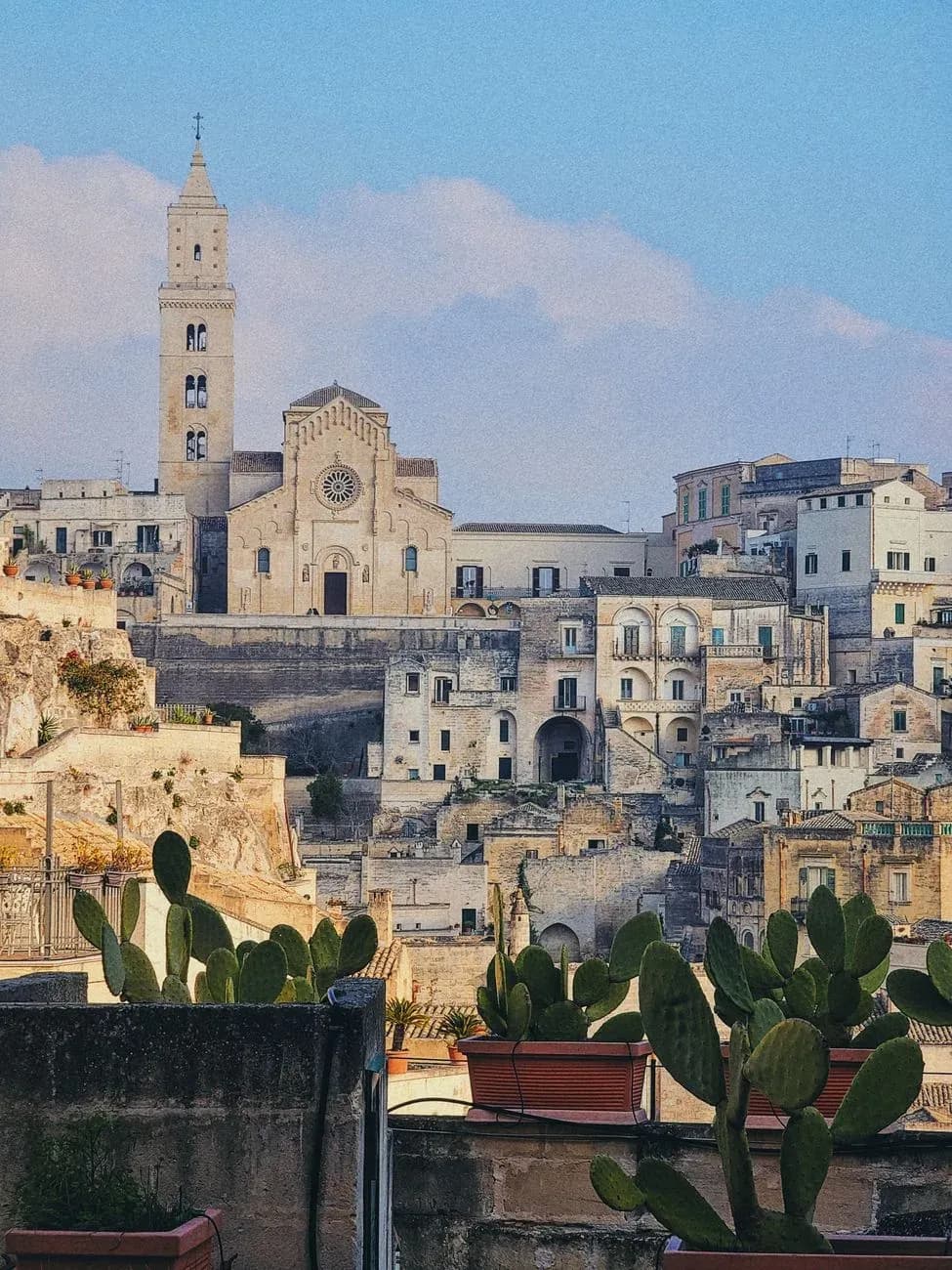
Planning a trip to Basilicata means preparing to drive through stark geographical contrasts. Distances aren't measured purely in kilometres, but in dramatic shifts of scenery: your route climbs from the bare rock of villages carved into tuff to high-altitude beech woods, before descending to dip your toes into two seas with entirely different seabeds. If you're looking for the sweet spot to combine the open sea with mountain trails, May to October is the ideal window. For those setting their sights on the woodlands, late autumn between October and November bathes the northern volcanic lakes in warm, rich hues.
To tackle these roads, you'll need your own car or a camper van. Public transport struggles to connect the small inland villages and the edges of the natural parks. You'll also need to allow plenty of buffer time for driving: crossing the region from the Ionian to the Tyrrhenian coast takes roughly two and a half hours, along winding roads full of hairpin bends that demand a steady, patient hand at the wheel.
How to plan your route
Day 1 — The volcano and the fortress
Morning
Your journey begins in the north, in the Vulture area near Rionero. It's best to start straight away at the Laghi di Monticchio. These are two volcanic lakes, Lago Piccolo and Lago Grande, nestled in the extinct crater of Monte Vulture amidst dense woodland. The area easily fills half a day, whether you rent a pedalo on the water or follow the footpaths winding through the trees. Looking up from the lake toward the sheer hillside, you'll spot the Abbazia di San Michele Arcangelo. This historic monastic complex is carved straight into the rock; step inside to explore the ancient votive caves and visit a museum dedicated to the local natural environment.
Afternoon
Leaving the lakes behind, drive down into the town of Melfi. The imposing bulk of the Castello Normanno Svevo di Melfi dominates the streets. Originally built under Frederick II, this fortress now houses the collections of the Museo Archeologico Nazionale del Melfese. The gates are open from Tuesday to Sunday, running continuously from 9:00 to 20:00, and you should set aside around two hours to take in the exhibits without rushing.
Evening
To round off your first day, stop for dinner in the historic centre of Melfi. Tucked away in the alleys is Trattoria L'Angolo del Buono. The kitchen serves traditional dishes from the Vulture area, focusing on fresh pasta and hearty, earthy ingredients.
Day 2 — Dolomiti Lucane and cliffside villages
Morning
On day two, head towards the rugged interior. The villages in this area enforce strict traffic restrictions; leave your vehicle in the municipal car parks outside the limited traffic zones. Once in Castelmezzano, tackle the Castelmezzano e Gradinata Normanna: fifty-four steps carved into the bedrock leading to a panoramic viewpoint over the mountains. If you prefer a proper hike, pick up the Percorso delle Sette Pietre. It's a two-kilometre trail that takes about an hour and a half, linking the village to neighbouring Pietrapertosa via installations inspired by local folklore. For an adrenaline rush, make sure to book your tickets for the Volo dell'Angelo well in advance. Running from May to November, this zipline sends you soaring between the peaks at over 100 km/h. For lunch, Ristorante Peperusko, also in Castelmezzano, serves local cured meats, cheeses, and fried peperone crusco.
Afternoon
Spend the afternoon in the neighbouring Borgo Antico di Pietrapertosa e Quartiere Arabata. Perched at 1,088 metres above sea level, it is the highest village in the region. The Arabata quarter retains its Arab-medieval layout, carved directly into the living rock.
Evening
Get back in the car and set off towards Matera, making an essential stop along the way: Craco Borgo Fantasma. Abandoned in 1963 following a landslide, it can now only be visited on a guided tour of Craco Borgo Fantasma, which must be booked in advance. The walk takes an hour and is done in a group wearing protective hard hats.
Day 3 — Ancient rock and the Ionian coast
Morning
Reaching the heart of Matera calls for shoes with excellent grip, thanks to the constant, slippery climbs and descents. The Sassi di Matera (Caveoso e Barisano) form an ancient network of dwellings carved into the tuff, recognised as a UNESCO World Heritage site. Be prepared to walk for at least three to four hours among cave-houses, courtyards, and panoramic lookouts over the ravine. For lunch, between via Santa Cesarea and the Sasso Barisano, head to Trattoria Stano. Here, you can dine with views over the Sassi, ordering cavatelli with fried breadcrumbs and peperone crusco, or hearty lamb dishes. Over on via Lucana 48, Antica Trattoria Lucana 1900 serves up fettuccine with broad bean purée and cardoncelli mushrooms.
Afternoon
In the afternoon, make your way towards the Ionian coast to Bernalda. The late afternoon softens the heat, making it the perfect time to visit the Parco Archeologico e Tavole Palatine di Metaponto, where you can spend about an hour and a half wandering among the Doric remains of the Temple of Hera. Afterwards, head to Lido di Metaponto. It's a broad stretch of pale sand fringed by pine groves, with very shallow waters. A little further south lies the Spiaggia e Oasi Bosco Pantano di Policoro, where the beach borders a WWF nature reserve popular for sailing sports.
Evening
Heading back inland, treat yourself to dinner at Osteria La Pignata, at via Emanuele Duni 20 in Matera. The restaurant specialises in traditional earthenware pot cooking, serving pignata of mutton and potatoes alongside Murge-style orecchiette. For a night sleeping in the rock, Aquatio Cave Luxury Hotel & SPA offers rooms hewn directly into the heart of the Sasso Caveoso.
Day 4 — Tyrrhenian descents and beaches
Morning
The Tyrrhenian coast is defined by sheer cliffs and tarmac that twists far more dramatically than the flat Ionian plains. At Marina di Maratea, the route winds down towards Cala Jannita (Spiaggia Nera). This beach is made up of dark volcanic pebbles and sand, sheltered by Mediterranean scrub. Just off the shore, you can spot the sea-level entrance to the Grotta della Sciabella.
Afternoon
For a more relaxed coastal stop, move on to Spiaggia di Fiumicello, also in the Maratea area. Here, the sheltered bay offers clean, golden sand, more space to stretch out, and crystal-clear water, all with unbroken views of the hills rising behind the shore.
Evening
Before night falls, it's worth making the drive up Monte San Biagio. At the summit stands the Statua del Cristo Redentore, a marble-and-concrete statue roughly twenty-one metres high. Waiting for sunset at this height treats you to sweeping views right across the depth of the Golfo di Policastro.
Tips for the road
- A car is essential. Regional buses struggle to link the natural parks to the provincial hubs; travelling from the Ionian coast to Maratea requires over two hours of driving along very winding roads.
- If you're travelling in a camper van or large vehicle, you'll find plenty of flat space and campsites along the Ionian coast between Metaponto and Policoro. On the Tyrrhenian side, roads are narrow and camper pitches fill up fast: book them well in advance.
- Activities with capped visitor numbers need booking ahead. Passes for the zipline between the Dolomiti Lucane villages and access to the ruins of Craco are sold strictly by reservation.
- The historic mountain centres and the entire Sassi area are completely closed to vehicles due to ZTL regulations and steep changes in elevation. Leave the car in perimeter car parks and wear shoes with good hiking tread to avoid slipping.
- When budgeting your daily spend, reckon on around €50 to €75 per person to cover fuel, entry fees to historic sites, and meals in local osterie, not including accommodation.
Where to stay
A four-star hotel with a swimming pool and roof garden, located just two hundred metres from the sands of Fiumicello.
View on Booking →A five-star resort set in an enclosed wooded park, boasting panoramic views and a private beach just two hundred and fifty metres away.
View on Booking →Rooms carved directly out of the rock in the Sasso Caveoso, complete with an on-site wellness centre for a stay inside the tuff stone.
View on Booking →