

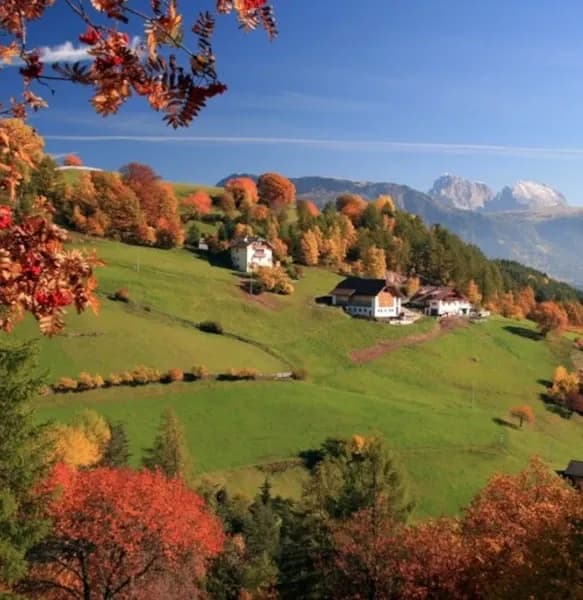
On the Renon plateau, the period from late September to mid-November is not regarded merely as an in-between time: locals explicitly call it the 'fifth season'. This is when broadleaf woodlands and chestnut groves transform, staging a display of foliage in Italy that is woven closely into the region's agricultural traditions. It is not just about admiring the leaves, but about walking between farmsteads (masi) to join in with Törggelen, the age-old rural custom of gathering after the grape harvest to taste the new wine and freshly pressed must, known as Suser.
Planning these three days calls for a radically different approach to the usual mountain break: having a car simply gets in the way. The local infrastructure is designed around walking or travelling on rails. You use a cable car, a 1907 narrow-gauge train and local buses that link the hamlets seamlessly. Staying at places like Parkhotel Holzner or Hotel Ansitz Kematen gives you free access to public transport, entirely doing away with parking hassles and valley-floor traffic jams.
How to plan three days on the plateau
Day 1 — Ascending from Bolzano and reflections on the water
Morning
The best way to reach the plateau is from down below, leaving your car in the park-and-ride by the valley station in Bolzano. From here, the Funivia del Renon runs continuously, ascending the elevation to 1,220 metres in just 12 minutes straight into Soprabolzano. Stepping out of the station, you can join the Passeggiata Freud (Freud-Promenade) immediately. The route is flat and takes around an hour and a half to cover the 5.5 kilometres from Soprabolzano to Collalbo. Walking in the morning gives you the best light to admire the Catinaccio and the first autumn colours along the trail dedicated to Sigmund Freud.
Afternoon
From Collalbo, you make the return journey to Soprabolzano on the wooden benches of the Trenino Storico del Renon, a narrow-gauge railway that trundles through pastures and woods in roughly 18 minutes, with services departing every half hour. From the station, carry on southwards to reach the Lago di Costalovara. A stroll of around 45 minutes takes you all the way around this small alpine lake, where mixed woodlands reflect on the water in warm autumn hues. Close by, for those visiting before 31 October, you can drop into the Museo dell'Apicoltura Maso Plattner, housed within a 600-year-old historic building. A tour of the farmstead, dedicated to South Tyrolean beekeeping traditions, takes between 40 and 60 minutes.
Evening
For your first dinner steeped in the tradition of Törggelen, head to Buschenschank Ebnicherhof in Soprabolzano. It is a farm tavern surrounded by ancient chestnut groves, with a terrace looking straight out towards the Dolomiti. The menu revolves around harvest-end recipes: barley soups, hearty traditional mains and rustic Krapfen pastries. As seating in the stube rooms is limited, you will need to book your table well ahead.
Day 2 — Along the chestnut trail and the earth pyramids
Morning
The entire day is based around the Sentiero del Castagno (Keschtnweg), a trail traversing the plateau's mid-slopes. Walking the main stretch on Renon takes roughly 4 to 5 hours, passing through hamlets such as Longostagno, Siffiano and Auna di Sotto, flanked by centuries-old chestnut trees displaying the most vibrant autumn colours in late October. Setting off from Soprabolzano, the first detour runs along the Rio Rivellone to view the Piramidi di Terra di Soprabolzano, clay geological pinnacles emerging from broadleaf woods with vistas across the Katzenbach gorge.
Afternoon
Following the trail south towards Valle Isarco, the woods open up to reveal the Piramidi di Terra di Auna di Sotto. Compared to the plateau's other earth pyramids, these see far fewer visitors and stand out for their very pale clay colour. If you prefer a shorter walk, you can trim the route by hopping on the 165 bus linking the villages. Right along the path, an ideal afternoon pit stop is Buschenschank Schlosshof in Auna di Sotto, an inn serving pumpkin soup, Schlutzkrapfen ravioli, roast chestnuts and grape must directly by the hiking trail.
Evening
The culinary finish line for this walk is Buschenschank Rielingerhof in the hamlet of Siffiano. This historic organic farm is celebrated for its roasted chestnuts, estate-grown wine, speck and homemade canederli. As with all seasonal taverns over autumn weekends, booking ahead is essential if you want a table indoors.
Day 3 — High among the larches and southern vineyard slopes
Morning
Catching the local bus takes you to Pemmern, the departure point for the cable car up to Corno del Renon e Cima Lago Nero. Reaching 2,071 metres above sea level, the landscape shifts: chestnut groves give way to larch forests that turn entirely golden at this time of year, with sweeping, unobstructed panoramas over the surrounding peaks of the Dolomiti. Back down in the valley, make your way over to Longomoso to see the Piramidi di Terra di Longomoso. These are Renon's most photographed glacial-clay spires, reached via an easy, flat walk of about 30 to 40 minutes.
Afternoon
Continuing south, your descent leads to the hamlet of Signato. Here the scenery shifts once again to make room for terraced vineyards along the Sentiero del Vino Rebe. This walking path winds through the sun-drenched farmsteads of the plateau's southern face, a route that coincides with the grape harvest in October. If you wish to extend your descent, the path links back up with the final stretch of the Keschtnweg ending at Castel Roncolo, an imposing medieval frescoed castle perched near the entrance to Val Sarentino.
Evening
Round off the trip among the vines at Buschenschank Baumannhof in Signato. This rustic tavern serves traditional South Tyrolean dishes in true Törggelen fashion, with tables overlooking the cliff faces of the Catinaccio. If you are staying in Collalbo, an excellent alternative is Hofschank Oberpfaffstaller, a farmstead with a cosy stube serving fresh filled pasta and home-smoked meats; remember to call ahead before turning up.
Practical tips for your trip
- Guests staying at partner accommodations receive the RittenCard, covering free travel on the cable car, narrow-gauge train and buses, plus one daily return ride on the Corno del Renon cable car.
- The prime window for autumn colours is the second half of October, which coincides with peak Törggelen season. Farmsteads operate on reduced hours and fill up quickly on weekends: book well in advance.
- To bypass traffic jams and narrow lanes, take the train to Bolzano or leave your car at the valley cable car station. On the plateau itself, dedicated car parks can be found in Soprabolzano, Collalbo and Costalovara.
Where to stay
An Alpine Art Nouveau property open since 1908, remarkably handy for getting around thanks to its setting beside the cable car.
View on Booking →Over 750 years of history define this noble residence, set in an elevated position with clean views over the Dolomiti.
View on Booking →A hotel entirely devoted to relaxation and organic beekeeping, just a short stroll from the little lake.
View on Booking →