

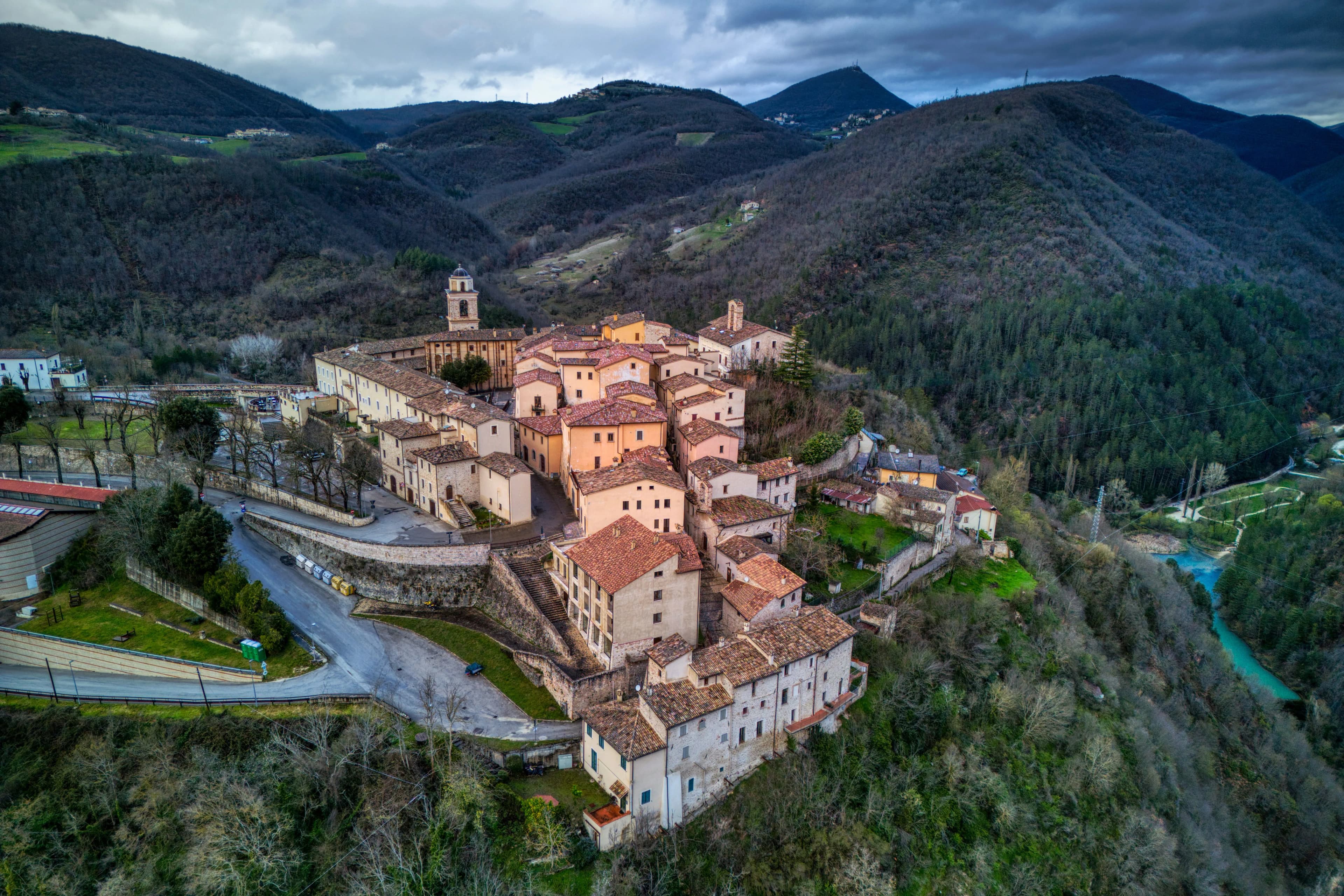
Winter in Umbria brings a harsh climate and sharp lines, especially when you head towards the hills of the Valnerina. A weekend in Sellano at this time of year offers a striking contrast: on one side, cold mountain air and the stone architecture of often isolated villages, and on the other, the warmth and crowds of the Christmas markets in the larger towns just a half-hour drive away.
Organising your days here requires a bit of calculation when it comes to getting around, as distances seem short but the roads follow the contours of the valleys. The landscape ranges from suspension bridges hundreds of metres high to hanging churches and isolated convents. Between late November and Epiphany, the itinerary inevitably crosses paths with the festive season: afternoons and evenings are spent in Foligno or Spoleto, where the squares fill up with local crafts, lights and sweets, while your mornings remain dedicated to exploring the woods and castles around the village.
Four days among heights and historic villages
Day 1 — The historic centre and the void beneath your feet
Morning
Your first approach to the village takes you through the streets of the centre. It's best to start with the Chiesa di San Francesco (Madonna della Croce), a sixteenth-century building that stands out for its octagonal floor plan, which is unusual for the area. The three-nave interior houses Renaissance altars in stone and wood, and a visit requires a good half-hour. A short distance away is the Chiesa Parrocchiale di Santa Maria Assunta, which dates back to the thirteenth century but was remodelled in later centuries; the remains of Blessed Giolo rest here, and there is a notably carved wooden pulpit. Once again, thirty minutes is enough to examine the 16th and 17th-century canvases displayed inside.
Afternoon
After a lunch of traditional dishes and local cured meats at the Ristorante San Francesco, located right at the entrance to the village, the afternoon is dedicated to the structure that has changed the valley's skyline. The Ponte Tibetano di Sellano stretches for 517 metres with a discontinuous tread. Walking suspended at a height of 175 metres takes about 30-45 minutes. Access is one-way and must be booked online by time slot. The end of the bridge coincides with the hamlet of Montesanto, home to the Borgo fortificato di Montesanto, a former fourteenth-century castle. Inside the walls, the Pieve di Santa Maria Assunta, dating between the 12th and 16th centuries, is well worth 45 minutes of your attention. To get back to the starting point, you must choose between a shuttle bus or a 9-kilometre loop trek through the woods.
Evening
Once back in the village, dinner can be enjoyed at the tables of the Convento di Acqua Premula - Residenza d'Epoca in the Ristorante La Foresteria, which uses the spaces of a seventeenth-century building to serve up recipes made with products from the surrounding woods.
Day 2 — Hillside castles and hanging architecture
Morning
The second day heads towards the neighbouring hamlets. The Castello di Postignano is a thirteenth-century fortified village built onto a slope. After decades of abandonment, it has been entirely restored, retaining the hexagonal tower that dominates it. Exploring the uphill alleys and small squares requires about an hour and a half of slow walking.
Afternoon
Stay inside the restored village to eat at the Trattoria La Casa Rosa, which offers a menu focused on truffle and seasonal Umbrian products. In the early afternoon, drive towards the hamlet of Cammoro to observe an architectural anomaly: the Chiesa Pensile di Santa Maria Novella. The medieval structure overlooks a vaulted covered passage carved directly into the rock. Inspecting this site takes around 40 minutes.
Evening
For the evening, it's worth heading towards the Valico del Soglio to sit down at the Bar Trattoria La Fojateria. The venue is locally renowned for serving fojata, a traditional rolled savoury pie stuffed with local herbs and vegetables.
Day 3 — Springs, lakes and wooden chalets
Morning
To avoid the queues, you need to arrive at Rasiglia e le sorgenti del Menotre before 10:30. This village, a 15-minute drive from Sellano, is crisscrossed by canals, small waterfalls and watermills. Count on one to two hours to walk along the footbridges over the water. Mid-morning, set off again towards the Valle del Vigi to reach the Lago di Vigi (Lago Lochness), a mountain basin surrounded by woods where you can spend an hour walking the dirt trails that skirt the clear waters.
Afternoon
Lunch is served with a lake view at the Loch Ness Pizzeria Ristorante, opting for Valnerina trout or grilled meats. The rest of the day brings a clear change of scenery. A drive of about 35 minutes brings you into Foligno. From the early afternoon, the historic centre hosts the Mercatino di Natale delle Strenne a Foligno. The main squares fill with wooden chalets selling artisan products, accompanied by music and illuminations that switch on as darkness falls.
Evening
The evening is spent entirely in Foligno, making the most of the market stalls for some Christmas shopping and grabbing a bite to eat at the food stands before heading back to your accommodation.
Day 4 — Valnerina, truffles and winter in Spoleto
Morning
The descent south begins with Scheggino e Parco di Valcasana, 25 minutes away. The town is a medieval village known for its water springs and black truffle; you can easily spend an hour and a half wandering the alleys and river walks. Continuing for another ten minutes brings you to the Abbazia di San Pietro in Valle, in Ferentillo. This is a Romanesque and Lombard complex isolated among the trees, with a silent cloister and walls covered in medieval frescoes. An hour is just right for a visit.
Afternoon
After 40 minutes of winding roads, you reach Spoleto. The upper part of the city is home to the Duomo e Rocca Albornoziana di Spoleto. Between the Cattedrale di Santa Maria Assunta and the walls of the fortress looking towards the Ponte delle Torri, you'll need at least two or three hours to complete your monumental tour.
Evening
After dark, Spoleto's medieval and Renaissance centre changes its face. In Piazza Garibaldi and the surrounding streets, the Mercatini di Natale di Spoleto come to life with crafts and traditional sweets. During the same hours, you can follow the trail of the Presepe e Mercatini di San Martino a Spoleto, which keeps the historic workshops open and offers nativity scene displays hidden amongst the alleys late into the evening.
Practical tips for getting around and surviving the cold
- A car is the only realistic way to stick to this itinerary: the buses connecting Sellano to Foligno or Spoleto are too sporadic to allow visiting multiple stops in the same day.
- Those intending to cross the Ponte Tibetano di Sellano must book their ticket online in advance, selecting a time slot. From the arrival point, you return either by paying €5 for the shuttle bus, or by walking for 9 km through the woods.
- The Mercatini di Natale in the nearby towns run between late November and Epiphany, really coming alive at weekends from late afternoon onwards. Thermal clothing is essential, given the harsh climate.
- The village of Rasiglia e le sorgenti del Menotre is often congested during the holidays. Arriving before 10:30 in the morning means you can find a regulated parking spot outside the village and walk around without being jostled.
- In the village itself, it's best to leave your car in the municipal car parks at the entrance to the built-up area, and then walk over the cobbles towards the centre and the ramp of the suspension bridge.
- Accommodation aside, you should calculate a budget of around €50-75 per person per day, a figure that absorbs the €25-30 for the bridge, lunches in trattorie and the odd truffle tasting.
Where to sleep in and around Sellano
Scattered rooms inside the restored thirteenth-century village, with the added bonus of a spa for winter evenings.
View on Booking →A seventeenth-century property surrounded by woods, useful for those seeking historic settings and absolute silence.
View on Booking →An agriturismo option among the hills a kilometre from the village, for more basic and traditional overnight stays.
View on Booking →