

The east coast of Sicilia combines Baroque architecture, active volcanic areas and archaeological sites layered across centuries. Distances are not excessive, but elevation changes and restricted access to historic centres require careful route planning, grouping destinations by geographic proximity.
The time of year significantly impacts logistics. Shoulder months, such as April, May, early June, or the weeks between late September and October, offer the ideal weather for walking around open-air sites. During these periods, the absence of peak summer traffic makes driving on state roads and along the motorway far easier.
How to organise the four days
Day 1 — Catania: markets and lava stone
Morning
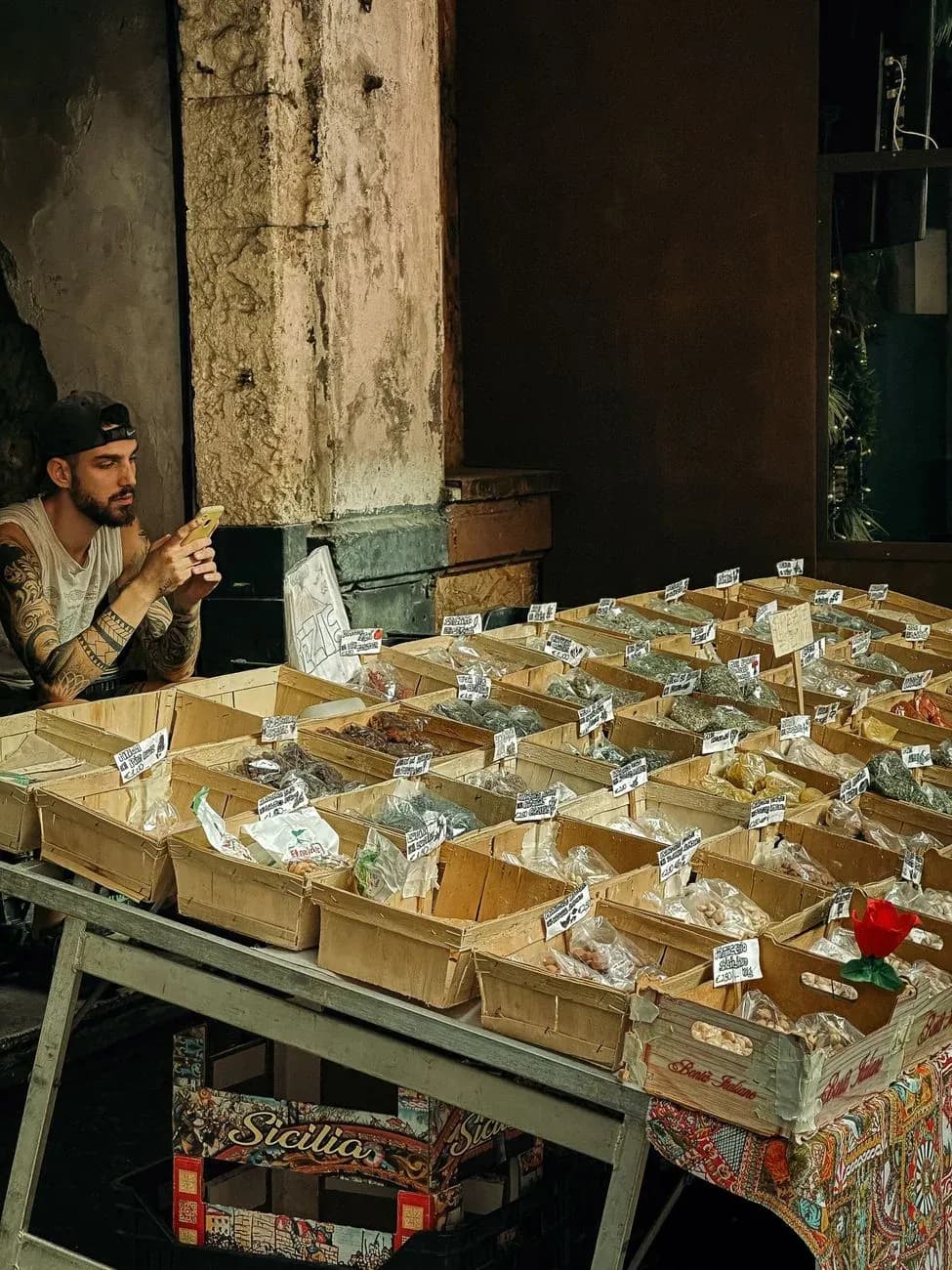
Your first introduction to the city begins in the historic centre. Arriving early at Piazza del Duomo e Fontana dell'Elefante, you can admire the Cattedrale di Sant'Agata and the Liotru carved from lava stone without the midday crowds. Just a short walk away is the Mercato della Pescheria, the city's authentic fish market. It is best visited in the morning, as the stalls wrap up around 13:00 or 14:00.
Afternoon
Have lunch right by the market area, on Via Pardo, at Osteria Antica Marina; seafood dishes come straight from the adjacent stalls, and booking ahead is strongly recommended. Afterwards, head to Piazza Dante to explore the Monastero dei Benedettini di San Nicolò l'Arena. This vast late-Baroque complex now houses the university; to truly understand its layout, join the 75-minute guided tour, bookable as Monastero dei Benedettini di San Nicolò l'Arena.
Evening
For dinner in the historic centre, stop off at Trattoria del Cavaliere. The venue serves generous portions focused on local classics, from pasta alla norma to grilled meat specialities.
Day 2 — High altitudes and river canyons
Morning
In the morning, head up towards Nicolosi and Etna Sud. The Crateri Sommitali dell'Etna are reached by cable car and 4x4 off-road vehicles, taking you up to an altitude of 3,000 metres. The excursion lasts 3 to 5 hours and strictly requires both a volcanological guide and advance booking. If you prefer a simpler alternative, stop at 1,900 metres near Rifugio Sapienza to view the Crateri Silvestri; these dormant cones can be reached on foot and take 45–60 minutes to explore without needing ski lifts.
Afternoon
Head down towards Motta Camastra and Francavilla di Sicilia to venture into the Gole dell'Alcantara (River Trekking e Canyon). In this basalt canyon, you walk through very cold water wearing wetsuits or chest waders. The routes take two or three hours and run from April to October, with booking entry times in advance highly recommended.
Evening
Spend the evening heading north or returning through the Etna foothills villages to set yourself up for the next leg.
Day 3 — Taormina: between sea and ruins
Morning
The coastal area of Mazzarò is home to Isola Bella, a nature reserve linked to the mainland by a narrow strip of pebbles. Early morning and the very beginning of the afternoon offer the best light and fewer crowds for a swim or for snorkelling in clear waters.
Afternoon
Heading up into the town along Via Bagnoli Croci, take a break at the Villa Comunale di Taormina. The public gardens, free to enter, warrant an hour's stop and feature curious Victorian structures known as beehives, surrounded by exotic plants. As sunset draws near, make your way to Via del Teatro Greco for the Teatro Antico di Taormina. The Hellenistic site looks out over the bay of Naxos. The visit takes an hour, and to skip the ticket-office queues, you can opt for priority admission: Teatro Antico di Taormina.
Evening
The pedestrianised town alleys offer plenty of spots for a drink or a bite to eat, rounding off the day up above the coast.
Day 4 — Siracusa and Noto's architecture
Morning
In Siracusa, use the morning hours to beat the heat at the Parco Archeologico della Neapolis. Over about an hour and a half to two hours, you will explore the Anfiteatro Romano and the vast Teatro Greco. The ticket also covers the Orecchio di Dionisio e Latomia del Paradiso, an artificial cave renowned for its unusual acoustics, which takes around 30–45 minutes to visit.
Afternoon
Lunch is on the island of Ortigia. On Via Roma, A Putia delle Cose Buone serves homemade pasta with seafood sauces and caponata. In the early afternoon, stroll through Piazza Duomo e Cattedrale della Natività di Maria Santissima, where you can clearly see the columns of the ancient Greek temple of Athena incorporated into the Baroque façade. At the tip of the island, the 13th-century Swabian fortress of Castello Maniace takes an hour to tour, before heading along Lungomare Alfeo to Fonte Aretusa at sunset. Before the day ends, a short drive brings you to Noto: Cattedrale di San Nicolò e Corso Vittorio Emanuele should be seen in the late afternoon, when the light brings out the golden stone.
Evening
On Corso Vittorio Emanuele in Noto, you will find Caffè Sicilia, a pastry shop renowned for its almond granitas and cassate by master confectioner Corrado Assenza.
Practical planning tips
- A hire car is the most practical way to manage your schedule. Picking it up at Catania-Fontanarossa airport, you can reach Taormina (via the A18) in an hour and Siracusa in around 50 minutes along the southbound motorway.
- Watch out for ZTLs: central Ortigia is monitored by electronic cameras, so leave your car at Parcheggio Talete or Molo Sant'Antonio. Taormina is entirely pedestrianised; park at the Lumbi or Porta Catania car parks, which run shuttle buses.
- For the summit craters at 3,000 metres, you will always need hiking boots, a fleece and a windproof jacket due to sharp temperature drops and strong winds, whatever the season.
- At the major archaeological sites in Taormina and Siracusa, between 12:00 and 15:00 queues are long and shade is minimal. Buy tickets online or schedule your visits for early morning or late afternoon.
Where to base yourself
A hotel enjoying sweeping, open views over the bay and the slopes of Etna.
View on Booking →A polished, central hotel strategically situated just outside the island of Ortigia.
View on Booking →A historic mountain lodge at an altitude of 1,920 metres, handy for an early start to explore the volcano.
View on Booking →