

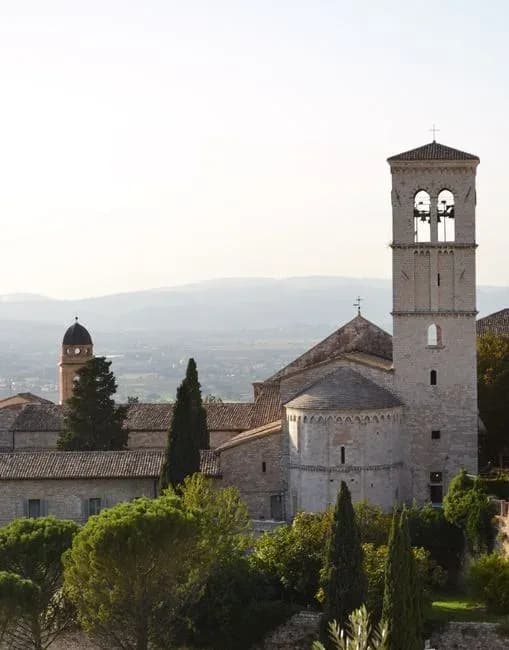
The months between April and June, alongside early autumn in September and October, offer the finest weather and colours for exploring Umbria. You will need a car from start to finish to link the hilltop towns and natural sights, but the main road network makes journeys straightforward: the SS75 Centrale Umbra dual carriageway between Perugia, Assisi, and Foligno, and the SS3 Flaminia towards Spoleto, are both toll-free four-lane roads.
To make the most of your time, the itinerary should be organised by grouping stops geographically and factoring in traffic restrictions. All the main historic centres have very strict limited-traffic zones (ZTL), meaning you should always allow a few extra minutes to walk in from the outer car parks.
Choosing a central base for the night helps keep driving distances down even further. Places like Valle di Assisi Hotel & SPA Resort in Santa Maria degli Angeli or UNAHOTELS Villa Dei Platani in Foligno let you reach almost every stop on the route within a 30-minute drive at most.
How to structure the two days
Day 1 — From Perugia to the slopes of Assisi
Morning
The first part of the day is based in the historic centre of Perugia. The monumental core revolves around Fontana Maggiore e Piazza IV Novembre, with the 13th-century sculptural group sculpted by Nicola and Giovanni Pisano, freely accessible on foot at any time. For lunch, stay in central Perugia and stop at Osteria a Priori (Via dei Priori 39), a restaurant dedicated to local agricultural presidia serving native pulses and Umbrian pasture-raised meats. As seating is limited, it is best to reserve a table a few days in advance.
Afternoon
The SS75 Centrale Umbra takes you from Perugia to Assisi in no time. Reaching the city walls, you must leave your car in the secure car parks at Porta Mojano or Piazza Matteotti to avoid the ZTL. From here, walk to the Basilica di San Francesco d'Assisi (Centro Storico). Admission to see the frescoes by Giotto and Cimabue is free for individual visitors and requires no advance booking, but allow an hour to an hour and a half for the full visit. If your trip falls on a Sunday, bear in mind that access hours are severely restricted due to mass.
Evening
Have dinner directly in Assisi without moving the car. Just a short walk away, Trattoria Pallotta (Piazza del Comune / Vicolo della Volta Pinta) sits beneath the Volta Pinta archway and has been running since 1860, specialising in game and strangozzi with truffles. Alternatively, right opposite the basilica, Ristorante San Francesco (Via San Francesco 52) has been open since 1945 and boasts panoramic views.
Day 2 — Spello, Spoleto, and the Valnerina
Morning
Driving from Assisi to Spello takes around fifteen minutes on the dual carriageway. In the Centro Storico of Spello, step inside the Cappella Baglioni (Collegiata di Santa Maria Maggiore) to admire Pinturicchio's fresco cycle. The visit takes about half an hour and admission costs three euros. This stop must be planned for a Saturday or weekday, as the chapel remains closed to the public on Sunday mornings for church services. Lunch is nearby at Ristorante La Cantina di Spello (Via Cavour 2), where you can tuck into truffle gnocchi and hand-rolled pasta surrounded by ancient Roman walls.
Afternoon
Joining the Flaminia, stop at Fonti del Clitunno (Campello sul Clitunno) before reaching Spoleto. The three-euro ticket lets you stroll among natural springs and willows for around 45–60 minutes. Set off again towards Colle Sant'Elia to visit Rocca Albornoziana e Museo Nazionale del Ducato in Spoleto. Leave the car at the Ponzianina car park: lifts and escalators run from there to bridge the climb. The 14th-century fortress, open continuously from 09:30 to 19:20, offers fine views over the Ponte delle Torri and takes about an hour and a half to explore. If you have extra time and want to head down into the Valnerina towards Terni, there is Cascata delle Marmore: entry is 12 euros and you will need two to three hours for the trails, but you must check the hydroelectric timetable first to confirm when the water is turned on.
Evening
Staying in Spoleto, book dinner at Il Tempio del Gusto (Via Arco di Druso 11), an eatery right by the Roman ruins of the Arco di Druso offering regional classics and an extensive wine cellar. If you prefer to detour to Montefalco instead, head to Enoteca Ristorante L'Alchimista (Piazza del Comune 14), where dishes are paired with glasses of Sagrantino di Montefalco DOCG.
Practical tips to make the most of your time
- For the Rocca Albornoziana in Spoleto, skip on-street parking and head straight for the Ponzianina car park, which connects directly to the upper town via a network of free lifts and moving walkways.
- If you plan to visit Cascata delle Marmore, check the official website the day before: the flow is artificial and controlled by a hydroelectric plant, so arriving at the wrong time means you will only see a trickle.
- On Sundays, reverse or tweak the order of stops because of church services: Cappella Baglioni in Spello is shut on Sunday mornings, while Basilica di San Francesco in Assisi heavily limits tourist access during mass.
- If you want to add Bagni di Triponzo (Cerreto di Spoleto) as an afternoon alternative in the Valnerina, remember that entry must be paid in full in advance, children under 14 are not admitted, and it is closed on Wednesdays.
- Excluding your hotel room, budget around 130–170 euros per person. This covers petrol, admission tickets (12 euros for Marmore, 7.50 euros for the Rocca, 3 euros each for Spello and Clitunno), and two meals a day at 30–45 euros each.
Where to stay
A four-star resort set right beneath the hill of Assisi, complete with swimming pool, restaurant, and spa.
View on Booking →An immaculate four-star hotel set within a 17th-century noble palazzo, right in the historic centre.
View on Booking →A converted former monastery turned four-star superior hotel, renowned for its extensive wellness centre.
View on Booking →