

Planning a weekend in Abruzzo requires your own set of wheels, as the drive between the mountainous interior and the Adriatic coastline takes around an hour and a quarter. The landscape shifts dramatically: you can travel from the rugged peaks of the Gran Sasso down to coastal sand dunes in just a few dozen kilometres.
The best time to plan these four days is from late May to mid-July, or throughout the month of September. These windows allow you to avoid the fierce August heat along the beaches of Vasto and enjoy ideal weather for high-altitude walks in the mountains around L'Aquila, while bearing in mind that many historic venues and local restaurants have limited seating and fill up very quickly during peak season.
How to organise your four days
Day 1 — From the heights of Little Tibet to fortified villages
Morning
Spend the first part of your day exploring the high altitudes of the Altopiano di Campo Imperatore, in the Gran Sasso area. Nicknamed 'Little Tibet', this vast karst plateau features trails free of tall vegetation, where you can walk for miles with sweeping views of the surrounding peaks. It pays to set off with sturdy walking boots and plenty of water, as the landscape is fully exposed to sun and wind, and tackle the hiking paths before the heat builds up.
Afternoon
Head down towards the Calascio area. The Castello di Rocca Calascio is a Norman fortress perched at an altitude of 1,460 metres, making it one of the highest in Europe. The best time to reach the ruins is late afternoon, towards sunset, when the golden light strikes the stone. Along the path up to the castle, you will encounter the Chiesa di Santa Maria della Pietà, an octagonal Renaissance shrine nestled on the ridge. The walk up requires some physical effort, but the sheer isolation of both structures makes it well worthwhile.
Evening
A short drive away lies the Borgo medievale di Santo Stefano di Sessanio, a fortified settlement built entirely of limestone, famed for its Torre Medicea and artisan workshops. Walking through the centre takes about two hours. For dinner, Ristorante La Bettola di Geppetto in the village serves deeply rooted, earthy dishes: local lentil soup, saffron ravioli, and classic arrosticini. If you are looking for a place to stay nearby, consider the carefully restored historic rooms at Sextantio Albergo Diffuso.
Day 2 — Aquilan architecture, castles, and street art
Morning
Set off this morning towards Porta Rivera in L'Aquila. Here you will find the Fontana delle 99 Cannelle, a medieval civic monument that stands as the very symbol of the city's foundation. Its defining feature is the 93 individual stone masks, all sculpted differently using alternating white and pink stone, from which fresh water spouts continuously.
Afternoon
Continue towards the Celano area to reach the Castello Piccolomini di Celano. This imposing fortress represents a transition between the Middle Ages and the Renaissance, and now houses the Museo Nazionale d'Arte della Marsica. Exploring the interior and grounds takes between one and two hours. From there, head up to 1,030 metres above sea level to Aielli - Borgo Universo. This small town has been transformed into an open-air street art museum, with dozens of murals painted across house walls, culminating at the historic Torre delle Stelle.
Evening
Heading back towards Santo Stefano di Sessanio, book dinner at Sextantio Cucina. The restaurant focuses on reviving traditional peasant recipes from Abruzzo's past, championing humble yet historic staples like spelt, heirloom pulses, and local saffron. Given the limited number of tables and the bespoke menu, you will need to book well in advance to secure a spot.
Day 3 — Ovid's hometown and the heart-shaped lake
Morning
Begin the day in Sulmona with a stroll across the vast Piazza Garibaldi e Acquedotto Medievale. This monumental square in the heart of Ovid's birthplace is framed on one side by the towering 13th-century arches of the Swabian aqueduct. The central area is completely flat and easy to explore on foot. Those staying at B&B Amores are already just a short walk from this hub, while remaining outside the ZTL (restricted traffic zone).
Afternoon
Climb up towards the Scanno area. Wander through the Borgo antico di Scanno along its maze of narrow alleys and stone palazzi, soaking in local customs from the traditional attire still worn by some older women to goldsmith workshops crafting the filigree 'presentosa' amulet. Spend the latter part of the afternoon at Lago di Scanno. This mountain lake is famous for its heart shape, which is clearly visible when walking the Sentiero del Cuore. Afternoon is the ideal time for a lakeside walk.
Evening
In the evening, make the drive of around an hour and a quarter down from the Appennino to the Adriatic coast. Once you reach Rocca San Giovanni, enjoy dinner at Ristorante Trabocco Punta Isolata. This traditional wooden fishing platform is suspended directly over the water and run by master traboccanti. The must-order dish here is the traditional coastal brodetto di mare fish stew.
Day 4 — Cliffs, cycle paths, and historic trabocchi
Morning
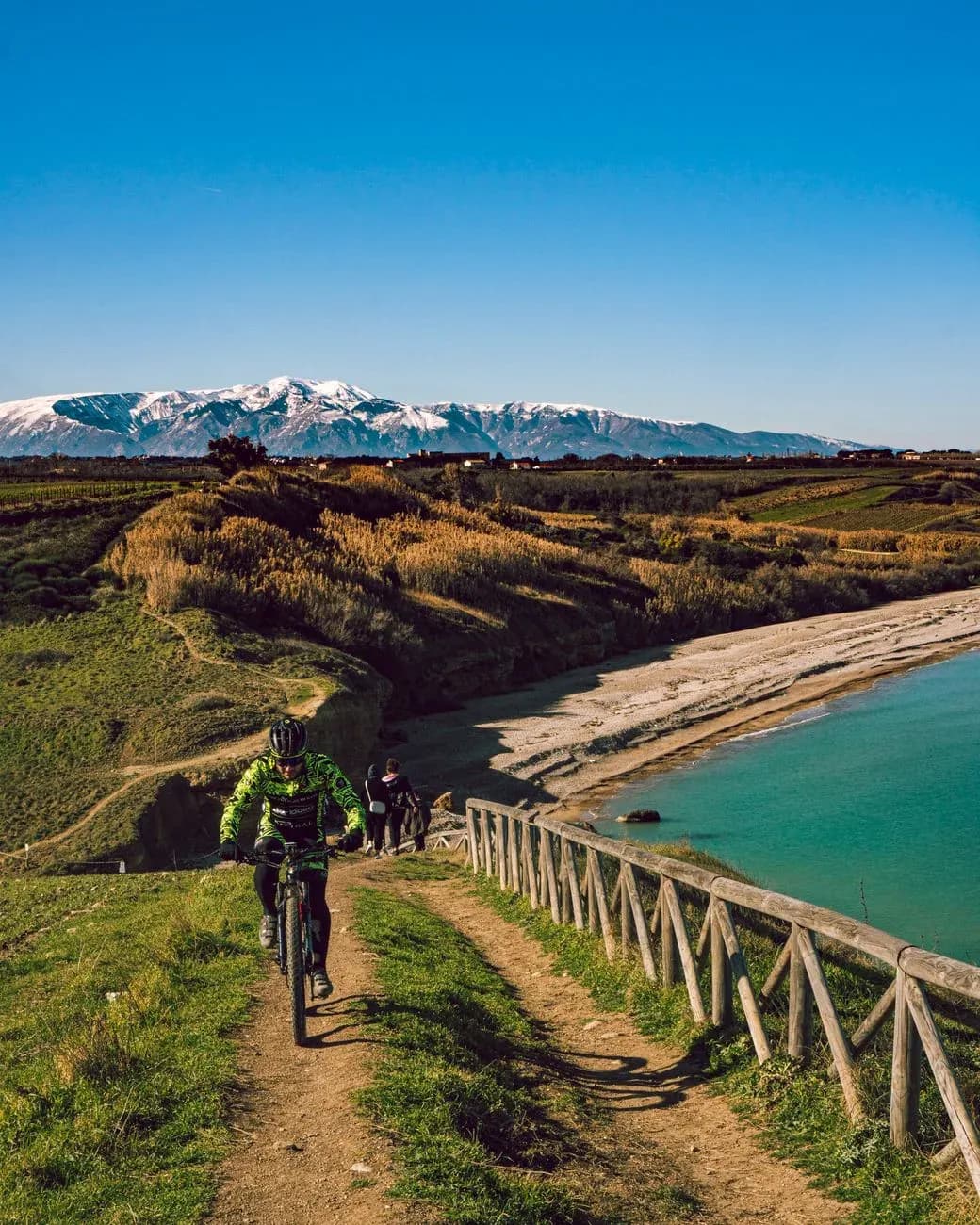
Today is devoted to the Costa dei Trabocchi. In San Vito Chietino, hire a bicycle to ride the Via Verde della Costa dei Trabocchi, a coastal cycle and pedestrian path stretching over 40 kilometres along a disused railway line. Pedalling south, you will come across the Trabocco del Turchino ed Eremo Dannunziano. Perched just beneath the headland of the hermitage, this historic fishing pier was immortalised by Gabriele d'Annunzio in his novel 'Triumph of Death'.
Afternoon
In Fossacesia, perched high on a promontory, stands the Abbazia di San Giovanni in Venere. This 12th-century Benedictine monastery boasts sweeping views across the shoreline below. Further south in Vasto, the scenery shifts: the Riserva Naturale Regionale Punta Aderci protects sheer cliffs and trails winding through Mediterranean scrub down to Mottagrossa beach. Nearby, the Spiaggia e Trabocco di Punta Penna features a long stretch of sand framed by dunes and watched over by a lighthouse. Before dinner, drive up to Ortona to watch the sunset from the Castello Aragonese di Ortona, a fortress hanging over the Adriatic that marks the northern limit of the trabocchi coast.
Evening
For your final evening, head to Ristorante Trabocco Punta Fornace in San Vito Chietino. Set on a wooden pier with direct access from the beach, it serves an exclusive set tasting menu driven by the day's local catch. With only around 35 covers, booking well ahead is essential.
Practical tips for the coast and the interior
- To dodge parking headaches along the Statale 16 and get between coves effortlessly, hire an e-bike in Fossacesia Marina or San Vito Chietino and stick to the Via Verde cycle path.
- At Calascio, leave your car in the mandatory designated parking bays just before the old village. From there, it is an uphill walk of about 20 minutes on rough terrain: pack water and wear closed hiking boots.
- Dining on a trabocco requires advance planning. These platforms seat only 30 to 35 people on average and serve fixed menus built around the catch of the day; during summer and on weekends, book several weeks ahead.
Where to stay between historic cities and villages
Rooms set inside sensitively restored ancient stone dwellings, right in the heart of a fortified medieval village.
View on Booking →Strategically positioned in the town centre yet outside the ZTL, just steps from the arches of Piazza Garibaldi.
View on Booking →Housed within an 18th-century palazzo 500 metres from the Duomo, right in the city's historic centre.
View on Booking →