

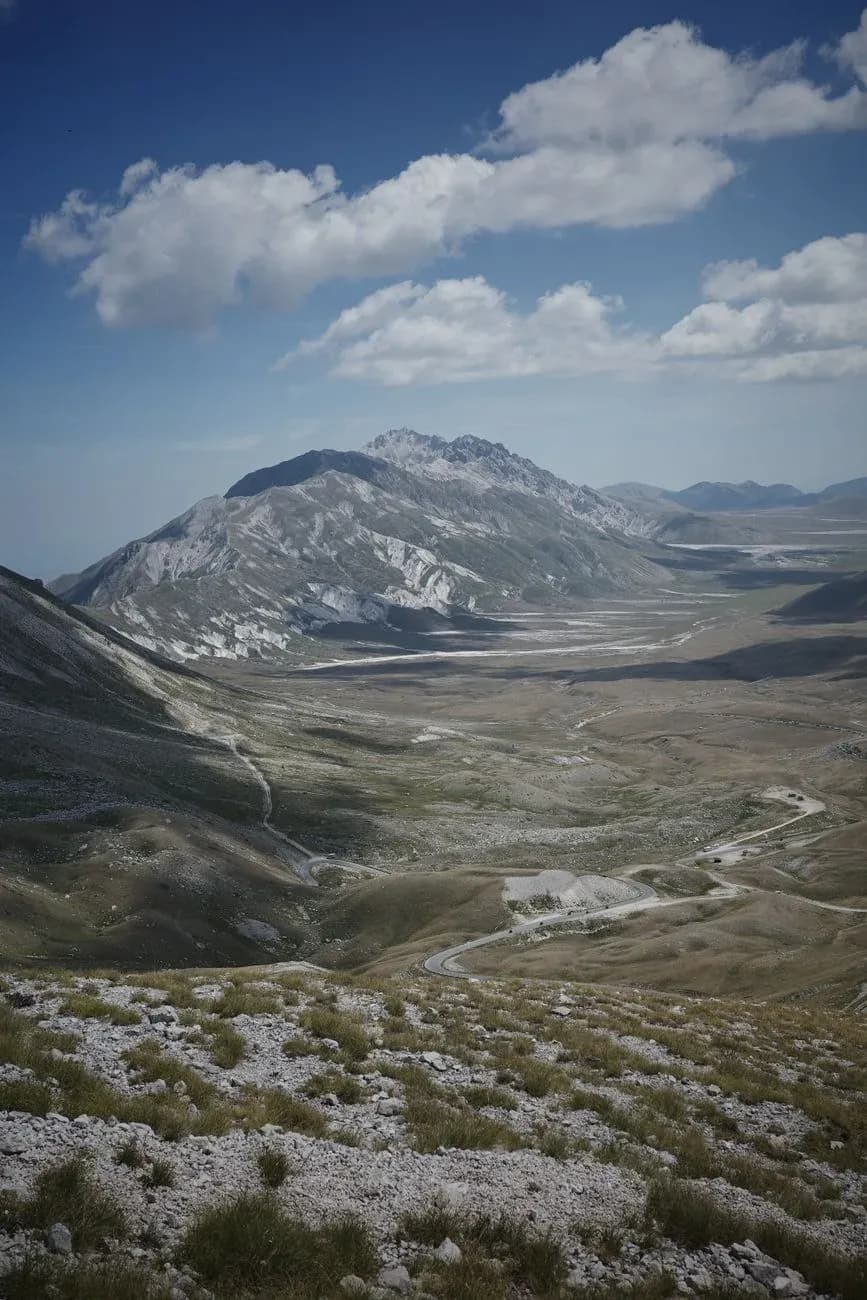
A car is essential for this Abruzzo road trip: linking the mountain villages of the Gran Sasso, the inland gorges and the coast by public transport is practically impossible, especially as mountain routes take around 45–60 minutes between neighbouring valleys. How you plan your drives will set the pace for the entire trip.
The best time to travel at these latitudes is from May to early October. In summer, the higher altitudes offer welcome relief from the coastal heat, while spring and autumn are ideal for catching the wild blooms and colourful beech forests without the tourist crowds.
For accommodation, spending your first few nights in the mountainous interior makes the logistics much simpler. Properties like Sextantio Albergo Diffuso in Santo Stefano di Sessanio or La Locanda di Gino in Sulmona give you comfortable bases to explore the surroundings before heading towards the Chieti coast.
Step-by-step itinerary
Day 1 — The high plateau and the albergo diffuso
Morning
Your first day begins exploring the Piana di Campo Imperatore, a vast karst plateau set within the Parco Nazionale del Gran Sasso. Known as Abruzzo's 'Little Tibet', the plain offers sweeping open spaces ideal for scenic hikes or a tour by hired e-bike.
Afternoon
Next, head down towards the Borgo medievale di Santo Stefano di Sessanio, a fortified settlement built from local limestone. The visit takes around two to three hours. Strolling around, you will immediately notice the meticulous conservative restoration work tied to its albergo diffuso, alongside the famous Porta Medicea. Standing proudly in the centre is the Torre Medicea di Santo Stefano di Sessanio, a 14th-century cylindrical watchtower that serves as the village symbol, fully rebuilt following earthquake damage.
Evening
For dinner, staying in Santo Stefano di Sessanio, head to La Bettola di Geppetto. This rustic trattoria is set inside an ancient stone house and is best known for its traditional local lentil soup and artisanal cured meats.
Day 2 — High-altitude fortresses and Roman ruins
Morning
Spend the morning at Rocca Calascio, a medieval Norman fortress perched at an altitude of 1,460 metres, offering panoramic views over the entire Gran Sasso massif. The site is open daily from 9:00 to sunset with free entry. Along the path just below the castle, you will also come across the Chiesa di Santa Maria della Pietà, an octagonal Renaissance chapel.
Afternoon
For lunch, walk down to the foot of the castle on Via della Torre to find La Taberna di Rocca Calascio, a traditional restaurant and shop specialising in cured meat and cheese boards and hearty mountain recipes. In the afternoon, head to Massa d'Albe to visit the Parco Archeologico di Alba Fucens. The site, which takes around 2–3 hours to explore and is open from sunrise to sunset, preserves the remains of a high-altitude Roman colony complete with a forum, amphitheatre and megalithic walls on the slopes of Monte Velino. Here you will also find the Chiesa di San Pietro in Albe, an ancient Romanesque church built on the foundations of a temple of Apollo, housing an exquisite Cosmatesque ambo.
Evening
In the evening, drive on to Sulmona. If you are after a generous, home-cooked meal, stop at Trattoria Don Ciccio in the historic centre of Sulmona on Corso Ovidio, renowned for its hearty Peligna dishes and solid value for money.
Day 3 — Canyons, castles and ancient Sulmona
Morning
Spend 2–4 hours of your morning hiking in the Riserva Naturale Regionale Gole del Sagittario in Anversa degli Abruzzi. The circular trails set off from Sorgenti del Cavuto and lead up to Castrovalva, cutting through a wild canyon managed as a WWF oasis.
Afternoon
After the trek, make your way to the Borgo di Pacentro, a fortified medieval village on the edge of the Majella and just a stone's throw from Sulmona, distinguished by the sturdy towers of Castello Cantelmo. Later, head into the historic centre of Sulmona. Take a stroll along the Acquedotto Medievale di Sulmona e Piazza Garibaldi, an impressive Swabian structure with 21 pointed arches dating back to 1256. Continuing along Corso Ovidio, you will reach the Complesso della Santissima Annunziata, a Gothic-Renaissance complex combining a church and a former noble palace, before arriving at the Cattedrale di San Panfilo, the bishop's seat featuring a pointed-arch portal and an ancient crypt.
Evening
For dinner in Sulmona, make your way to Piazza Santa Monica for Clemente. Set in converted 19th-century stables, this restaurant serves a menu dedicated to regional cooking and local specialities.
Day 4 — From a cliffside hermitage to the Trabocchi Coast
Morning
Venture into the Majella area to reach the Eremo di San Bartolomeo in Legio in Roccamorice. This Celestine hermitage is carved entirely out of a sheer rock face overlooking the gorge. It is accessible on foot via a walking trail starting from Macchie di Coco, taking around 40–45 minutes to reach.
Afternoon
In the afternoon, head down to the coast at San Vito Chietino. Here stands the Promontorio ed Eremo Dannunziano, a coastal viewpoint fringed with pine trees and broom that once served as a literary retreat for Gabriele D'Annunzio. Your next stop is the Trabocco Turchino, an ancient wooden fishing machine built on stilts. To step aboard, you will need to join a guided tour, which must be booked in advance.
Evening
Wrap up your trip with dinner by the sea. In San Vito Marina, on Via Cristoforo Colombo near the Via Verde cycle path, Sottosale Osteria di Mare serves fresh local catches. Alternatively, in San Vito Chietino, Ristorante Trabocco Valle Grotte is set right on an authentic trabocco suspended over the water, offering a seafood tasting menu.
Top planning tips
- Cars are not allowed in the historic village at Rocca Calascio. You must leave your car in the designated spaces in Calascio and walk uphill for 20–30 minutes. There are no water fountains or facilities among the ruins at the top, so bring water and wear sturdy walking shoes.
- The walk down to the Eremo di San Bartolomeo in Legio from Macchie di Coco takes 30–45 minutes. As the path has no artificial lighting, plan your timing carefully to ensure you do not have to hike back in the dark.
- Whether you want to dine on a trabocco along the coast or join a historical guided tour of Trabocco Turchino, booking several weeks in advance is essential, particularly at weekends and during peak season.
Where to stay
Rooms set within a fortified village, rigorously restored using authentic local limestone.
View on Booking →A handy base right by the trails leading up to the Norman fortress and the Campo Imperatore plain.
View on Booking →Convenient town-centre location within easy walking distance of the medieval aqueduct and the Complesso dell'Annunziata.
View on Booking →