

Towards the end of October, when temperatures drop and mist rises from the larch woods, the lower Valle d'Aosta changes its face. It is the ideal time for an itinerary dedicated to Halloween and mysterious places, far from commercial parties and close to old tales of burnings at the stake and apparitions. At the centre of this journey through the Alpine valleys is Fénis, a village known above all for the Challant family's fortress. Behind its crenellated walls, you won't just find frescoes, but dark events passed down through generations by popular tradition. You'll hear tales of sudden icy draughts and unexplained noises in the stone corridors, linked to the ghost of an heir murdered by his stepmother.
The valley between Aosta and the middle valley holds an incredibly high density of eerie manors and villages linked to dark 15th-century episodes. You'll move from memories of Europe's first witchcraft trials to old rural dwellings where, according to local tales, the spirits of soldiers and decapitated heiresses still roam. Making the most of the short autumn days, the biting cold, and the solitude of the less-trodden Alpine valleys, the days between October and November offer the perfect atmosphere for exploring this network of ruined towers and underground crypts.
Three days among isolated manors and old legends
Day 1 — The cold rooms of Chez-Sapin
Morning
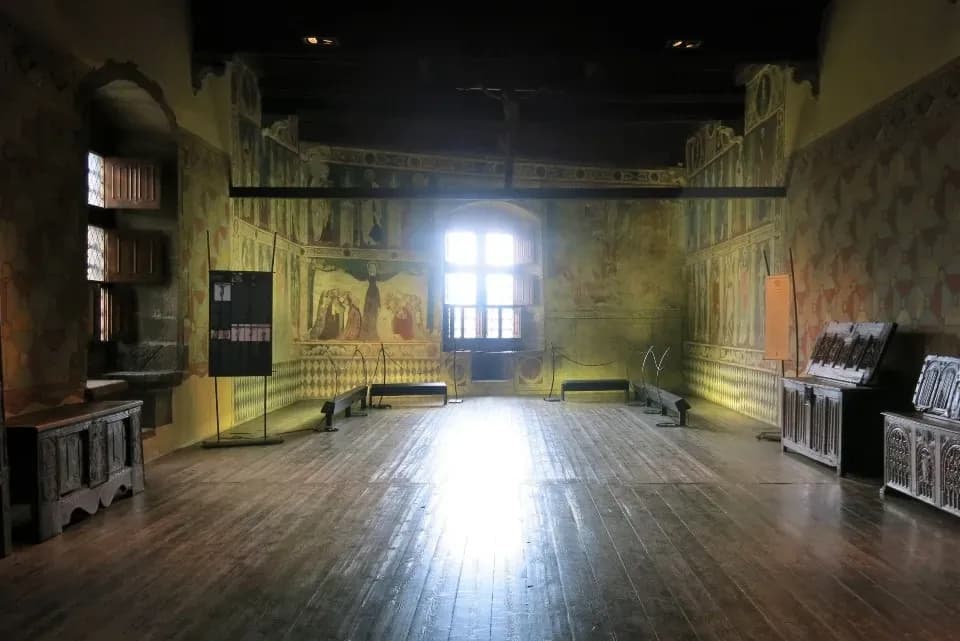
Your weekend starts straight at the Castello di Fénis, located in the Chez-Sapin area. The building immediately stands out among the meadows with its double defensive walls and the massive appearance typical of the Challant family. In the 1980s, thanks to its austere Gothic architecture, the exterior was used as Count Vlad's home in the comedy film 'Fracchia contro Dracula'. The real legends, however, are found inside. Local valley folklore persistently talks of a child's spirit – a son from a first marriage and rightful heir – who was murdered and embalmed by his stepmother to secure the succession for her own son. There are tales of moving furniture, unusual noises, and sudden temperature drops in the rooms. From October to March, entry is allowed from 10 to 13 and from 14 to 17, but keep in mind that it is always closed on Mondays. The visit is strictly guided and lasts about 30 or 40 minutes. There is no heating, the walkways are uneven cobblestones, and to avoid waiting outside in the cold, you need to arrive at the entrance with an online booking.
Afternoon
Once you've walked down to the bottom of the hill leading to the castle, break up the day with a stop at the Bar Trattoria Des Alpes. It is a traditional eatery where you can recharge your batteries with a platter of local cured meats and cheeses, enjoying the home-style cooking. Just a short walk from the fortress, you will find the MAV - Museo dell'Artigianato Valdostano di Tradizione, at frazione Chez-Sapin 86. If you buy a reduced combined ticket at the ticket office, entry is cheaper. The rooms house wooden sculptures and items of Alpine material culture, with a special focus on the historical Jules Brocherel collection. Exploring the museum takes a good 45 minutes to an hour, and it is open continuously from Tuesday to Sunday, from 10 to 18. Just bear in mind that the museum is closed for the whole month of November.
Evening
Stay in the same hamlet for dinner, stepping into the wooden interiors of the Trattoria Le Bourg. The menu skips snacks to focus on hot, peasant-style dishes. You will find thick winter recipes: potato flan with fonduta, pasta made with chestnut flour, and hearty portions of polenta concia prepared with fontina. For the night, if you are looking for a nearby base, head back towards the manor and book a room at the Hotel Comtes de Challant, located in the village right next to the medieval fortress walls.
Day 2 — Witch hunting in the upper valley
Morning
For your second day, you need to get back in the car, cross to the opposite side of the main valley, and focus on historical memories. Reaching the town of Saint-Denis, you'll spot the Castello di Cly, an early enclosure castle, on a rocky outcrop. A true story is woven into its walls: in 1428, Johanneta Cauda was imprisoned here. She was the first woman condemned for witchcraft and burnt at the stake in Valle d'Aosta. Her imprisonment is directly confirmed in the Errores Gazariorum treatise. Driving towards the neighbouring municipality, you'll then come across the Castello di Saint-Marcel. This rural, single-block complex has an esoteric aura well known to locals. Stories speak of nocturnal apparitions: an armed ghost, described as a 17th-century soldier, wandering around the building with his sword drawn.
Afternoon
For lunch, head up to the hamlet of Les Crêtes. At the Le Foyer de Grand Mère agriturismo, run by young local producers, you can eat zero-mile vegetables and cheeses from their own farm, sitting with a direct view of the towers of the Castello di Fénis. Dedicate your afternoon to the open air of the Val Clavalité. You can reach this unspoilt and wild Alpine valley by car from the village, driving up to the Robioz or Plan Clavalité car park at an altitude of 1,525 metres. Walking among the larch woods and ancient stone cabins, enveloped in the damp air and high-altitude mist, rounds off the harsh, solitary feel of the mountains.
Evening
Back in the village at the end of the day, take a seat at the Ristorante Comtes de Challant, a historic spot in the medieval village. The kitchen serves carbonada, Alpine meat stews, and Valdostana fonduta to fight off the evening temperature drop. If you prefer to spend the night inside a historic village building, just two hundred metres from the main attraction, you will find a room at the B&B da Verena in the nearby hamlet of Pommier.
Day 3 — Dim light in Aosta and phantom heiresses
Morning
The third day calls for a quick trip westwards along the state road or motorway. An isolated spot hides in the historic centre of the Valdostan capital: the Criptoportico Forense di Aosta. This vaulted corridor dating back to the 1st century BC runs beneath the city's cathedral, far from urban noise and immersed in a constant dim light. You head underground, exploring cold passages on a route that takes about half an hour. To get in, you need a single ticket for the Aosta Archeologica circuit.
Afternoon
After finishing your underground walk and taking the road back east, you'll come across the imposing Castello di Quart, perched high up just a short distance from Fénis. According to local tales, the tormented soul of a woman unjustly condemned to death in the 16th century wanders this spot. For your final stop, you'll need to drive for about twenty-five minutes to reach the municipality of Issogne. The Castello di Issogne is a Renaissance residence, but it too is scarred by bloody tales. Stories report nocturnal apparitions of Bianca Maria Scapardone, a countess beheaded in 1526, whose spirit has allegedly never left the rooms. If you decided to wrap up your itinerary by sleeping outside the main towns, you can stay at the Le Foyer de Grand Mère agriturismo, located in the hamlet of Les Crêtes.
Evening
The final evening allows you to slowly head back towards the main roads, with the castles now closed and swallowed by the Alpine darkness.
Tips for organising your time
- Fénis is easily reached by exiting the A5 motorway at the Nus tollbooth and proceeding along the SR13. A car is essential to move around the manors in the neighbouring municipalities or to head up to the high-altitude car parks in Val Clavalité, as valley-floor public transport mainly stops in Nus. You will find free public car parks in the village just a few minutes' walk from the fortress entrance.
- Visits to the interior of the Castello di Fénis are limited to 30-minute intervals and are strictly guided. You must book in advance on the regional online platform MIDA Ticket. It is also worth asking at the ticket office for the reduced combined ticket, which includes entry to the nearby MAV museum.
- During the winter months, the stone rooms and interior corridors of the Castello di Fénis have no heating. You need to wear heavy layers and sturdy shoes to comfortably walk on the cobbled outdoor sections.
- Autumn mists enhance the fortress's charm, making it a focal point for autumn weekends. On a cinematic level, the site was used in 1985 as the gothic home in 'Fracchia contro Dracula', while local folklore maintains strong rumours about the murdered child's ghost.
- Not far away, between the ruins of the Castello di Cly in Saint-Denis and the Chambave area, lies a piece of true Alpine inquisition history, with the trial and burning of the suspected Johanneta Cauda recorded in the 1428 Errores Gazariorum treatise, one of the earliest documents on witch trials in Europe.
Where to stay in the area
A hotel located in the village, centrally positioned right next to the medieval castle.
View on Booking →A bed and breakfast housed inside a historic building just two hundred metres from the fortress.
View on Booking →A farm and agriturismo offering rooms and a restaurant serving zero-mile local produce.
View on Booking →