

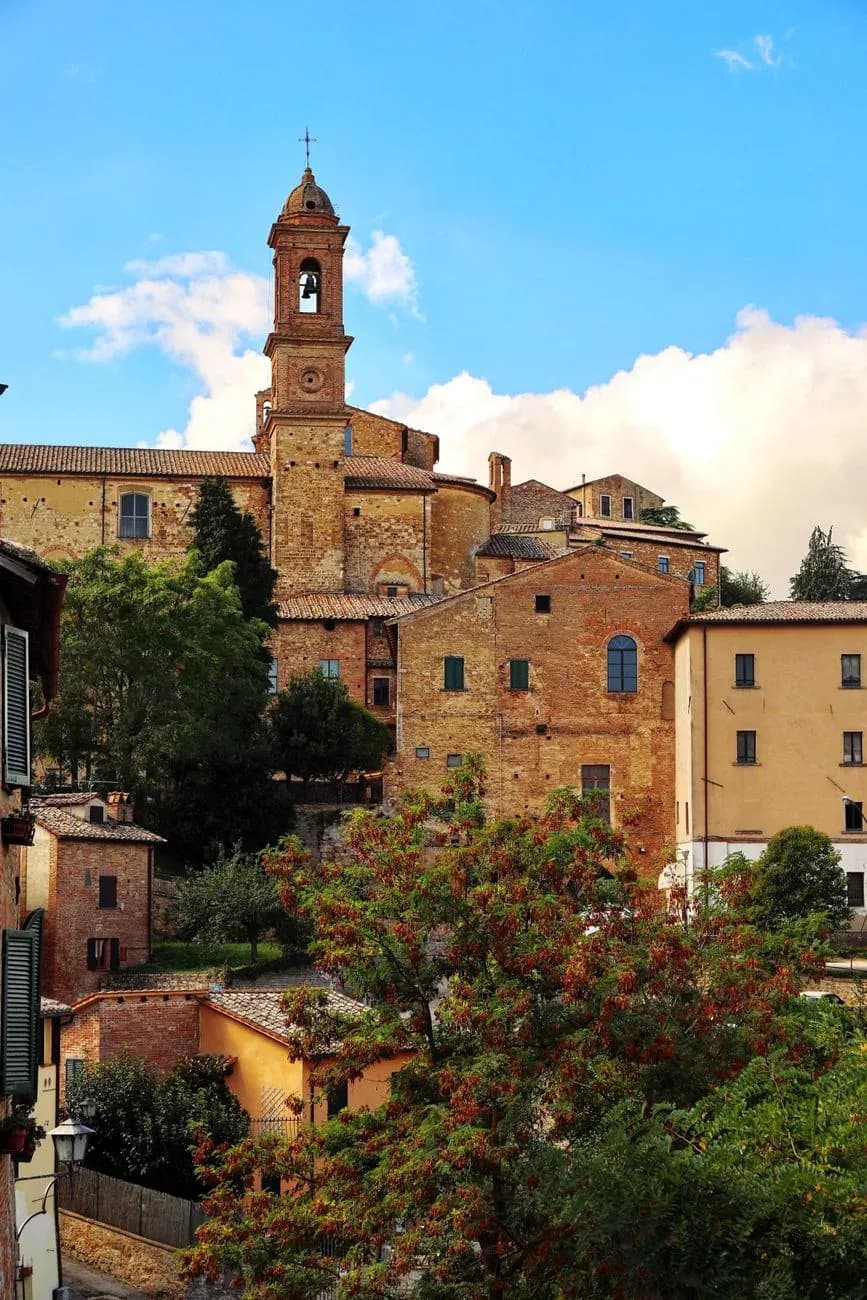
Toscana is a fixture on the collective postcard, but discovering its most authentic corners means leaving the most obvious routes behind. This four-day road trip takes you through Val d'Orcia by car, an absolute must for linking the short scenic hops between villages, which typically take 15 to 30 minutes along cypress-lined country roads.
The best time to plan the trip is in spring, between April and June, when the hills turn a vibrant green, or between September and October, ideal months for catching the grape harvest and the morning mists. It is a landscape of soft contours and restrained architecture that is best enjoyed at an unhurried pace, leaving your car outside the historic centres, almost all of which are restricted traffic zones (ZTL).
How to plan four days in Val d'Orcia
Day 1 — The ideal city and its geometries
Morning
Your route starts at Piazza Pio II e Centro Storico di Pienza, the heart of this Renaissance project. It is worth spending a couple of hours here, preferably in the morning, wandering down evocative streets such as Via dell'Amore and Via del Bacio. Just a short walk away stands Palazzo Piccolomini, a papal residence open from 10:00 to 16:30 (closed Tuesdays). Its courtyard and hanging loggia overlooking the valley deserve about an hour and a half.
Afternoon
Leaving the centre behind, the countryside opens up. At Podere Il Casale on Via Podere Il Casale 64, an organic farm with a terrace looking out across the hills, you can sample homemade pecorino cheeses and zero-kilometre dishes. Later, head towards the Campi Elisi de Il Gladiatore (Pieve di Corsignano): a dirt lane, accessible only on foot after leaving the car in the lay-bys along the road, where a 30-45 minute stop lets you take in the sunset light hitting the cypresses.
Evening
For dinner, head back into the historic centre of Pienza. On Via San Carlo 2 you will find Ristorante Trattoria Latte di Luna, an intimate spot renowned for fresh pasta and roast meats. Given how busy it gets at weekends, be sure to book well in advance.
Day 2 — Between formal gardens and water squares
Morning
In San Quirico d'Orcia, the Horti Leonini offer a glimpse of sixteenth-century garden design. Entry is free, and a stroll through the boxwood hedges and medieval walls takes 30-45 minutes. In the historic centre along the Via Francigena stands the Collegiata dei Santi Quirico e Giulitta, a Romanesque church with portals carved from sandstone and travertine, requiring just half an hour to visit.
Afternoon
Stay in the heart of the medieval village for lunch at Ristorante Degli Archi, with its internal courtyard sheltered by brick vaults, where handmade pici meet authentic Sienese flavours. In the late afternoon, along the SS2 Cassia, the famous Cipressi di San Quirico d'Orcia stand out against the clay hills: a twenty-minute photo stop catches the scenery in the best light.
Evening
At Bagno Vignoni the landscape shifts completely. The Piazza delle Sorgenti is a vast sixteenth-century stone basin with rising thermal vapours, perfect for a twilight stroll. Just steps from the pool, on Via dei Mulini 3, Osteria del Leone offers an intimate setting with reinterpreted traditional dishes and a carefully curated regional wine list.
Day 3 — Secluded abbeys and fourteenth-century fortresses
Morning
Moving on to Montalcino, the Fortezza di Montalcino dominates the skyline with its keep. Open Tuesday to Sunday from 9:00 to 18:00, with rampart admission around €4, the wall walk rewards you with 360-degree views across the Brunello vineyards. In Castelnuovo dell'Abate, the Abbazia di Sant'Antimo stands isolated in travertine and alabaster; church entry is free, an optional video guide is available for a fee, and a visit takes about an hour.
Afternoon
Heading towards Castiglione d'Orcia along the SR2 Cassia, the Viale di Cipressi di Poggio Covili is well worth a fifteen-minute stop to photograph one of Italy's most iconic tree-lined drives. Next, make your way to Monticchiello. The Borgo medievale di Monticchiello is a fortified hilltop hamlet, renowned for its Teatro Povero and winding approach road; exploring it on foot takes around an hour.
Evening
For the evening, head back towards Bagno Vignoni to the hamlet of Osteria dell'Orcia, where Ristorante La Vecchia Posta welcomes guests in a garden along the river. The menu features refined cooking, with fresh pasta and tagliata al Brunello showcasing local flavours.
Day 4 — Montepulciano's Renaissance and iconic cypresses
Morning
In San Quirico d'Orcia, reaching the Cappella della Madonna di Vitaleta involves a walk of around 700 metres from the unpaved parking area along the SP146. This tiny chapel framed by cypresses is a ten-minute walk away and is especially magical in the early morning light.
Afternoon
Continue towards Montepulciano to explore Piazza Grande e Duomo di Montepulciano. Set at the highest point of the village and flanked by striking landmarks like Palazzo Comunale and Palazzo Contucci, as well as historic underground cellars, it takes one to two hours to take it all in. Later, in Bagno Vignoni, the Parco dei Mulini on the village slopes features rock-hewn channels and free natural thermal pools for a final 45-minute wander.
Evening
For your final evening, head back to one of the villages you have visited, bearing in mind that centres like Pienza and Montepulciano are pedestrianised or covered by ZTL restrictions, meaning you will need to park just outside the historic walls.
Top tips for planning your trip
- A car is the only practical way to explore the area's villages over four days, as public transport is very limited. Drives between the main stops take between 15 and 30 minutes.
- Historic centres like Pienza, Montepulciano and Montalcino cannot be accessed by car due to ZTL zones. You must park outside the city walls in paid bays or time-disc spaces.
- To reach scenic spots like Cappella di Vitaleta or the Campi Elisi, you will need to park along provincial roads and walk along dirt tracks for roughly 500 to 1,000 metres.
- At weekends and during peak season, popular restaurants in small villages like Pienza and Bagno Vignoni fill up quickly; make sure to book everything well in advance.
Where to stay for easy exploring
Restored eighteenth-century farmhouse with a spa and swimming pool, taking in sweeping scenic views.
View on Booking →Historic residence with a garden and pool along the banks of the Orcia river, featuring an on-site restaurant.
View on Booking →Art Nouveau-style boutique hotel with a garden, located right by the historic centre of San Quirico.
View on Booking →