

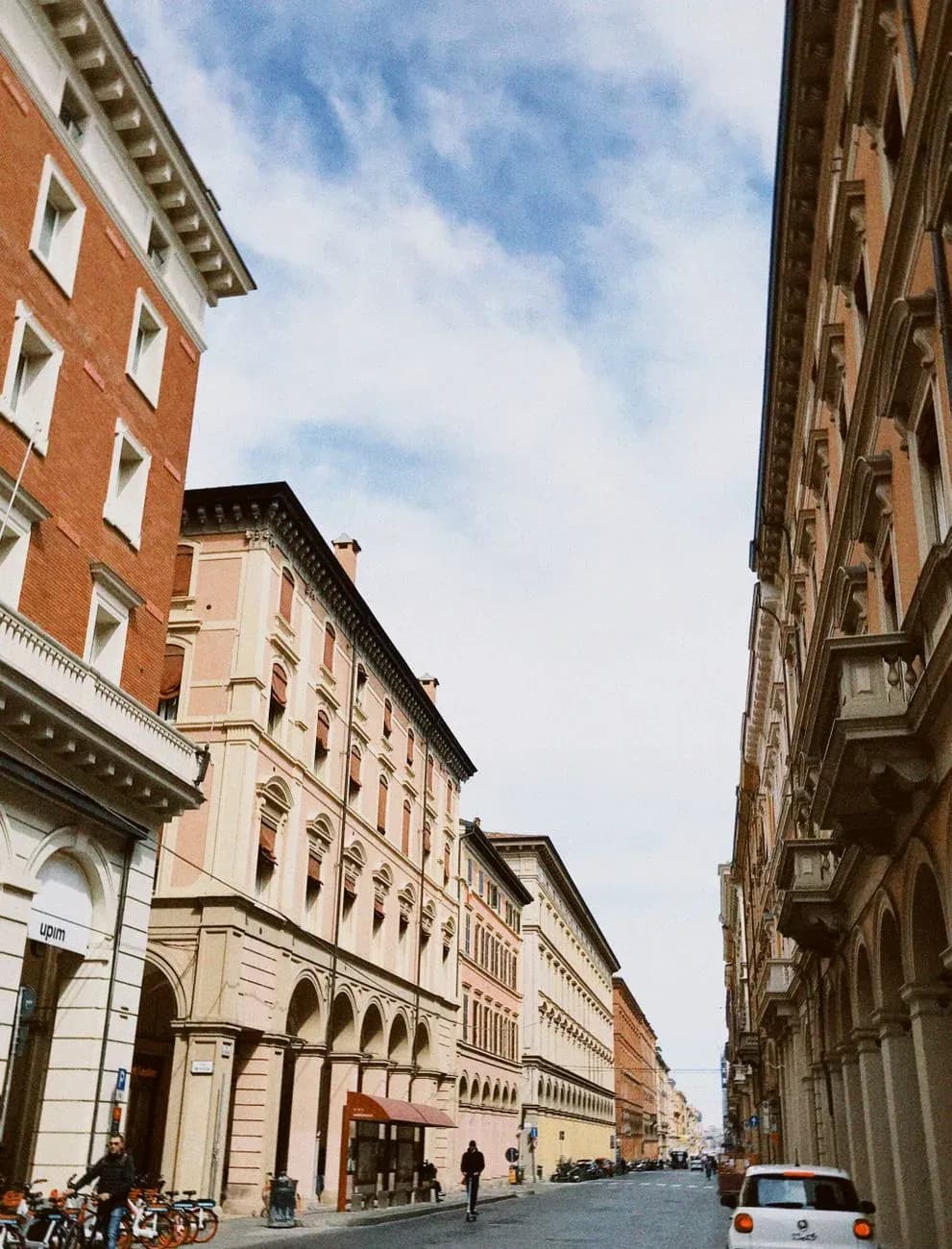
I have an issue with crowds. I can't stand them. Strangers' elbows, slow queues on pavements, café tables packed so close you can count your neighbour's breaths—it all gives me anxiety. So when we decided to plan a weekend in Bologna, there was only one strategy: wake up before everyone else and time things carefully to find the streets as empty as possible.
We left the car well away from the ring roads. The historic centre is almost entirely a limited traffic zone, and at weekends the main streets become fully pedestrianised. Driving into that hornet's nest was out of the question from the start. We got around entirely on foot, helped by our base at the Albergo delle Drapperie, tucked inside a 19th-century palazzo right in the heart of the ancient lanes. The room had high ceilings and Wi-Fi that barely worked near the window, but we hadn't come to stare at our phones.
Saturday morning. Alarm at 6:45. The air was still crisp and sharp when we stepped outside. Walking at that hour gives you a true sense of space. We arrived at Piazza Maggiore e Basilica di San Petronio when there was hardly a soul about, save for a couple of street sweepers and a delivery van. A vast, silent emptiness. We stepped inside the basilica, which remains unfinished with its facade sliced in half. The stone floor was freezing, and our footsteps echoed. We traced the line of the world's longest indoor sundial marked along the floor, trying to decipher the faded patches of light. Visiting at this hour makes total sense: no hum of chatter, just the scent of wax and old dust.
Shortly afterwards came our first snag. Convinced I had the map memorised, I led Elena towards Piazza di Porta Ravegnana to see the towers. Dead end. Barriers, orange plastic netting and warning signs everywhere. The Torre della Garisenda and the Torre degli Asinelli are closed for urgent safety works. The pedestrian paths around them were blocked or diverted. Elena gave me an arched eyebrow, pulling her jacket tight. "Brilliant sense of direction," she declared. We had to take a massive detour around the building site.
Towards mid-morning we slipped into the Ghetto Ebraico for the Finestrella di Via Piella. They call it little Venice. We stopped for just ten minutes, looking out over this fleeting view of the Canale delle Moline running narrow between weathered houses. Nothing over the top: just brick-red walls, dark water below and trailing ivy.
Midday. The critical moment. We were hungry and wanted to eat at the Osteria dell'Orsa, right in the heart of the Zona Universitaria. The prices are modest and people would genuinely fight over their tagliatelle al ragù, but they don't take any reservations whatsoever. The golden rule is to turn up well in advance. We positioned ourselves outside the door half an hour before opening, stamping our feet against the cold. When the waiter flipped the sign, our table was secured. The table wobbled noticeably under my elbow, but the tagliatelle was rich, coarse and piping hot. We settled the bill, leaving exactly three euros in loose change as a tip, emptying out my heavy pockets.
In the early afternoon, escaping the bustle of the filling tables, we sought refuge at the Complesso di Santo Stefano (Le Sette Chiese). Admission is by donation. It's a labyrinth of interconnected red-brick churches, featuring Romanesque cloisters where street noise simply ceases to exist. We spent an hour and a half there, perched on the low cloister walls, gazing at the uneven pillars as clouds gathered overhead. Nobody raised their voice.
Late afternoon drew us, almost by inertia, towards the Mercato Quadrilatero. At that hour, Via Drapperie and Via Pescherie Vecchie are the exact opposite of what I seek: crowds, shouting, jostling elbows. But the smell pulls you in. Mature cheese, freshly sliced mortadella, warm bread. The historic stalls pump out aromas thick as fog. We bought a wedge of parmigiano in a small shop, priced by the gram, and nibbled on it as we walked.
Sunday morning we needed to move. To break a sweat. No buses, no shuttles. We set off on foot for the Portico di San Luca e Colle della Guardia. From Porta Saragozza, it is an unbroken climb. An hour and a half's walk and 666 arches. Short of breath, calves burning halfway up, sweat beneath my scarf. At one point, as I was panting over a particularly steep step, the San Luca Express tourist train trundled past us. Elena glanced at the passengers sitting comfortably behind the glass, then turned to me. "Next time, I'm doing the planning," she muttered, before resuming the climb.
Heading down from the hill, ravenous and with aching feet, we stopped at Trattoria Trebbi in Via Solferino. It has been there since 1946, and it shows in the unhurried way they do things. We sat outside under the porticoes. Tortellini in brodo, even though the chill had worn off outside, to restore our lost salts. Proper broth, suitably rich, with thick pasta.
We wrapped up our itinerary in Bologna with two timed slots booked to the minute to skip the queues. First, the Torre dell'Orologio e Collezioni Comunali d'Arte. With a time-slot booking, you head straight up inside Palazzo d'Accursio without fuss. From the top, the view over the terracotta roofs of Piazza Maggiore reveals how the city's geometry has stayed true to centuries past.
Finally, the Teatro Anatomico e Palazzo dell'Archiginnasio. Just a forty-five-minute visit, but perhaps the strangest place we saw. A 17th-century amphitheatre carved entirely from spruce. The scent of dry wood is intense. Supporting the canopy are the statues of the Spellati: wooden figures stripped of their skin, muscles and tendons laid bare. I stared at them for ages. An odd blend of physical unease and sheer fascination. We stepped back onto the street just as the street lamps flickered to life and the Sunday evening crowd began filling the porticoes, ready for our journey home.