

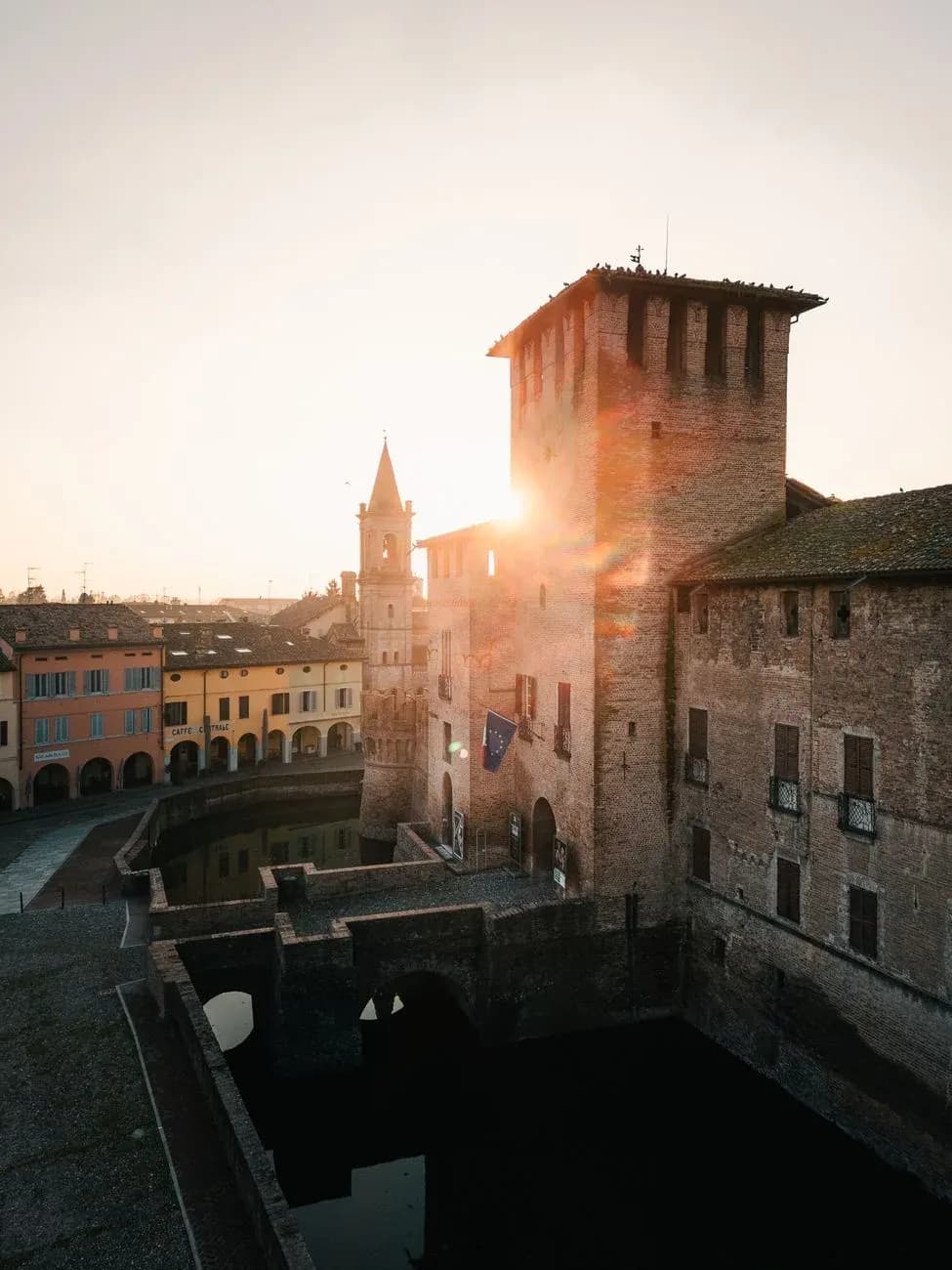
Emilia-Romagna offers far more than just flat plains and bustling coastal resorts. Head up towards the rolling hills and the Appennino, and you'll find wooded valleys, high-altitude lakes and castles that once guarded ancient territorial borders.
This itinerary requires a car to travel comfortably between Val Trebbia, the Appennino Reggiano and the provinces of Romagna. The hillside roads are often winding and call for an unhurried pace, but they allow you to journey through remarkably diverse landscapes within just a few hours. The best time to take the wheel is from May to October, when the weather is ideal for long walks and the mountain lakes are framed by nature's changing hues.
How to plan your stops day by day
Day 1 — Val Trebbia and the Piacentino
Morning
Your trip begins in the centre of Bobbio, the heart of Val Trebbia. The first stop is the Abbazia di San Colombano, a monastery founded in 614 AD that was once one of early medieval Europe's most significant cultural hubs; allow around an hour for the visit. Afterwards, head up to Castello Malaspina dal Verme, a 14th-century fortress overlooking the town, complete with panoramic ramparts and an on-site museum. Before moving on, stop at Albergo Ristorante Piacentino in Piazza San Francesco to sample maccheroni alla bobbiese with slow-cooked beef sauce alongside classic Piacenza-style pisarei e fasò.
Afternoon
Continue towards Val Nure to explore the Borgo neomedievale di Grazzano Visconti. As a picturesque settlement rebuilt in neo-medieval style, complete with artisan workshops and a castle, it tends to draw large tour groups, so visiting on a weekday is best to dodge the crowds. Heading back towards Bobbio at golden hour, a stroll across the pedestrian Ponte Gobbo (Ponte del Diavolo) over the Trebbia river offers the finest view of the historic centre's stone houses.
Evening
For dinner, head towards Gazzola to reach Locanda del Falco in Borgo di Rivalta. Set within the fortified village walls, this atmospheric trattoria serves Piacenza PDO cured meats, handmade tortelli and hearty cuts of meat.
Day 2 — Val d'Arda strongholds and the climb to the lakes
Morning
Start the day in Val d'Arda, spending an hour or so at the Rocca Viscontea di Castell'Arquato, an imposing mid-14th-century brick fortress overlooking Piazza Monumentale. A short drive away lies the Borgo medievale e Mastio di Vigoleno: this fortified hamlet has remained remarkably intact and houses the Romanesque Pieve di San Giorgio. Its patrol walkways offer sweeping vistas across Val d'Ongina, taking between one and two hours to explore fully.
Afternoon
Leaving the province of Piacenza behind, the roads climb into the Appennino Reggiano. Once in the Ventasso area, a 15-minute forest walk leads to Lago Calamone (Lago del Ventasso), a glacial basin sitting at over 1,300 metres above sea level and encircled by dense beech woods. Close by is the mountain resort of Cerreto Laghi e Lago Cerretano, an alpine hub in the Appennino Tosco-Emiliano that serves as a launchpad for hikes towards smaller mountain tarns.
Evening
To round off the day without straying from the woods, book a table at Rifugio Venusta, which looks directly over the shores of Lago Calamone (Lago del Ventasso). The menu centres on traditional mountain-ridge dishes, serving steaming polenta and porcini mushrooms.
Day 3 — From the Parma hills to Brisighella
Morning
Spend the early morning in the Parco Nazionale Appennino Tosco-Emiliano, in the municipality of Corniglio. Here lies Lago Santo Parmense, which, at 1,507 metres below Monte Marmagna, is the largest glacial lake in the region. You can reach the water by hiking the footpaths or by taking the chairlift from Lagdei.
Afternoon
After a longer drive into Romagna, you'll reach Valle del Lamone to discover the three gypsum hills of Brisighella. Start with a wander along Via del Borgo (Via degli Asini), a raised, covered 14th-century medieval street illuminated by arched openings looking out over the square. Heading up the hillside paths, you'll reach the Torre dell'Orologio di Brisighella, a 1290 watchtower rebuilt in the 19th century with a six-hour clock face, and the nearby Rocca Manfrediana di Brisighella, built in 1310. From here, sweeping views take in the entire Vena del Gesso and the Appennino faentino.
Evening
Just steps from Brisighella's famous covered walkway, dine at Ristorante Albergo La Rocca on Via delle Volte. The kitchen serves seasonal Moretto artichokes and dishes finished with Brisighello PDO extra virgin olive oil. If you plan to stay overnight, you can check straight into Albergo La Rocca.
Day 4 — Murals, wine and impregnable fortresses
Morning
Your fourth day begins in the historic centre of Dozza, celebrated for the Muri Dipinti di Dozza. Since the 1960s, the village house facades have formed an open-air gallery showcasing over a hundred murals. At the highest point stands the fortress tied to Caterina Sforza. A visit to the Rocca Sforzesca ed Enoteca Regionale Emilia Romagna lets you tour the noble apartments before heading down into the cellars, home to a regional wine collection of more than 800 labels.
Afternoon
The final drive takes you into Valmarecchia to explore San Leo. First, stop in the historic core to view the Pieve di Santa Maria Assunta e Cattedrale, one of the country's most notable Romanesque complexes, built directly into the sandstone rock. Next, climb to the isolated Fortezza di San Leo, a Renaissance fortress designed by Francesco di Giorgio Martini. Perched on a massive rocky spur, it famously served as the prison of the Count of Cagliostro; allow up to two hours to visit.
Evening
Stay up high in San Leo for dinner at Ristorante Osteria Belvedere. The restaurant features a panoramic terrace overlooking the surrounding peaks and focuses on traditional Montefeltro cuisine, featuring fresh handmade pasta.
Practical tips and useful advice
- Driving between the different provinces requires patience: heading from Val Trebbia to the Appennino Reggiano or Romagna takes between 1.5 and 2.5 hours on winding roads.
- When arriving in Castell'Arquato, head straight for the lower car park near the cemetery to find a space easily before walking up into the historic centre.
- The village of Grazzano Visconti is entirely pedestrianised, with two paid car parks at the entrance; aim to arrive early in the morning to beat the tour buses.
- Rocca Sforzesca and the Enoteca in Dozza are closed on Mondays, so plan your visit for another day of the week to avoid finding the doors shut.
- Sturdy walking shoes are essential for Lago Santo Parmense, Lago Calamone and the gypsum trails around Brisighella, as the footpaths and mule tracks get slippery when damp.
Where to stay along the route
Elegant accommodation set less than 100 metres from the cathedral, ideal for exploring the historic centre on foot.
View on Booking →A historic, family-run hotel right at the foot of the elevated street, perfect for relaxing at the end of the day.
View on Booking →A welcoming property with a restaurant and terrace, nestled directly beneath the village's famed Renaissance fortress.
View on Booking →