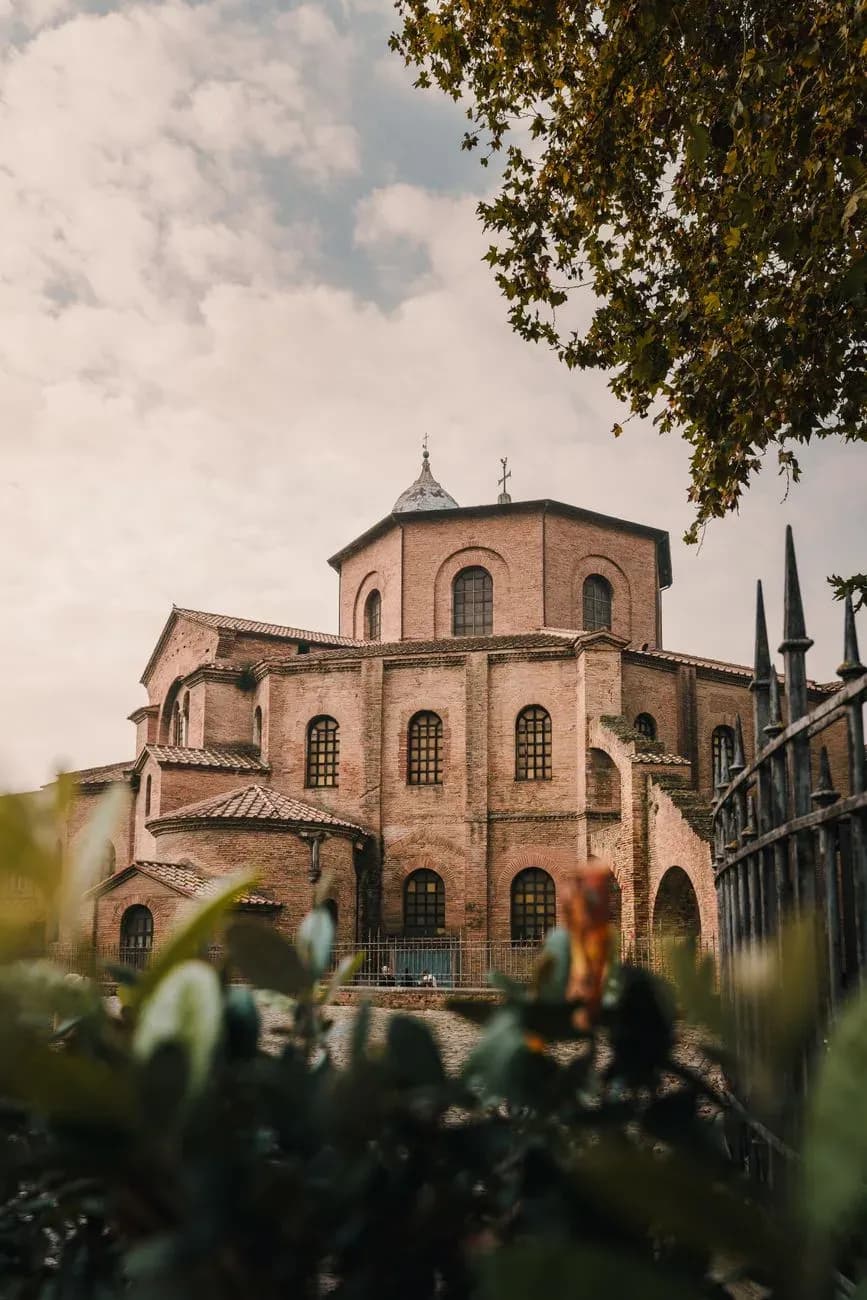
Behind the red bricks lie skies of blue enamel. Working out what to see in Ravenna takes time: its treasures are tucked away inside, beneath domed ceilings and in underground sites. Go on foot or by bicycle. The centre shuts out traffic almost entirely. Leaving the car in the park-and-ride car parks outside the walls will save you from ZTL fines.
Visit between April and June, or in early autumn. Navigating the alleys works best in these windows. High summer brings flatland humidity and sultry air. You need four days. That spreads out the timed-entry slots without any rush, leaving room to reach the pine forests and parks outside the city.
How to plan four days between the centre and beyond
Day 1 — Imperial mosaics and timed entry
Morning
Basilica di San Vitale, the starting point. An octagonal plan. Examining the mosaics of Justinian and Theodora takes about 45 minutes. Just a few metres away stands the Mausoleo di Galla Placidia with its starry, cobalt-blue ceiling. Getting inside requires advance planning: you must book a fixed time slot. You stay inside for just 5 minutes — the microclimate must not be disturbed. Osteria dalla Zabariona is barely two hundred metres away. Pedestrian area. They serve homemade pasta for lunch.
Afternoon
Three metres beneath the church of Sant'Eufemia. Down there, the Domus dei Tappeti di Pietra reveals a Byzantine archaeological site. Fourteen paved rooms: the Dance of the Seasons is a highlight. The Battistero Neoniano is the next stop. No intact monument in Ravenna is older than this. Your entry time must be booked in advance before arriving. Maximum stay is strictly set at 5 minutes.
Evening
Traditional Romagna dishes and a roaring fire. At Bello al Rustichello, near Porta Adriana, the pasta is rolled out by hand. Securing a table means calling a few days ahead.
Day 2 — The Dante quarter and Istrian stone
Morning
Zona del Silenzio. That is what they call the area around the Tomba di Dante. This neoclassical temple housing the poet's remains is always open and free to enter. Next door, the Basilica di San Francesco hides a flooded underground crypt: goldfish swim over the ancient mosaic floor, visible from above. On Via Corrado Ricci, stop at Ca' de Ven. A wine bar set in a fifteenth-century palazzo with frescoed ceilings. Tuck into warm piadine, cured meats and formaggio di fossa.
Afternoon
In Piazza San Francesco your eyes are drawn to the Cripta Rasponi e Giardini Pensili. A neo-Gothic turret and a fountain define its silhouette. Head towards the station area. The Battistero degli Ariani can be visited with a 2–3 euro ticket. The Mausoleo di Teodorico commands attention nearby: a massive tomb from 520 AD in Istrian stone. There are no mosaics inside — the city's only UNESCO site without them. The roof is made from a single 230-tonne monolith.
Evening
Night falls over the Darsena di Ravenna. The former industrial dock on the Candiano canal is lined with wooden boardwalks, street art and bars. Dinner at Darsenale - Bizantina Brewpub. A warehouse converted into a craft brewery with the brewing vats in plain view. Grilled meats on the tables.
Day 3 — Heading south: the former sugar refinery and flamingos
Morning
Leave the centre to reach the hamlet of Classe. If you are without a car, take the regional train from the station — a five-minute ride — or the number 4 or 176 bus. The enormous decorated apse of the Basilica di Sant'Apollinare in Classe welcomes you inside: the saint prays in a green meadow filled with sheep under a golden sky. A restored former sugar refinery houses the Classis Ravenna museum a short distance away. It retraces the city's naval history.
Afternoon
Head towards the mouth of the Bevano river to enter the Pineta di Classe e Oasi dell'Ortazzo. A portion of the Parco del Delta del Po. Designed for walking in nature, renting a mountain bike or birdwatching among herons and ducks.
Evening
Back in town. Dinner at Osteria Passatelli 1921. Via Ponte Marino, set inside the premises of the former Cinema Mariani. The spotlight is on passatelli: served dry or in broth.
Day 4 — Contemporary art and downtime
Morning
The MAR - Museo d'Arte della città di Ravenna fills the final morning. A sixteenth-century cloister, the Loggetta Lombardesca. The vast collection showcases contemporary mosaics. Works by Chagall and Guttuso feature among the displays.
Afternoon
Outings with the children. Spend the afternoon in the hamlet of Savio at Mirabilandia. Italy's largest theme park by surface area easily covers half a day between rides and shows.
Evening
A gentle stroll through the pedestrian centre for your final evening. A glass of Sangiovese or Albana, then pack your bags.
Practical tips for planning and skipping queues
- Buy the Ravenna Mosaici Pass combined ticket online. It costs between €11.50 and €13.50. It is valid for one week across five sites: San Vitale, Sant'Apollinare Nuovo, Museo Arcivescovile and the two timed-entry monuments. Booking your time slot for the Mausoleo di Galla Placidia and the Battistero Neoniano is mandatory when purchasing.
- Outside the diocesan network, state or civic sites must be paid for separately. The Battistero degli Ariani, Mausoleo di Teodorico and Domus dei Tappeti di Pietra charge admission fees ranging from €2 to €6 per entry.
- Keep daytime expenses down. Kiosks and wine bars ring up bills for piadine and Romagna street food at around €6–€10. The bill for a full sit-down dinner in a traditional osteria ranges between €30 and €45 per person.
- Buses to reach the Classe sites and the former sugar refinery: public holiday timetables on Start Romagna routes (4 or 176) run less frequently than the regional train.
Where to stay near the monuments
A period palazzo on Via IV Novembre, just steps from Piazza del Popolo and convenient for exploring the UNESCO sites on foot.
View on Booking →Strategically positioned between the railway station and the Mausoleo di Teodorico, ideal if you are getting around by public transport.
View on Booking →A modern property with free parking, roughly two kilometres from the centre but a great base if you arrive by car.
View on Booking →