

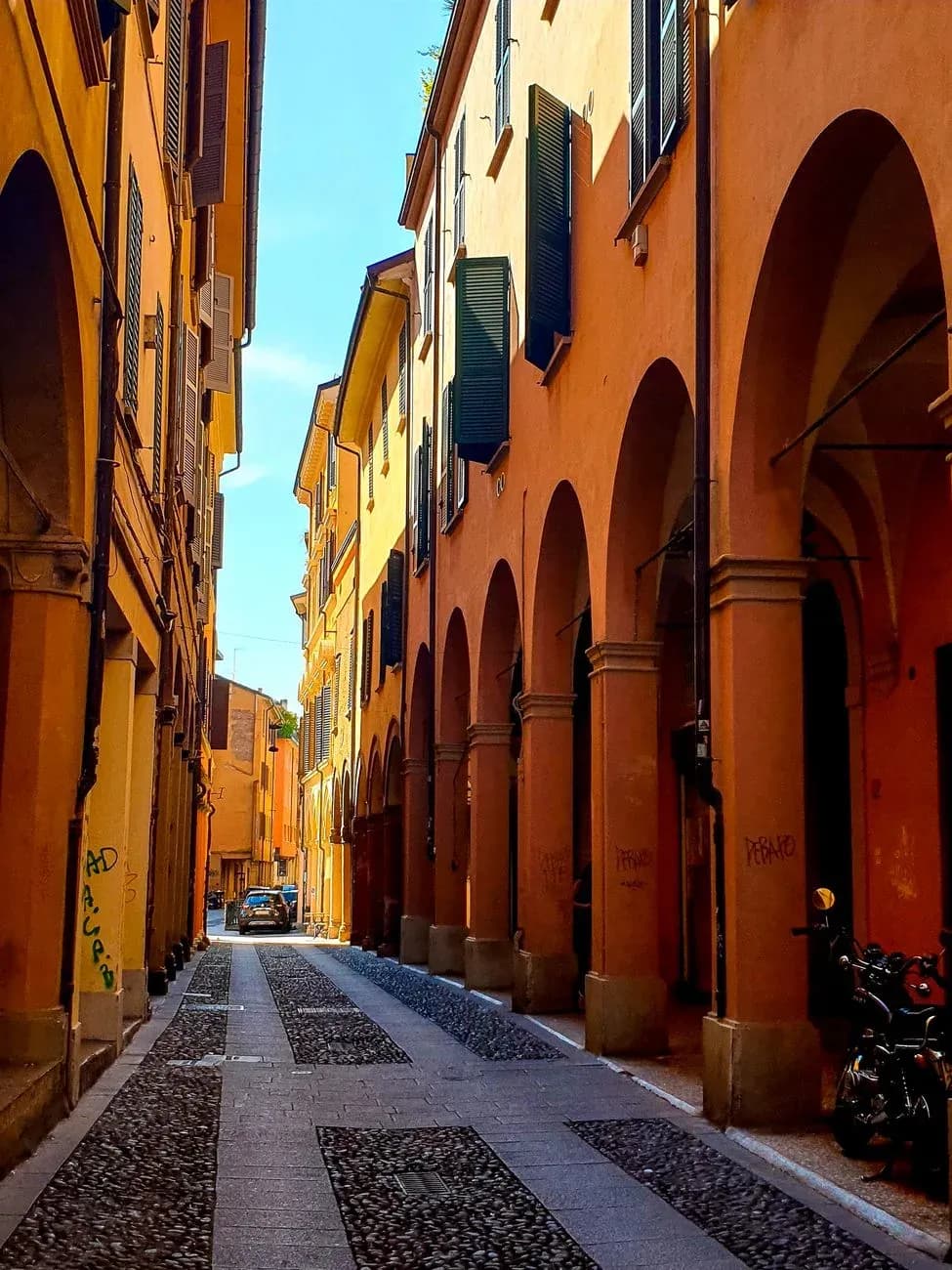
The best time to plan a weekend in Bologna is during the shoulder seasons. Spring and autumn guarantee the right temperatures for alternating long walks around the city with your first excursions into the hills, without having to brave the intense summer heat.
The centre is explored almost entirely on foot, taking advantage of the vast network of porticoes that shelter you from both rain and sun. If you prefer to spend the night away from the traffic, you can opt for properties immersed in greenery yet close to the city, such as Casa Fluò in the hills or other estates just outside the city gates. Driving within the city is ill-advised due to strict traffic restrictions.
How to organise the two days
Day 1 — From the waters of the Ghetto to the main squares
Morning
The day begins in the Ghetto Ebraico to look out from the Finestrella di Via Piella. This is a small window overlooking Canale delle Moline, revealing a glimpse of the city's ancient water network. The stop takes 10 minutes at most, but it is best to arrive early in the morning to avoid queuing along the pavement. Right after, still in the Centro Storico, the counters at Forno Brisa serve speciality coffee, breakfast pastries, and slices of sourdough pizza. Once you have finished your snack, head towards Piazza Maggiore e Basilica di San Petronio. Visiting the church takes between 45 and 60 minutes and lets you see the longest indoor sundial in the world. Admission is free, but covered shoulders and knees are strictly required.
Afternoon
The itinerary continues with the Torre dell'Orologio e Palazzo d'Accursio. The climb brings you to two panoramic terraces looking out over the terracotta roofs, offering a solid alternative whenever Torre Asinelli is closed. You will need 45 minutes to complete the visit, and closed shoes are strictly required for safety reasons. A short distance away, in the Galvani area, stands the Teatro Anatomico e Palazzo dell'Archiginnasio, formerly the seat of the Università di Bologna. Inside, you can see the carved wooden hall once used for historic anatomy lectures. The visit takes 40 minutes, but entry must be booked in advance. To break up the afternoon, Mercato delle Erbe on Via Ugo Bassi features historic food stalls alongside kiosks and wine bars, perfect for sitting down to enjoy a traditional tagliere.
Evening
Towards the late afternoon, make your way to the Santo Stefano neighbourhood to visit the Complesso di Santo Stefano (Le Sette Chiese). This maze of sacred buildings and Romanesque cloisters, known as the Bolognese Jerusalem, takes up to an hour to explore among the naves. Entry is not permitted on Mondays. For dinner, head to the Zona Universitaria and Osteria dell'Orsa, at Via Mentana 1. This historic, bustling osteria is renowned for its tagliatelle and homemade fresh pasta. As they do not take bookings, the only way to get a table quickly is to arrive before the standard dinner rush.
Day 2 — Panoramic terraces and UNESCO porticoes
Morning
The second day shifts focus towards the Colli Bolognesi, starting from the Belvedere di San Michele in Bosco. Perched right above the centre, this terrace affords an open view across the city and lets you experience the optical illusion known as the telescope effect, seen from the convent corridor. The visit takes around 45 minutes. From here, head towards the San Mamolo area to explore Parco di Villa Ghigi. This green expanse lets you unplug from the urban pace, strolling for a couple of hours along the various trails marked by the CAI. Back down at street level, stop for lunch in the Porto-Saragozza neighbourhood at Trattoria dell'Autotreno, at Via della Secchia 3. A firm local favourite, it serves traditional dishes such as fried crescentine with cured meats and cotoletta alla bolognese.
Afternoon
The entire afternoon is dedicated to the climb up to the Santuario della Madonna di San Luca e Portico, set atop Colle della Guardia. The pedestrian route winds beneath nearly four kilometres of UNESCO-listed porticoes, requiring between an hour and a half and two hours of steady uphill walking. The best time to take on the climb or photograph the descent is during the afternoon of the second day, making the most of the pre-sunset light.
Evening
Having walked back down from the hill, wrap up the itinerary around the table in the Porta Saragozza area, dining at Trattoria Trebbi on Via Solferino. The atmosphere retains a homely feel, focusing on classic local cooking with strictly hand-rolled fresh pasta and a selection of traditional desserts to round off the weekend.
Top tips for planning ahead
- If you are arriving by car, be mindful of the city centre's ZTL (restricted traffic zone), in force daily from 7:00 to 20:00. At weekends, key thoroughfares such as Via Indipendenza, Via Ugo Bassi, and Via Rizzoli become fully pedestrianised, making driving in unadvisable.
- To avoid fines and park comfortably on the edge of the ZTL, the best options are the underground car parks at Piazza VIII Agosto or Riva Reno. From both locations, you can walk to Piazza Maggiore in just over ten minutes.
- If you lack the time or stamina to walk the full climb of 666 arches to the Santuario di San Luca, you can hop on the San Luca Express tourist train, which departs regularly from central Piazza Galvani.
- To lower the cost of individual entry tickets to municipal museums and the climb up Torre dell'Orologio, it is worth considering the Bologna Welcome Card, which also offers discounts on public transport.
- If you choose to extend your itinerary into the Appennino to visit Rocchetta Mattei, you must plan your trip for a weekend and strictly book your ticket online beforehand, as entry without advance registration is not allowed.
Where to spend the night
A small bed and breakfast surrounded by greenery, ideal for those seeking peace and quiet within easy reach of the centre.
View on Booking →A historic property at the foot of the hills, featuring centuries-old grounds, a swimming pool, and a wellness area.
View on Booking →A hotel with an outdoor pool and extensive parkland, handy both for reaching the centre and for hiring e-bikes to explore the hills.
View on Booking →