

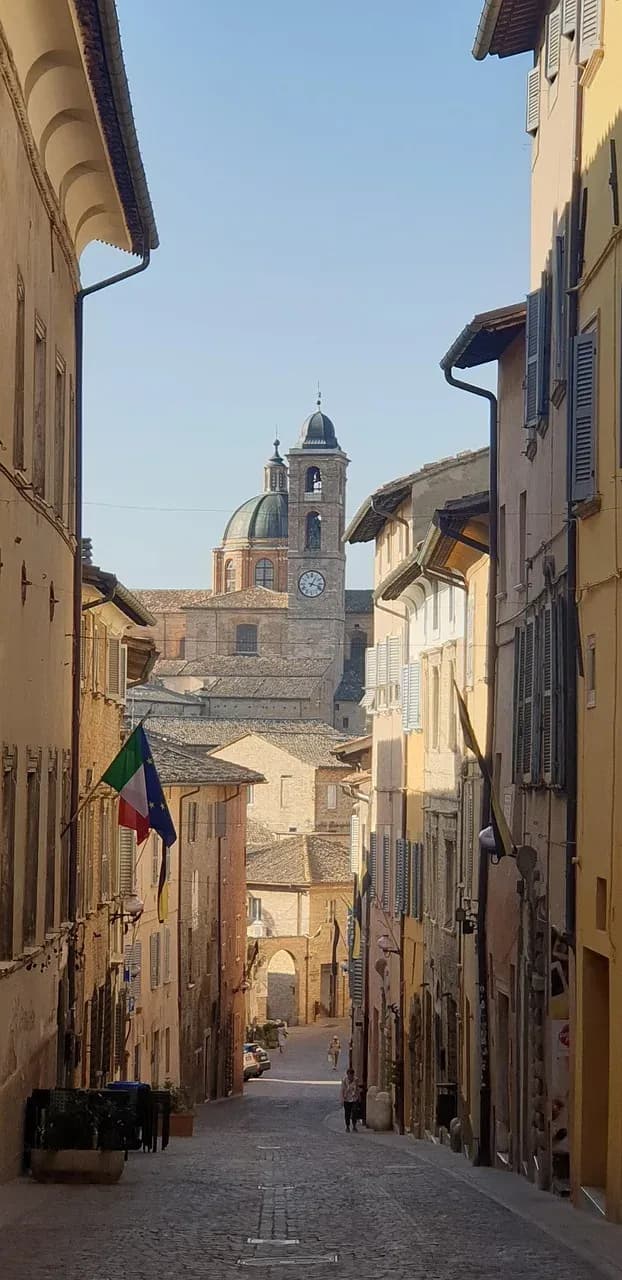
The centro storico di Urbino is entirely pedestrianised and monitored by electronic traffic cameras. Getting here means tackling the hills of Montefeltro; those travelling by public transport will find a direct connection via buses departing from Pesaro railway station. The journey takes around 45-50 minutes and terminates at Borgo Mercatale, right at the foot of the city walls.
The best times to visit are spring, particularly April and May, and early autumn, between September and October. Temperatures during these periods make walking the hills comfortable, avoiding the fierce summer heat, while the sunlight brings out the warmth of the red brickwork typical of the ducal palaces. Getting around town means negotiating a constant rise and fall of cobbled alleyways, known locally as "piole". The streets are steep and require shoes with excellent grip.
For an overnight stay, options within the walls save you extra travel. Albergo San Domenico offers rooms set inside a former convent located right opposite the ducal palace. Alternatively, Hotel Bonconte occupies an elegant noble villa two hundred metres from the duomo.
How to organise your days in town
Day 1 — From Borgo Mercatale to the Fortezza
Morning
The route begins at Borgo Mercatale, the arrival point for buses and location of the underground car park. The climb up to the main squares is made easy by the Rampa Elicoidale e Data - Scuderie Ducali. This piece of Renaissance engineering was designed by Francesco di Giorgio Martini with a very specific purpose: allowing the Duke to ride up on horseback from Piazza Mercatale to the palace. Once you reach Piazza Rinascimento, you will need most of the morning for the Palazzo Ducale e Galleria Nazionale delle Marche. Commissioned by Federico da Montefeltro, the palace houses masterpieces such as the famous Studiolo and the painting 'Città Ideale'. The tour inside takes around two to three hours. On public holidays and spring bank holiday weekends, book your admission online in advance. Directly adjacent stands the Cattedrale di Santa Maria Assunta (Duomo di Urbino), set between Piazza Pascoli and Piazza Rinascimento. The neoclassical building preserves canvases by Barocci; touring the interior takes between 30 and 45 minutes. For lunch, head to Via Vittorio Veneto for Tanto Piacere, a street food-style spot where you can pick up a hot, freshly made crescia sfogliata for a quick bite.
Afternoon
Pick up your tour again in Piazza della Repubblica, the main crossroads that brings together Urbino's social and university life. From here, continuing along Via Raffaello, you reach the Casa Natale di Raffaello. This is a fifteenth-century residence, the birthplace of Raffaello Sanzio. The rooms still retain the workshop of Giovanni Santi alongside early works and frescoes by the painter. The visit takes around 45 minutes.
Evening
As the sun dips, sunset is the perfect time to head up Colle del Monte. Here you will find the Fortezza Albornoz e Parco della Resistenza, a fourteenth-century fortress surrounded by parkland. Its vantage point provides an unobstructed view over the Torricini and the rooftops of the town. Once you have finished exploring the grounds, stop for dinner on Via Don Minzoni at Ristorante Pizzeria Il Ragno D'Oro. It is a classic spot to enjoy the traditional crescia sfogliata stuffed with ciauscolo and casciotta, all while soaking up the panoramic views.
Day 2 — Historic oratories and the mausoleum outside the walls
Morning
Your second day begins once again in Piazza Rinascimento to admire the exterior of the Chiesa di San Domenico, a fourteenth-century building featuring a Renaissance travertine portal crafted by Maso di Bartolomeo, topped with a lunette by Luca della Robbia. Walking down Via Barocci, your morning continues with two sites open from 10:00 to 13:00. First is the Oratorio di San Giovanni Battista, famed for its International Gothic fresco cycle painted by the Salimbeni brothers in 1416; a visit inside takes around 30-40 minutes. Just a few steps away stands the Oratorio di San Giuseppe, which houses a sixteenth-century, life-sized Nativity scene sculpted in stucco and tuff by Federico Brandani. Come lunchtime, take a seat at Trattoria del Leone, located between Via Cesare Battisti and Piazza della Repubblica. The menu centres on Montefeltro recipes, featuring passatelli, mushrooms, and truffles.
Afternoon
The afternoon takes you just outside the walls, on Colle di San Donato. Walk up to the Chiesa di San Bernardino (Mausoleo dei Duchi), a Renaissance convent complex designed by Francesco di Giorgio Martini. The building was conceived to house the cenotaphs of Federico and Guidobaldo da Montefeltro and offers an expansive view over the entire historic centre.
Evening
Returning inside the walls, head back to Piazza della Repubblica for a coffee break or an aperitivo. For your final dinner, there are two nearby options. On Via Santa Margherita you will find Antica Osteria Da La Stella, set within a fifteenth-century building; the kitchen focuses on game dishes, truffle pasta, and Marche formaggi di fossa. If you prefer a different style of menu, opt for Ristorante Portanova on Via Cesare Battisti, recommended by the Michelin Guide, which serves contemporary Marche cuisine.
Practical tips for your trip
- Vehicular traffic is not permitted in the historic centre. If you arrive by car, the most convenient place to park is the paid underground car park at Borgo Mercatale, which allows you to head up into town via the Rampa Elicoidale or using the public lifts.
- To skip the queue at the entrance of Palazzo Ducale on public holidays and spring weekends, you will need to purchase your ticket in advance via the Musei Nazionali delle Marche online portal.
- If your itinerary extends beyond the town out towards the coast, it is worth buying the combined ticket. The pass covers both the Galleria Nazionale delle Marche and the Rocca di Gradara, and remains valid for 5 days from the date of issue.
Where to stay in the centre
A historic former convent located right in the centre, situated directly opposite the entrance to Palazzo Ducale.
View on Booking →An elegant noble villa in the historic centre, located just two hundred metres from the cathedral Duomo.
View on Booking →A historic palazzo situated around two hundred metres from both the Duomo and the Palazzo Ducale complex.
View on Booking →