

We arrived at Grand Hotel Palace on Friday around lunchtime. Or rather, I had hoped to be there by eleven, but getting a six- and an eight-year-old ready in time to catch a train borders on the impossible. And let's be honest: my mornings only really get going after ten. The hotel is set in an eighteenth-century palazzo near the port, and its great virtue is being just a stone's throw from everywhere.
Our first afternoon began at the Mole Vanvitelliana (Lazzaretto). We reached it by strolling along the harbour. It's a massive pentagonal fortress rising out of the water, designed by Vanvitelli. The idea of an artificial island that started out as an eighteenth-century quarantine station instantly gripped the children. Inside is the Museo Tattile Statale Omero. We spent nearly two hours here—record-breaking for my kids in a museum. The concept of being allowed to touch the sculptures, rather than facing the usual "do not touch" signs, is pure genius.
Leaving the Mole, the sky was threatening rain. We crossed the road to reach the Arco di Traiano on the historic docks. The plan had been a romantic evening walk along the quays, but a biting wind made us abandon that almost immediately. We sought shelter in the centre, in Piazza del Plebiscito (Piazza del Papa). It's a truly striking stepped square, dominated by the statue of Clemente XII. Here hunger took over, and after a brief debate over who wanted pizza (the kids) and who wanted to try local food (us adults), we went for Trattoria La Moretta. It's a historic spot, open since 1897. We tried their famous pan-cooked stoccafisso all'anconetana. Honestly? I was expecting bolder flavours, but it was still very good, even if the children retreated to a plain plate of pasta in bianco.
On Saturday morning we got up at our own pace. A bit too slowly, in fact. By 11:30 we were finally ready to tackle the city. Ancona is a relentless rollercoaster of ups and downs. We'd read that comfortable shoes are essential, and that's no exaggeration. The climbs between Colle Guasco and Colle Cardeto are real leg-breakers. It took quite an effort to reach the top of Colle Guasco to see the Cattedrale di San Ciriaco (Duomo di Ancona). It's built from white Conero stone. From up there, the view over the harbour is incredible. It was a pity not to visit at sunset, as had been recommended, but family schedules wouldn't allow it.
Heading down from the hill (with our knees creaking), we visited the Museo Archeologico Nazionale delle Marche (Palazzo Ferretti). The frescoed halls with their sea-view terrace are gorgeous, but the prehistoric and Picene artefacts had bored the kids after half an hour. Perhaps the suggested two-hour visit, included with the combined ticket for the Roman amphitheatre, was just too much for them. We made up for it with a stop at the Fontana del Calamo (delle Tredici Cannelle) on Corso Mazzini. Local lore has it that drinking from it ensures you'll return to the city. I gave it a miss—I'd just spotted a pigeon taking a bath a few inches away.
For dinner, eager to give the local cuisine another try, we headed towards the station and stopped at Ristorante Da Gino in Piazza Rosselli. Their stockfish with potatoes is award-winning, and this time my expectations were fully met.
Sunday morning brought clear blue skies. After our usual late breakfast, we took a local bus from the centre (trying to park near the port had been a nightmare the day before; the blue bays were €1.20 an hour, but you had to circle aimlessly for 20 minutes) to reach the Quartiere Adriatico. Our destination was the Monumento ai Caduti e Pineta del Passetto.
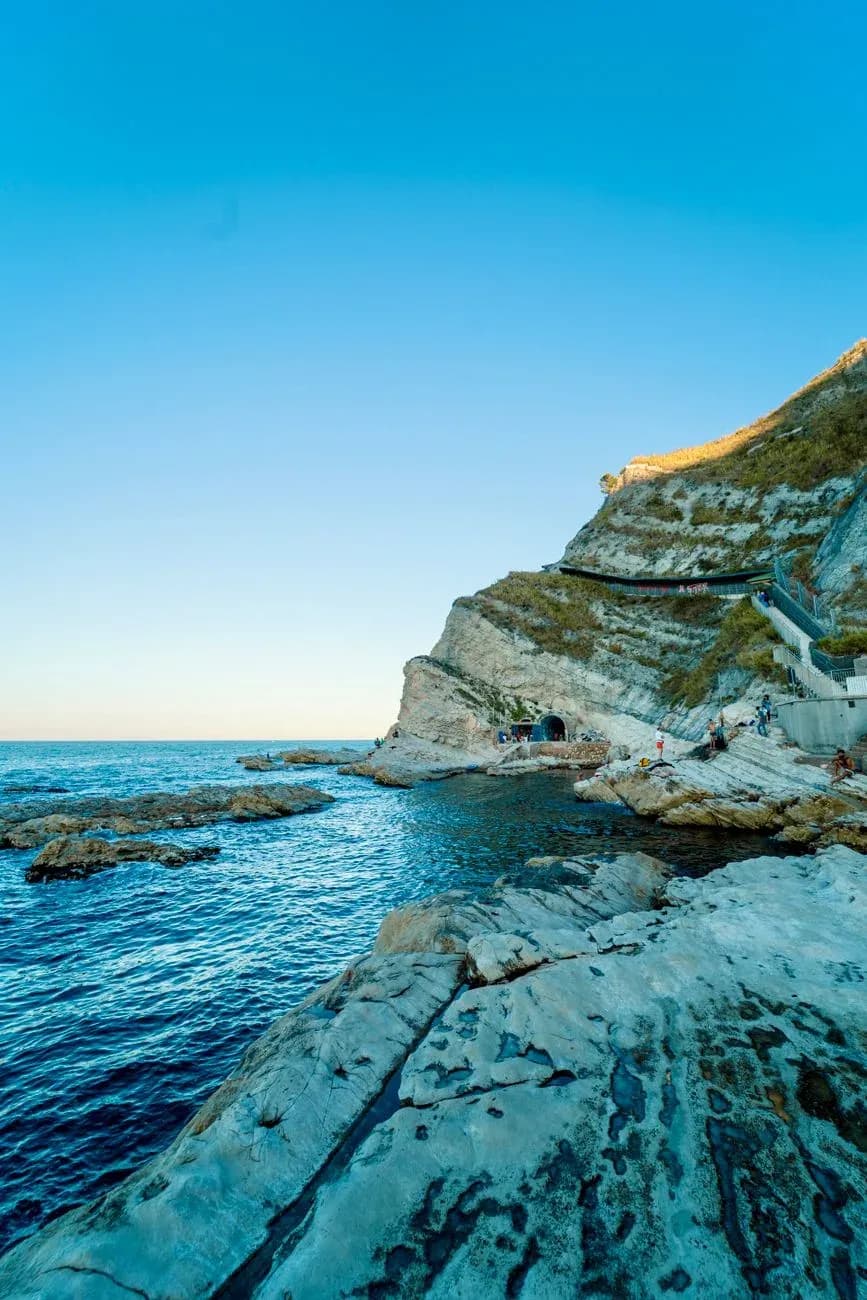
From the viewpoint, the sea opens right up before you. We decided to walk down to the Grotte del Passetto e Scalinata. These are old fishermen's shelters carved into the rock face, fitted with colourful wooden doors. The children had a blast counting the steps of the monumental staircase. Going back up, however, was a different story. We opted for the panoramic lift, which luckily was running.
Before heading home in the late afternoon, we retrieved the car from a multi-storey near the station and drove to Baia di Portonovo e Lago Grande, twenty minutes from the centre. The beach is made of smooth white pebbles. It was a little hectic due to the limited parking, but we managed a short walk to the Chiesa di Santa Maria di Portonovo, a small Romanesque church nestled between the greenery and the beach. A perfect finish to an imperfect, tiring weekend, lived entirely at our own pace.