

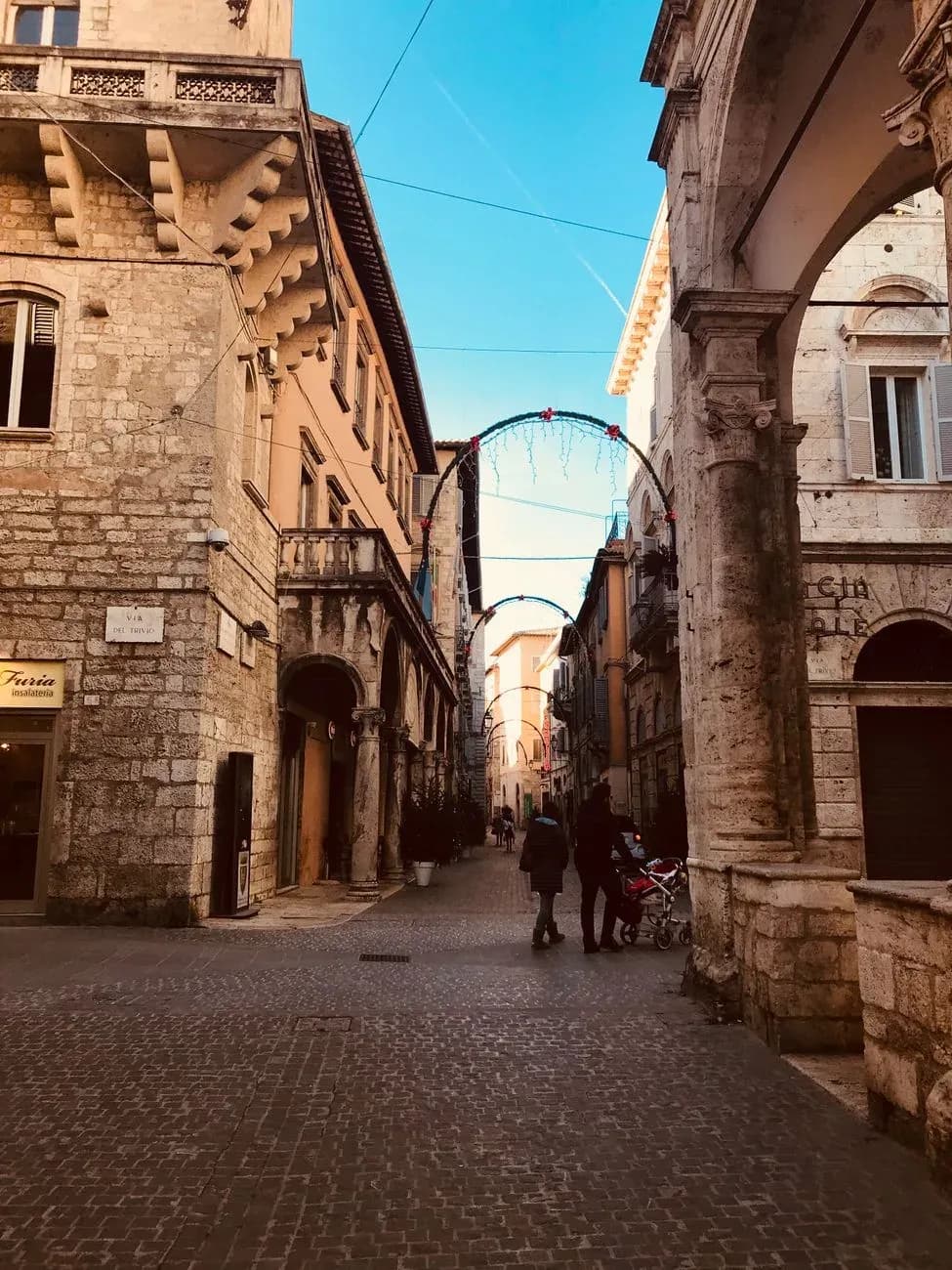
The historic centre of Ascoli Piceno is compact and entirely flat, making it easy to explore on foot with minimal effort. Most of the architecture and squares are built from travertine, the local pale limestone that defines the entire city's look.
The best times to visit are spring, between April and June, and autumn, from September to October, to make the most of the mild weather. In the summer months of July and August temperatures climb, though you can watch the historical Quintana joust or head for the coast. In winter, the main draw shifts to the nearby ski slopes.
For well-located places to stay, Di Sabatino Resort and Albergo Sant'Emidio let you step out in the evening just moments from the main squares and bars.
The Four-Day Itinerary
Day 1 — Monumental Architecture and the Loggia
Morning
Start out in Piazza del Popolo, regarded as the city's open-air drawing room and framed on all sides by travertine buildings. Overlooking the paving stones is Palazzo dei Capitani del Popolo, a 14th-century civic building with a bell tower and a Renaissance courtyard; you will need about 45 minutes to tour the interior. A short walk away stands Chiesa di San Francesco, a massive Gothic Franciscan church. Allow between 30 and 40 minutes to visit the building, its Chiostro Maggiore and the adjacent Loggia dei Mercanti.
Afternoon
Heading away from the centre towards the river Tronto, walk down to Rua delle Stelle, an ancient medieval walkway, locally known as le Rive, that traces the line of the old city walls. Heading back up towards the town, you will come across Chiesa dei Santi Vincenzo e Anastasio, famous for its chequered facade of 64 panels that once each held frescoes. In the late afternoon, head back to Piazza del Popolo for an outdoor table at Caffè Meletti, a historic Art Nouveau cafe dating from 1907, to sip an Anisetta con la mosca beneath the frescoed ceilings.
Evening
For dinner, stroll down Via Cesare Battisti to Osteria Il Vinattiere, recommended by Slow Food for its traditional dishes from Marche and Abruzzo paired with local wines. If you visit over a weekend, be sure to book a table in advance, as it gets very busy with tourists and locals alike.
Day 2 — Crypts, Art Galleries and Panoramas
Morning
Day two focuses on Piazza Arringo, the city's oldest monumental square, graced with travertine fountains carved with sea horses. First up is Cattedrale di Sant'Emidio e Cripta. The visit takes around 45 minutes, giving you time to admire the polyptych by Carlo Crivelli and descend into the mosaic-covered crypt holding the relics of the patron saint. Leaving the Duomo, it is just a few steps to the Battistero di San Giovanni, an octagonal Romanesque baptistery built over earlier Roman remains.
Afternoon
Stay in the square to enter Palazzo dell'Arengo, home to the Pinacoteca Civica di Palazzo dell'Arengo. The civic palace's state rooms display works by artists including Tiziano, Crivelli and Pellizza da Volpedo; allow about an hour and a half to see it all. Afterwards, take a 15-minute uphill walk from the centre up to Fortezza Pia e Colle dell'Annunziata, the highest point in the city, where you will find Roman ruins, rampart walkways and panoramic views across the rooftops.
Evening
Plan an informal, street-food-style dinner focused on fried specialities. Under the portico opposite Palazzo dei Capitani is 180 Gradi, a fry shop serving classic and truffled olive ascolane. Moving on to Piazza Arringo at number 2, round off your meal at Migliori Olive Ascolane, a historic shop serving piping-hot paper cones of DOP Piceno olives and fried cremini.
Day 3 — Archaeology and Rock-Hewn Necropolises
Morning
Start the day once again in Piazza Arringo, this time heading into Palazzo Panichi to visit the Museo Archeologico Statale. The one-hour visit provides an overview of Picene civilisation and traces the settlement's Roman development. From the museum, make your way towards the course of the Torrente Castellano to reach Forte Malatesta, a star-shaped Renaissance fortress that once guarded the river, now a museum you can tour in an hour. From there, stroll into the neighbouring district to cross Ponte Romano di Solestà e Borgo Solestà, a remarkably intact ancient bridge where you can even inspect the interior vaulting.
Afternoon
You will need the car to leave the city behind and head to Lago e Borgo di Castel Trosino. The village, of ancient origins, sits atop a limestone crag of travertine and preserves a significant Lombard necropolis. The valley below is dominated by the reservoir of the Castellano river, with several walking trails running along its shores.
Evening
Back in town, near Piazza Simonetti and Corso Trento e Trieste, sit down for dinner at Siamo Fritti. This wine bar and fry shop serves freshly prepared olive all'ascolana alongside fried cheese, served directly on wooden boards or in paper cones.
Day 4 — From Apennine Peaks to the Adriatic Coast
Morning
The morning calls for the car for drives of 25 to 40 minutes. If you opt for the mountains at the foot of the Monti Sibillini, make for Lago di Gerosa between Montemonaco and Comunanza; this mountain lake features small beaches and pine woods ideal for walking, as well as kayaking and canoeing. In winter, just 20 km from the provincial capital in the Montagna dei Fiori area, head for Stazione Sciistica Monte Piselli, renowned for winter ski runs that look out towards the sea.
Afternoon
Weather permitting, or if you prefer the coast, take the dual carriageway for a half-hour drive to the Adriatic shore. The destination is San Benedetto del Tronto e Riviera delle Palme, famed for its sweeping sandy beach and grand seaside promenade lined with palm trees.
Evening
Once back in the city, or before starting your journey home, spend the late afternoon and early evening with one last stroll over the travertine paving of Piazza del Popolo, bringing your trip to a close.
Practical Planning Tips
- The entire monumental centre is a Zona a Traffico Limitato (ZTL). The most convenient place to park is Parcheggio Saba Porta Torricella, a two-minute walk from Piazza Arringo; it is a 24-hour covered car park costing around €1 per hour or €10 for the full day. LPG vehicles are not permitted inside.
- If travelling by camper van, the secure parking area is at the former Seminario Vescovile on Viale Alcide De Gasperi, 500 metres from the historic centre and very close to Forte Malatesta, equipped with electrical hook-ups and a fresh drinking water point.
- For on-the-ground spending, excluding accommodation, allow a budget of around €40–€60 per person per day. This covers a full dinner in a trattoria for €25–€40, quick street-food lunches from paper cones for €5–€8, monument admissions at €5 each, and a coffee or a glass of wine in historic cafes.
- While you can get around the city streets on foot, you will definitely need a car to reach San Benedetto del Tronto or the surrounding mountains. Drives outside the city typically take between 25 and 40 minutes.
Where to Stay in the City
A central boutique hotel just steps from Piazza del Popolo, featuring suites and a rooftop terrace with views across the town.
View on Booking →A beautifully kept property set in a restored medieval convent, complete with an on-site wellness centre.
View on Booking →Housed in a spacious historic palazzo, this hotel sits right in the heart of Ascoli Piceno's monumental centre.
View on Booking →