
I arrived in late September to an unseasonable bout of heat. The sun was beating straight down on the dashboard and I was breaking into a cold sweat at the mere thought of accidentally tripping a ZTL camera. I despise traffic fines; they ruin my mood for weeks and drain budget I'd far rather spend in an osteria. I'd read about a handy place to leave the car near the pedestrian centre: the Saba Torricella underground car park on Via Porta Torricella. I squeezed the car between two pillars with some effort. The ticket machine jammed for a solid two minutes before finally spitting out the paper slip, but at least I was just a two-minute walk from the central square, free from any fine-induced anxiety.
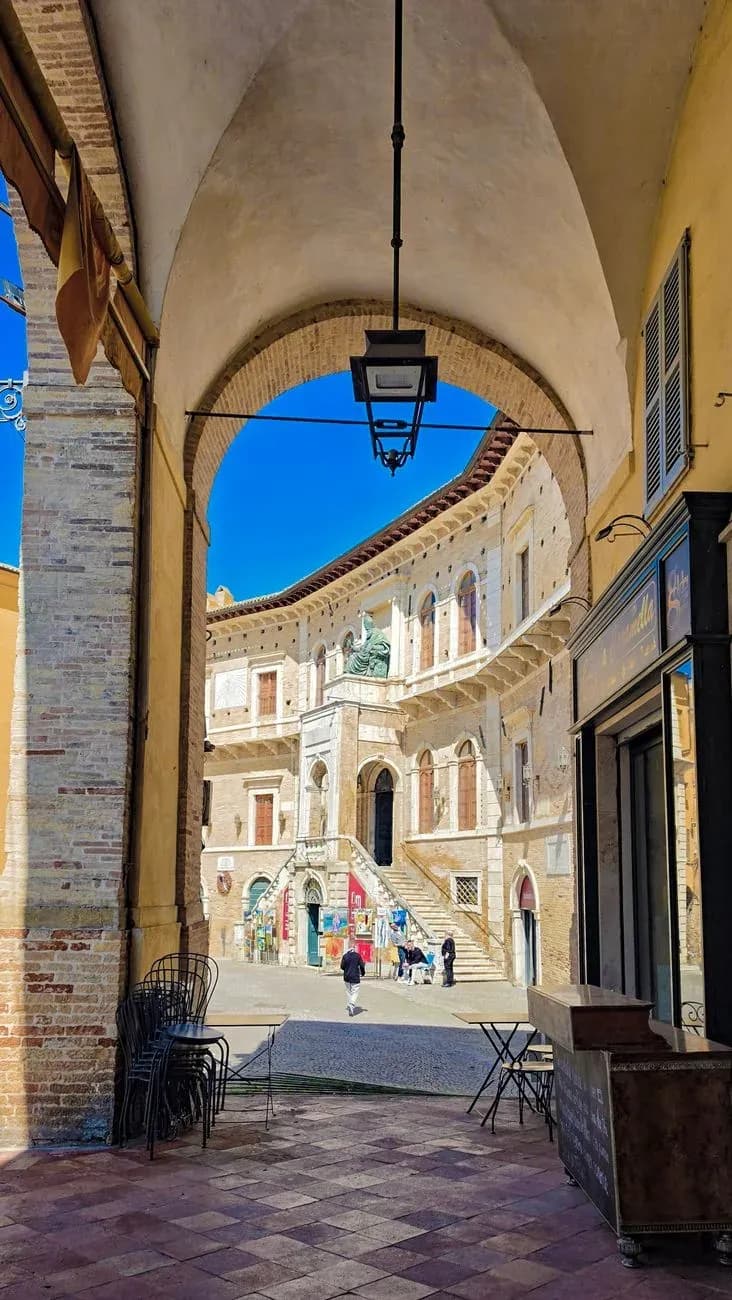
I dragged my wheelie bag over the sampietrini cobbles to B&B Il Duomo. It sits inside a historic palazzo looking straight out onto Piazza Arringo e Cattedrale di Sant'Emidio. The room had ceilings about three metres high, though the Wi-Fi only worked if I stood teetering right by the bathroom window. Never mind; I hadn't come to stare at my phone. I dropped everything and headed down. Ascoli Piceno is completely flat and cradled within a bend of the river, so it's wonderfully easy to explore on foot. Splendid news, as I had no intention of getting back behind the wheel anytime soon.
The first thing that hits you as you step outside is the glare. All that travertine reflects the light so intensely it's almost blinding. There were very few people in Piazza Arringo e Cattedrale di Sant'Emidio. I had a quick look at the Duomo, the crypt containing the patron saint's relics and the Battistero di San Giovanni. The square is the city's oldest, but hunger soon got the better of my interest in history. I'm not one for posh sit-down lunches. I wanted substance, reasonable prices and zero fuss. I walked straight over to Migliori Olive, just a stone's throw away, and ordered a piping-hot paper cone to go. I made sure to ask for the authentic oliva ascolana del Piceno DOP—the real deal made with spiral-pitted ascolana tenera olives stuffed with a three-meat filling—paired with sweet fried cremini. It cost me just a few euros; I scalded the roof of my mouth on the first bite because I was in such a rush, but it was worth every single cent. Perched on a low wall with greasy fingers, I was in absolute heaven.
Nibbling away, I strolled over to Piazza del Popolo. Everyone calls it the city's living room, and it's true that the vista across those broad travertine slabs makes quite an impression. But honestly? I found the Palazzo dei Capitani del Popolo overrated. Or rather, the fourteenth-century structure with its bell tower and Renaissance courtyard looks imposing from the outside, but the thought of locking myself indoors for 45 minutes to tour the interior didn't tempt me in the slightest. I'd rather be out in the open air. I sat down on the steps by the Chiesa di San Francesco e Chiostro Maggiore. I took in the lines of the Franciscan Gothic church, had a glance at the Loggia dei Mercanti and the cloister, and in barely half an hour I'd seen everything I wanted to see, entirely at my own pace.
Towards the end of the day, I wanted to try the famous aperitivo. Every guidebook points you towards Caffè Meletti. It's a historic Liberty-style venue, very elegant. Too elegant, really. Stiff waiters, immaculate tables out on the terrace, and tourists snapping photos of their drinks from every possible angle. I sat down feeling distinctly out of place in my dusty shoes. I ordered the traditional Anisetta with the "fly"—a single roasted coffee bean floating in it. Was it good? Yes. Would I go back? No. I loathe places where people go to be seen rather than to enjoy a drink in peace.
The next morning, boots on. I wanted to get away from the centre. I'd laced up my walking boots with deep, grippy treads—an essential detail for what I had in mind. I hopped in the car and took fifteen minutes to drive up towards Colle San Marco. The air was fresher; chestnut woods all around. I started hiking along the Sentiero della Memoria e Colle San Marco. Among the dry-stone caciare huts, the 'Dito del Diavolo' rock spire and the partisan Resistance memorials of the Monti della Laga, there was hardly a soul. The ground is uneven and steep in places. I carried on towards the Eremo di San Marco, setting off from the hamlet of Piagge: a forty-minute trek through the woods.
The hermitage is embedded in a sheer thirteenth-century cliff face. Reaching it means tackling a flight of stairs hewn roughly out of the travertine. Halfway up the steps, distracted by the view over the valley, I misplaced my footing. I slipped on a smooth patch of stone and landed flat on my backside with a dull thud. A half-stifled curse slipped out. An older man with a worn rucksack, a local who later introduced himself as Sergio, was heading down. He stopped, eyed my soil-stained trousers and gave a half-smile. "Look at the ground, not up in the clouds," he declared before walking on. He couldn't have been more right. The absolute silence and the cold rock against my back, once I reached the top, made up for the bruise.
Heading back down into town in the afternoon, my stomach was rumbling. I popped into Siamo Fritti on Corso Trento e Trieste for a quick bite. Pure street food, fried to order. Classic olives, fried cheese, all handed over in a brown paper bag. Eating as I walked, I wandered down towards Porta Cartara. I wanted to hear running water. The Cartiera Papale sits right beside the Castellano torrent, a complex of historic watermills that still breathes industrial heritage, complete with period machinery and a paper museum. From there I walked towards Porta Maggiore as far as Forte Malatesta, the Renaissance fortress perched right on the water.
At sunset I reached the Rua delle Stelle (Le Rive). I think it was my absolute favourite street in the whole town. It's a paved medieval walkway that hugs the defensive walls and follows the curve of the river Tronto. Barely anyone around. Zero traffic. Just the sound of water and the cooling evening air. I followed it right to the Ponte Romano di Solestà, in Borgo Solestà: a colossal arch spanning the river, remarkably intact and still open to traffic.
For dinner, I settled in at Vinattiere Osteria con Cucina on Via Cesare Battisti. Listed by Slow Food, it serves traditional dishes from Marche and Abruzzo. The table had a bit of a wobble, the dishes were hearty and unpretentious. The waiter didn't bother with fake smiles; he brought my wine and left me to eat in peace. Exactly my kind of place.
On the third day, I decided on a proper hill walk without touching the car: a good three hours of urban trekking on foot. I climbed up to the Colle dell'Annunziata e Parco della Fortezza. Roman ruins and the Fortezza Pia. The climb works up a sweat, but from up there you can truly understand how the city was laid out. Dead tired by lunchtime, I headed to BoccaScena on Via del Trivio, right opposite Teatro Ventidio Basso. They serve home-style pasta dishes and olives made from a family recipe handed down through decades.
In the afternoon, I took the car out towards the Valle del Castellano to see the Borgo di Castel Trosino. It's a fortified medieval village clinging precariously to a travertine crag, renowned for its Lombard necropolis. Dead silence, a biting wind, and cats dozing on stone walls. Not a single souvenir shop in sight.
I dedicated the fourth day to exploring further afield in the Ascoli hinterland. A 25-minute drive brought me to the Borgo di Offida. They have this vast fourteenth-century church, Santa Maria della Rocca, perched right on the edge of a cliff. Elderly women were sitting out by their front doors working on bobbin lace, a craft that requires a level of patience I won't possess in three lifetimes. Afterwards, I drove for another thirty minutes or so towards the Riviera delle Palme; I wanted to see the Adriatic before heading home.
I arrived in Grottammare Alta. It's a medieval coastal village with terracotta-paved alleys and a watchtower along the ramparts. The sea below was a steely grey, a brisk wind was blowing, and the parking meter demanded €1.50 per hour, strictly in coins. Naturally, I only had notes and a credit card. I had to wrangle with the owner of a nearby tabaccheria who refused to give me change unless I bought something. I ended up buying a pointless packet of mints just to get some small change.
Before hopping back onto the motorway for the journey home, I swung through Ascoli's centre one last time. I stopped by Lorenz Cafè under the porticoes and had them pack up a box of handmade, uncooked olive all'ascolana to fry at home. A rugged trip, hard on the knees, but thoroughly authentic. Just the way I like it.