

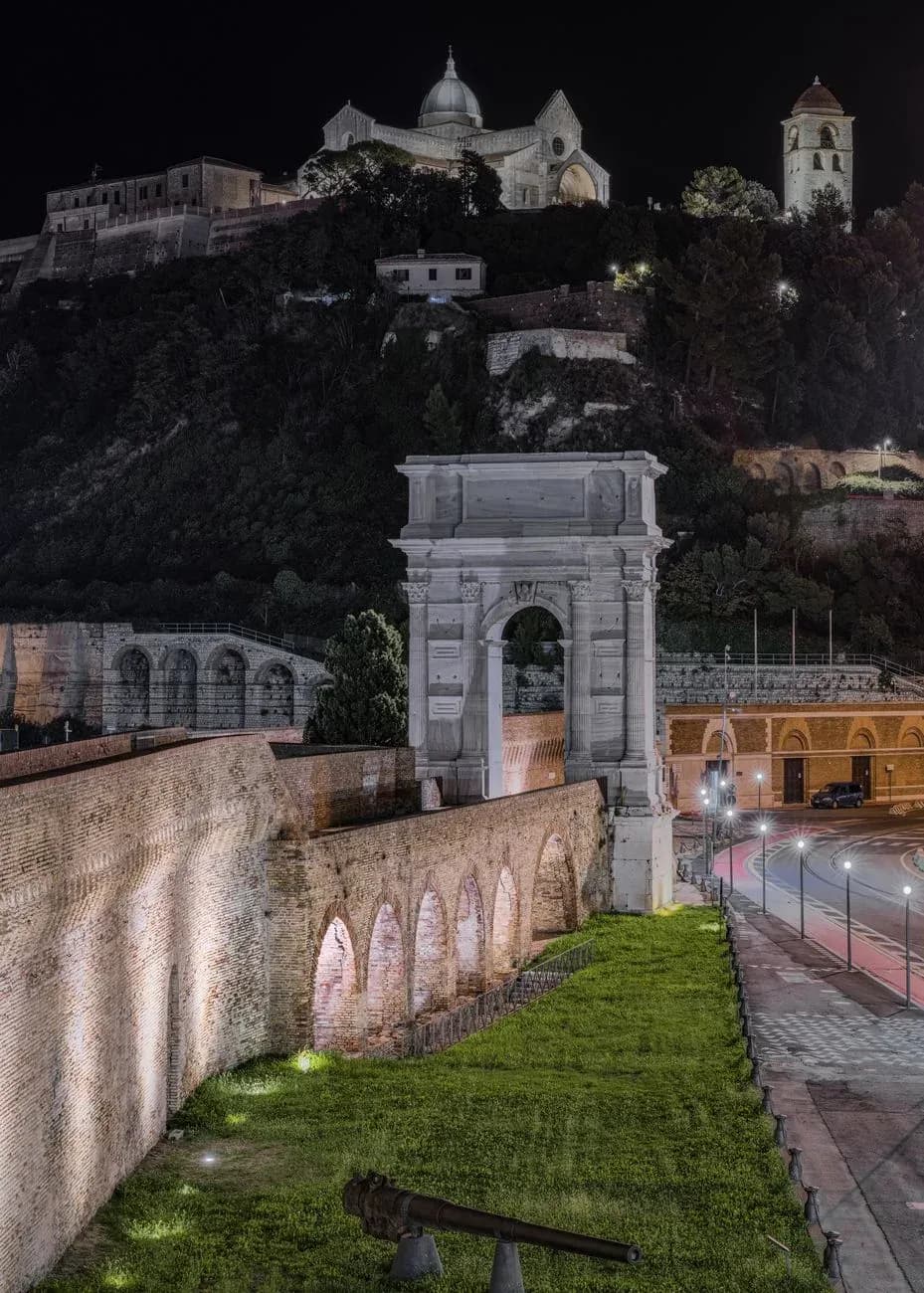
The Adriatic coast of Marche changes dramatically as it meets the Conero promontory. Flat sandy beaches give way to sheer cliffs plunging into the sea, white limestone, and woods stretching almost down to the water. Exploring Ancona and the Riviera del Conero takes a little logistical planning: the historic centre is walkable, though it features steep climbs and flights of steps. To reach the beaches, coves, and nearby coastal villages you will need your own vehicle, with drives averaging twenty to thirty minutes, though seasonal shuttles and local buses run in summer.
Spring and early autumn, especially May, June, September, and October, offer the most pleasant weather for a trip here. Temperatures are ideal for tackling trails over the promontory and strolling through the city without the oppressive summer heat, while coastal tourist traffic is kept to a minimum.
The urban area is split between the port, historic piazzas, and surrounding hills, while just outside lies a network of woodland trails and small seaside villages. Staying close to the harbour, at places like the Grand Hotel Palace or the SeePort Hotel, allows you to start your days exploring the oldest quarter on foot before heading south.
How to plan your four days
Day 1 — The port and the city hills
Morning
Start the day in the Porto Antico area, dominated by the Mole Vanvitelliana. This grand pentagonal building, also known as the Lazzaretto, was designed in the 18th century by Vanvitelli to isolate quarantined goods and crews. Today its interior hosts exhibitions and the Museo Tattile Statale Omero, a multisensory museum where sculptures and scale models of architectural masterpieces are meant to be explored purely through touch. Walking north along the quays, you will come across the Arco di Traiano, a Turkish marble arch erected in 115 AD to honour the emperor who expanded the port basin.
Afternoon
Heading up on foot towards the historic centre, you will immediately notice the steep gradient of the streets. Tucked among the alleys stands the Chiesa di Santa Maria della Piazza, an 11th- and 12th-century church with a facade rich in bas-reliefs; beneath the floor lie the remains and mosaics of an earlier palaeo-Christian place of worship. The uphill walk continues towards Colle Guasco to reach the Cattedrale di San Ciriaco, the city's Romanesque-Byzantine cathedral perched on high ground. Allow around forty-five minutes to visit the interior and admire the views: the square in front overlooks the entire gulf and is especially striking at sunset.
Evening
Evening life centres on Piazza del Plebiscito, known locally as Piazza del Papa thanks to the statue dedicated to Clemente XII. It is laid out across stepped terraces, framed by the flight of stairs leading to the Chiesa di San Domenico. Dine here at Trattoria La Moretta, open since 1897 at number 52, a historic spot to sample brodetto all'anconetana or stoccafisso.
Day 2 — From the hill to the fishermen's caves
Morning
The city's parks follow the contours of the hills. Parco del Cardeto, stretching between Colle dei Cappuccini and Colle Guasco, is a vast green space perched high above the water, taking in the ruins of historic military fortifications, the silhouette of the 19th-century old lighthouse, and the grounds of the ancient Campo degli Ebrei. Heading east towards the Rione Passetto, the coastline turns even more rugged. Here stands the Monumento ai Caduti e Pineta del Passetto, a circular Istrian-stone monument set in pine woods, designed for a scenic walk with sweeping views of the Adriatic Sea.
Afternoon
Below the monument lies a unique coastal landscape. Follow the steep stairways down, or take the municipal lift, to reach sea level and explore the Grotte del Passetto. These are not natural caverns, but historic shelters for boats and fishing gear carved straight into the cliff face by local residents. Brightly painted wooden doors seal the entrances just metres from the tide line, creating an atmospheric settlement tracing the base of the rock.
Evening
Staying in the neighbourhood for dinner, you can head to Ristorante Il Giardino at Via Fabio Filzi 2. In business for decades, it is renowned throughout the city for serving stoccafisso prepared in strict accordance with local tradition.
Day 3 — Promontory trails and seaside villages
Morning
Leave Ancona behind to explore the protected nature reserve to the south. Park the car and join Sentiero 302 for the Trekking al Passo del Lupo. The route takes two to three hours return, winding along the flanks of the promontory. Sturdy hiking shoes, plenty of water, and a hat are essential, as many limestone stretches are fully exposed to the sun with no drinking fountains. The path ends at a high vantage point looking straight down on the sea stacks of Le Due Sorelle and the beach below.
Afternoon
After the hike, drive south towards Borgo di Numana Alta e La Costarella, a historic fishermen's quarter characterised by a long, steep flight of steps bordered by flowering pots, linking the upper village to the small harbour. Just to the north lies the Borgo medievale di Sirolo, perched high on the cliff edge. Its narrow lanes open into a wide piazza gazing out over the water, perfect for a break before dinner as the afternoon light softens across the Adriatic coast.
Evening
Heading back towards Ancona's outer quarters, stop for dinner at Trattoria Da Nordio in Via Mamiani, near Piano San Lazzaro. It is a genuine neighbourhood osteria serving hearty portions of home-style cooking based on the day's catch and classic local seafood recipes.
Day 4 — Natural bays and sandstone labyrinths
Morning
The final day is dedicated to the area around Portonovo, a sheltered bay nestled beneath Monte Conero. The natural setting of Baia di Portonovo combines bright white pebble beaches, brackish coastal pools fringed with greenery, and crystal-clear waters. It is well worth spending at least half a day here. Walking along the shore, you will reach the Chiesa di Santa Maria di Portonovo, a Romanesque church set mere metres from the waves, whose secluded position was famously mentioned by Dante. It is best visited in the morning.
Afternoon
Head inland to explore the Grotte di Camerano (Città Sotterranea). This extensive underground network winds beneath the town, forming a maze of corridors and chambers carved out of the sandstone, some decorated with friezes and religious high-reliefs. Independent visits are not permitted: the guided tour lasts around an hour and a half, and booking your tickets in advance is mandatory, especially at weekends or on public holidays.
Evening
For your final dinner, head to Osteria La Bottega di Pinocchio, in the Ancona neighbourhood of the same name at Via Pinocchio 48. The kitchen serves substantial dishes such as marinated anchovies paired with pacasassi—a wild herb harvested from the coastal cliffs—spaghetti with sardines, and the quintessential stoccafisso with potatoes.
Practical travel tips
- If you plan to hike the peaks of Parco del Conero, such as Sentiero 301 or the Anello di Portonovo, you must bring proper walking boots with good grip, plenty of drinking water, and a hat, as much of the limestone trail offers neither shade nor water fountains.
- Along the Passo del Lupo trail, local authorities strictly prohibit descending to the beach of Le Due Sorelle due to the danger of rockfalls. The beach can only be reached from the water, by taking the small shuttle boats that run from the pier in Numana.
- City traffic in the provincial capital is restricted by ZTL zones, and street parking is almost entirely metered. It is best to leave your car in the large multi-storey car parks—Stamira, Traiano, or Cialdini—for easy access to the historic centre, or look for free street bays near Passetto and Cardeto.
- Access to the Grotte di Camerano is strictly capacity-controlled and only possible on guided tours. Be sure to book your slots before your trip to avoid finding all time slots fully booked.
- Factoring in entry tickets to cultural sites and meals of local seafood or stoccafisso, expect an average on-the-ground budget of €45 to €65 per person per day, excluding accommodation.
Where to stay: hotels near the itinerary stops
A four-star hotel set within a period palazzo, overlooking the quays of the historic port.
View on Booking →A former abbey perched atop the mountain, surrounded by woods and well away from towns.
View on Booking →A practical spot near the Ancona Sud motorway exit, convenient for visiting the underground tunnels and nearby villages.
View on Booking →