

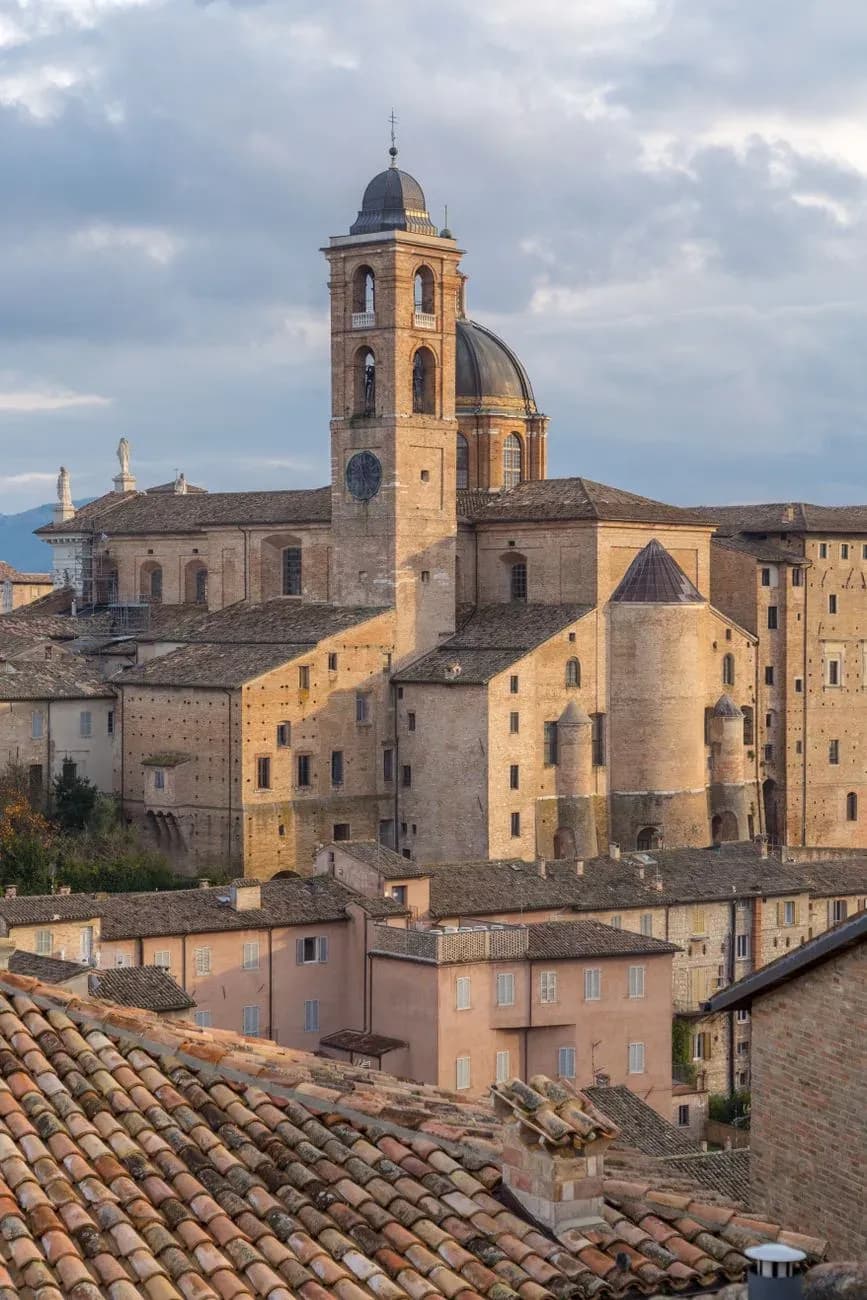
The Marche region offers landscapes that change dramatically within just a few dozen kilometres. This four-day itinerary requires a car: there are no fast, direct rail connections between the inland valleys and the coast, and journeys between stops often exceed an hour of driving through the hills.
The best months to set off are May, June, and September. During these periods, the temperatures allow you to tackle mountain trails and enjoy the Adriatic beaches without dealing with the heavy traffic and chronic parking shortages typical of July and August.
How to plan your journey
Day 1 — From Urbino to the Gola del Furlo
Morning
The route starts in the historic centre of Urbino with a visit to the Palazzo Ducale e Galleria Nazionale delle Marche, a Renaissance masterpiece commissioned by Federico da Montefeltro. The visit takes around two to three hours. It is open from Tuesday to Sunday between 8:30 and 19:15, and during peak periods it is best to book tickets in advance. Just a short walk away, on Via Raffaello, stands the Casa Natale di Raffaello. Visiting this 15th-century residence takes about 45 minutes (open daily 10:00–13:00 and 15:00–19:00). Round off the morning at the Oratorio di San Giovanni Battista to admire the late-Gothic fresco cycle by the Salimbeni brothers; allow 30 minutes for a quick visit, bearing in mind the split opening hours on weekdays and holidays.
Afternoon
Moving on towards Acqualagna and Fermignano, the late afternoon brings ideal weather to explore the Riserva Naturale Statale Gola del Furlo. The canyon was carved out by the Candigliano river. You can opt for the flat pedestrian pathway, which takes an hour and a half, or take on the hike up to the Terrazza del Furlo, which requires between three and a half and five hours in total.
Evening
Head back into the Montefeltro hills in Urbino for dinner. Ristorante Ponente c/o Aura Relais serves a refined menu rooted entirely in local Marche produce.
Day 2 — Genga and the water trails
Morning
From Urbino, drive for about an hour and a quarter towards Genga. Making the most of the morning light, walk up to the Tempio del Valadier ed Eremo di Santa Maria Infra Saxa. This neoclassical sanctuary with an octagonal plan is reached on foot in 30 minutes via a steep, 700-metre paved path. Next, head to the car park for the Grotte di Frasassi. The guided tour of this subterranean karst complex takes 75 minutes at a constant temperature of 14 degrees.
Afternoon
At the entrance to the gorge stands the Abbazia di San Vittore delle Chiuse, an 11th-century Romanesque Greek-cross church with free admission that is well worth a 30-to-45-minute stop. From here, drive towards Pioraco to follow the Sentiero de Li Vurgacci. Set along wooden walkways at the foot of the Appennino, this 90-minute trail skirts the waterfalls, ravines, and whirlpools carved by the Potenza river.
Evening
The area around Genga and Pioraco offers a chance to rest before the next leg. Given the driving times across the inland region, it is best to have dinner at a local spot and then head towards the Macerata area ahead of the following morning.
Day 3 — The Monti Sibillini
Morning
Driving from Frasassi towards the Fiastra area (another hour and a quarter by car), you enter the Monti Sibillini territory. The Sentiero delle Lame Rosse sets off from the dam at Lago di Fiastra. The hike to the red gravel pinnacles and canyon takes around two and a half to three hours (6.5–7 kilometres return) and should be tackled early in the morning to avoid the summer heat. Once finished, stop in San Lorenzo al Lago at Osteria del Lago, a small restaurant with a veranda specialising in game and truffles.
Afternoon
Spend the early afternoon relaxing by Lago di Fiastra. Along the equipped shores, you can hire canoes or stroll beside the turquoise mountain reservoir. Afterwards, head to Sarnano to explore the Borgo medievale di Sarnano. Allow half a day to wander through the alleyways of this walled brick village built in concentric rings, which offers direct views of the Monti Azzurri.
Evening
Head up to Sassotetto for dinner. Baita Solaria is a mountain retreat focusing on cured meats, local cuts, and traditional Appennino dishes.
Day 4 — The Riviera del Conero
Morning
From the Fiastra area, drive for about an hour and ten minutes towards the Ancona coast. Start the morning in Portonovo with a walk along the white pebbles of the Baia di Portonovo e Chiesetta di Santa Maria, a Romanesque building set right on the water's edge. Stay on the beach for lunch at Ristorante Emilia, a historic family-run spot renowned for wild moscioli mussels and seafood pasta.
Afternoon
In Sirolo, choose between two options. Spiaggia Urbani is a crescent-shaped cove sheltered by cliffs and featuring a natural cave, ideal for a two-to-three-hour break and reachable by shuttle buses from the town centre in summer. Alternatively, head to the Spiaggia delle Due Sorelle, framed by twin sea stacks and accessible only by sea.
Evening
Your final stop is the Borgo e Terrazza Panoramica di Sirolo. Perched on Monte Conero, this square offers the best view at sunset before a stroll through the historic centre. Dine at Ristorante Da Silvio, a historic restaurant overlooking the Riviera, famed for its seafood cuisine and fresh Adriatic catch.
Top tips for your trip
- A car is essential: the journeys from Urbino to Frasassi, Frasassi to Fiastra, and Fiastra to Sirolo each take over an hour of driving through valleys that have no direct rail links.
- Entry to the Grotte di Frasassi requires booking tickets online in advance. Arrive at the shuttle bus car park at least thirty minutes before your booked time slot.
- The overland trail via 'Passo del Lupo' to Spiaggia delle Due Sorelle is closed due to landslide risk. The only way to get there is by sea via canoe, boat, or ferry, with advance booking required in summer.
- Sturdy hiking shoes are essential for the Sentiero delle Lame Rosse to safely navigate the slippery final scree slope. There are no drinking fountains along the route, so carry plenty of water.
Where to stay
Adults-only property featuring a panoramic pool overlooking the Montefeltro hills and a spa for unwinding.
View on Booking →Historic residence with a wellness centre and stone vaults, just 200 metres from Palazzo Ducale.
View on Booking →Albergo diffuso at the foot of the mountains, ideal as a base for hiking excursions in the Appennino.
View on Booking →