

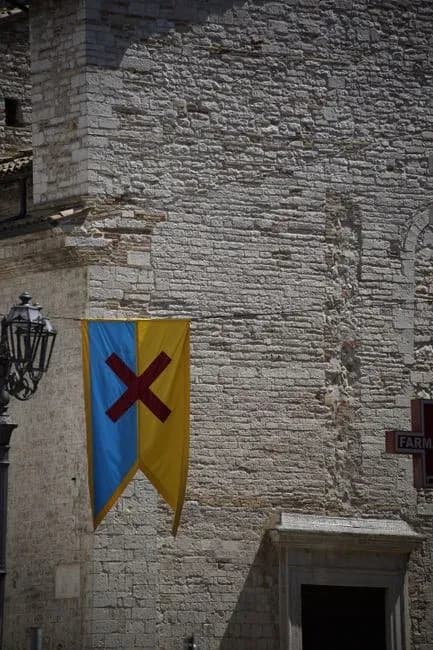
Reaching and exploring Urbino calls for careful planning to avoid wearing yourself out. The town itself—an entirely pedestrianised or limited-traffic historic centre—is shaped by steep stone-paved climbs and descents, known locally as 'le piole', often interspersed with flights of steps. To make your way through the alleys, flat shoes with non-slip rubber soles are essential, and it is best to leave heavy or cumbersome wheeled luggage at home.
If you are travelling by public transport, keep in mind that there is no active passenger railway station. You will need to take a train to the stations of Pesaro or Fano, and then catch an intercity bus that takes around 45–50 minutes to reach the terminus at Borgo Mercatale, right at the foot of the town walls. Those arriving by car or camper van also use this very hub as their main access point and car park before beginning the walk up into the historic heart.
A Three-Day Itinerary to Optimise Your Visits
Day 1 — From Mercatale to Palazzo Ducale
Morning
Your day begins at Borgo Mercatale, where you can tackle the climb up to Piazza Rinascimento effortlessly by using the Rampa Elicoidale e Data. This ingenious piece of Renaissance engineering, designed by Francesco di Giorgio Martini, originally allowed pedestrians and horses to reach the upper parts of the city. Once at the top, dedicate your first block of time to Palazzo Ducale e Galleria Nazionale delle Marche, an architectural masterpiece commissioned by Federico da Montefeltro. Inside, world-class works are on display, including paintings by Piero della Francesca and Raffaello. You will need about 2–3 hours inside; bear in mind that on standard Mondays the venue runs reduced hours or closes in the afternoon, and over bank holiday weekends or peak-season weekends it is well worth booking a timed-entry ticket online to avoid getting stuck at the ticket desk. Right next door stands the Cattedrale di Santa Maria Assunta (Duomo di Urbino), rebuilt in neoclassical style by Giuseppe Valadier following an earthquake in the late 18th century.
Afternoon
After visiting the cathedral's main floor, head down into the crypt to explore the Oratorio della Grotta, an underground complex beneath the Duomo housing four chapels, best known for the marble Pietà sculpted by Girolamo Campagna. For a quick break, right opposite the Duomo on Via Puccinotti, Osteria km 0 is great for trying traditional crescia sfogliata, prepared with locally sourced ingredients. Once refreshed, make your way towards Via Raffaello to visit Casa Natale di Raffaello. This is the 15th-century house where the painter spent his youth, and you can still admire frescoes produced by his father's workshop. You only need to set aside about 45 minutes for this visit.
Evening
For dinner on your first evening, head to Via Cesare Battisti and La Trattoria del Leone, a traditional spot tucked among the old streets that focuses on regional dishes from Montefeltro, with a fine selection of fresh local pasta. If you are staying right in the centre, perhaps in a historic property like Hotel San Domenico, you can easily stroll back on foot.
Day 2 — Through Alleys, Oratories, and Viewpoints
Morning
Begin your second day on the western side, passing under the imposing 17th-century arch of Porta Valbona. This marks the start of Corso Garibaldi, the main thoroughfare leading into town. From here, make your way towards Via Barocci to explore two neighbouring religious sites. The first is the Oratorio di San Giovanni Battista, where you will want around 30–40 minutes to take in the Late Gothic fresco cycle by brothers Lorenzo and Jacopo Salimbeni, focusing on the Crucifixion and the life of Saint John the Baptist. Just a few metres away lies the Oratorio di San Giuseppe, home to a remarkable 16th-century life-sized stucco Nativity scene, sculpted by Federico Brandani.
Afternoon
Stay on the central Corso for lunch at Osteria Gula, a welcoming spot dedicated to the cuisine of Marche, ideal for platters of cured meats, cheeses, and truffle-topped pasta dishes. In the afternoon, as you head back towards Piazza Rinascimento, stop by the Chiesa di San Domenico. Its Gothic facade is graced by a Renaissance-style portal crowned with a distinctive glazed terracotta lunette by Luca della Robbia.
Evening
Before night falls, make your way up to the panoramic viewpoint on Monte San Sergio. Here you will find the Fortezza Albornoz e Parco della Resistenza, a stronghold built in the 14th century. At sunset, the terrace offers the most sweeping view across the entire historic centre, especially of the twin-turreted facade of Palazzo Ducale. To round off the day, book dinner at Antica Osteria da la Stella on Via Santa Margherita: set inside a 15th-century palazzo, it serves local recipes such as passatelli with truffle and Casciotta d'Urbino cheese.
Day 3 — Beyond the Centre: Fortresses and Nature Reserves
Morning
Your final day requires a car to explore the neighbouring municipalities. A 20–25-minute drive brings you to the Riserva Naturale Statale Gola del Furlo e Lago del Furlo, set between the territories of Fermignano and Urbino. The natural gorge carved by the Candigliano river stretches between Monte Paganuccio and Monte Pietralata. Here you can walk along the path of the ancient Via Flaminia as far as the Roman tunnel built by Vespasian, before taking a break along the banks of the reservoir.
Afternoon
Depending on your interests, the afternoon offers two alternative detours about 20 minutes away. The first takes you to Urbania, once known as Castel Durante, to visit the Palazzo Ducale e Ponte del Riscatto di Urbania, a complex built along the Metauro river that served as a second hunting lodge for the dukes of Montefeltro. The second option heads north towards the Rocca Demaniale di Gradara, the medieval fortress where Dante set the tragic tale of Paolo and Francesca—accessible with the combined ticket if you purchased it on your first day.
Evening
Back in Urbino, stop for the final meal of your weekend at Taverna degli Artisti on Via Donato Bramante. The setting is rustic, with heavy frescoed vaults overhead, and the menu combines pizza with casual Marche specialities. Hotels such as Hotel Bonconte are just a short walk away to wrap up your evening.
Practical Tips for Planning Your Weekend
- If arriving by car or camper van, the most convenient option is the large car park at Borgo Mercatale at the foot of the town, where you will find both the lifts and the pedestrian ramp. In high season, however, spaces fill up quickly; camper van drivers should also double-check vehicle length, as bays are marked for standard cars.
- If you plan to visit Palazzo Ducale in the middle of the morning during public holidays, spring long weekends (April and May), or busy peak weekends, we strongly recommend booking a timed-entry ticket online in advance to avoid queuing outside.
- If you want to cast your net wider and take in the surrounding fortifications, it is worth knowing that a combined ticket covers both the Galleria Nazionale delle Marche (Palazzo Ducale) and the Rocca di Gradara: it costs €16 and remains valid for 5 days from the date of issue.
- To avoid unnecessary strain on the uphill cobblestones, keep hard-shell suitcases with small wheels to a minimum, and stick to backpacks or soft bags that won't get in your way as you tackle the steps throughout the pedestrianised town.
Where to Stay in the City
A comfortable base set in a 14th-century former convent looking straight out over Palazzo Ducale.
View on Booking →A modern hotel with panoramic views and a wellness centre to unwind in at the end of the day.
View on Booking →A four-star hotel set within the ancient walls, just a short walk from the main sights.
View on Booking →