

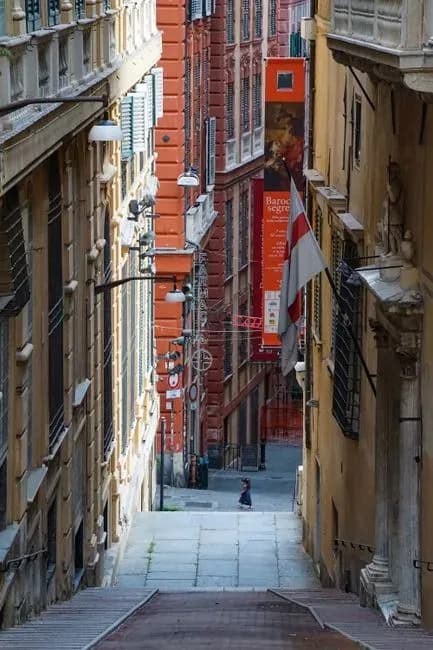
The best way to take in Genova is to watch it rise vertically, from the harbour quays right up to the hills guarded by seventeenth-century ramparts. Flat ground is virtually non-existent, and neighbourhoods tumble over one another in a dense web of steps, hidden squares, and brick-paved creuze. The ideal months to tackle this continuous climb, without facing the intense summer heat, are spring and early autumn, when the weather lets you walk for hours through the alleys and along the ridges.
The old town and the harbour area can only be explored on foot. The caruggi, narrow and often cloaked in shade, leave no room for traffic, setting a slow, deliberate pace. To reach the terraces and residential quarters up in the hills, make use of the public vertical lifts and funiculars instead; they form an integral part of the city's transport network and allow you to cut straight up entire hillsides in minutes.
How to plan three days in the city
Day 1 — Noble palaces, towers, and warm focaccia
Morning
Your first taste of the city begins on Via Garibaldi, a Renaissance street designated a UNESCO World Heritage site. The entire thoroughfare is framed by the Palazzi dei Rolli, the historic noble residences that once hosted visiting dignitaries on state visits. Exploring the street's primary landmarks, which notably include Palazzo Rosso, Palazzo Bianco, and Palazzo Doria-Tursi, takes a good half day. Towards lunchtime, head down into the neighbouring alleys to find Panificio e Grissineria Claretta on Via della Posta Vecchia: an artisan bakery celebrated locally for its classic Genoese focaccia.
Afternoon
In the afternoon, continue into the heart of the historic centre to reach the Cattedrale di San Lorenzo. Its Gothic façade of alternating black and white bands opens onto an interior that houses an unexploded shell from the 1941 bombardments along the right aisle. During your visit, you can climb the towers on foot to reach the panoramic loggia for sweeping views over the slate rooftops. Once outside the cathedral, a short stroll brings you to the Art Nouveau lift, Castelletto Levante, which whisks you up to Spianata Castelletto, a terrace suspended above the city with a complete panorama of the houses and harbour cranes.
Evening
Stay within the central alleys for dinner and seek out a table at Antica Trattoria Sa' Pesta. This historic shop and trattoria, with roots tracing back to the nineteenth century, focuses its menu on traditional Genoese home cooking: specialities include savoury vegetable pies with prescinsêua and farinata, baked directly in heavy copper pans inside the wood-fired oven.
Day 2 — Maritime history and sunset colours
Morning
The morning of day two is dedicated entirely to the Porto Antico area. Your first stop is the Acquario di Genova, the largest facility of its kind in Europe, housing over 12,000 marine animals. Walking through the exhibits takes around two to three hours. Given the heavy footfall, book a timed-entry ticket online in advance to ensure swift access to the tanks. For a quick bite before your next stop, head into the caruggi just behind the port to Focaccia e Dintorni, a bakery renowned for its Ligurian fügassa and freshly baked slices of farinata straight from the oven.
Afternoon
Staying along the quays, spend the early afternoon at the Galata Museo del Mare e Sommergibile Nazario Sauro. This interactive museum documents maritime history and waves of Italian emigration. The visit, which lasts around two hours, also includes access to a real submarine moored in the basin outside. Here too, booking your ticket online in advance is wise. In the late afternoon, make your way towards the neighbourhood of Albaro to visit Boccadasse, an old fishing village clustered around a pebble beach and pastel-hued houses, perfect for a stroll and an evening aperitivo.
Evening
After your stop in Boccadasse, return towards the Molo district for dinner. Antica Osteria di Vico Palla, open since the seventeenth century, serves mixed fried seafood, pasta with Ligurian pesto, and classic stoccafisso accomodato. Space is very tight, so it is essential to secure a table by contacting the restaurant at least one or two days in advance.
Day 3 — Ridge-top fortresses and coastal cliffs
Morning
Your third day kicks off at Largo Zecca, where you catch the historic Funicolare Zecca-Righi. This funicular railway climbs steeply to the Righi hill, the natural starting point for exploring the heights. From here begins the trail through the Parco Urbano delle Mura e Anello dei Forti, a scenic hiking route running alongside the seventeenth-century Mura Nuove. The full loop, which takes an average of three to four hours on foot, links several military strongholds: Forte Sperone, Forte Begato, Forte Puin, and Forte Diamante.
Afternoon
Back in town, stop for lunch before crossing to the other side of the city at Locanda Tortuga on Via di Ravecca, a trattoria serving fresh Ligurian pasta dishes, mortar-ground artisan pesto, and melted focaccia al formaggio prepared Recco-style. Immediately afterwards, head towards the eastern edge of the city to the Nervi district to walk the Passeggiata Anita Garibaldi. This pedestrian path, around two kilometres long, is carved directly into the seaside cliffs, connecting the local marina with the surrounding city parks.
Evening
For your final evening, base yourself conveniently near the port or in the historic centre, wandering through the illuminated alleys for a last stroll beneath the grand façades of Via Garibaldi before returning to your hotel.
Practical tips for your trip
- Driving within the city centre is counterproductive due to strict limited-traffic zones and a severe lack of parking. It is best to leave your car at the 'Piastra di Genova Est' park-and-ride, located just off the motorway exit, and reach the centre in 15 minutes by local bus.
- If you plan to visit the Acquario di Genova and the Galata Museo del Mare e Sommergibile Nazario Sauro on a Saturday or Sunday, buy timed-entry tickets online in advance: this drastically cuts waiting times at the ticket desks, which can be very long at weekends.
- Anyone planning to hike the Anello dei Forti through the Parco Urbano delle Mura e Anello dei Forti should wear proper hiking shoes and carry water. The paths are entirely exposed to sun and wind, and the dirt trails can become slippery following rain.
- If you want to dine at the traditional osterie in the caruggi or the Molo district, plan well ahead: these historic spots have very few tables, which fill quickly at weekends. Booking at least 24-48 hours in advance is essential to secure a spot.
Where to stay in Genova
Located right on the harbour quays, putting the aquarium just a five-minute walk away.
View on Booking →A four-star hotel looking directly over the harbour, situated at the entrance to the historic caruggi.
View on Booking →A convenient base right in the heart of the city, within easy walking distance of both the Rolli palaces and the waterfront.
View on Booking →