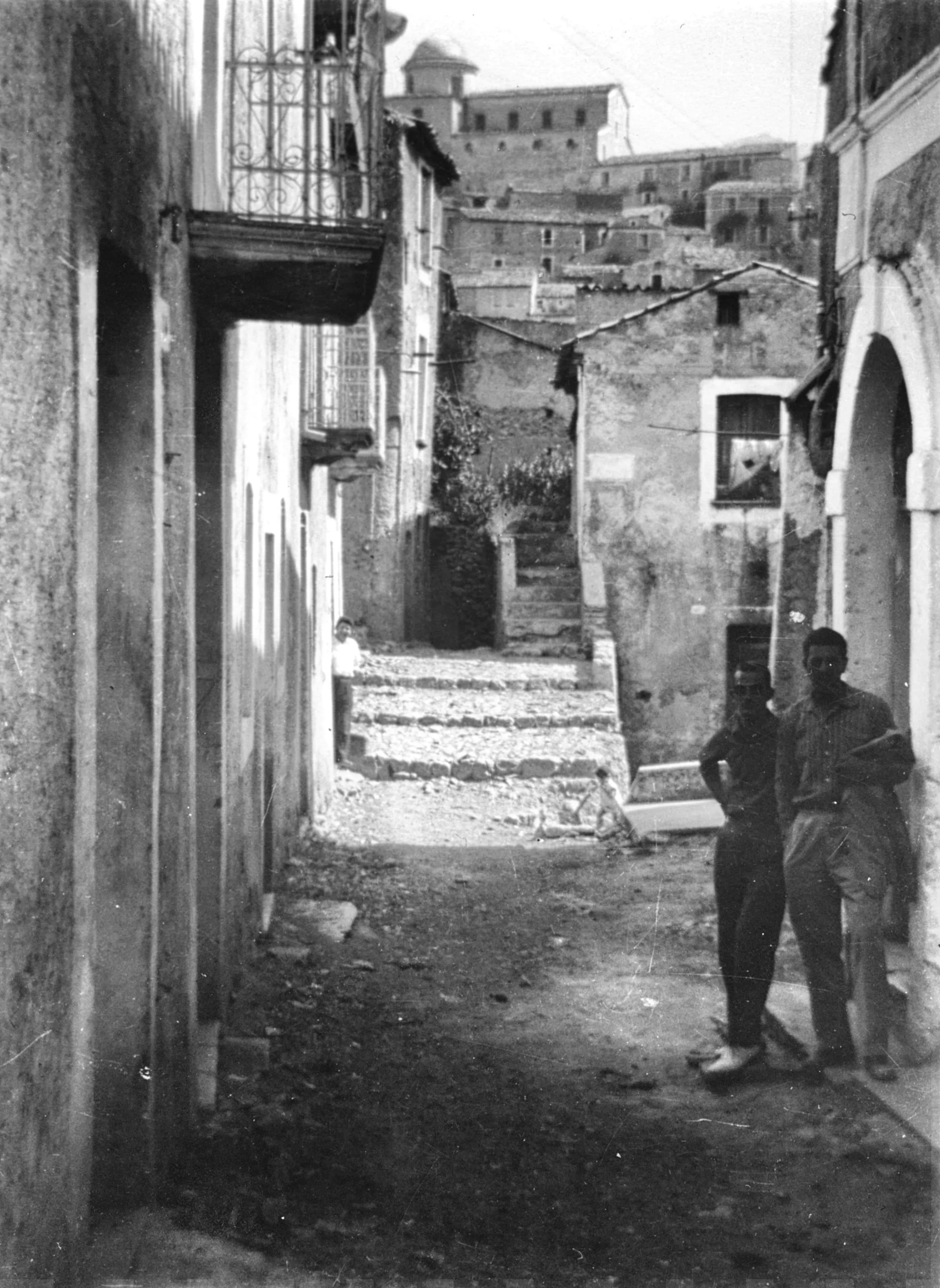
Your first sight of Morano Calabro is a cascade of grey houses tumbling down the hillside. Perched at an altitude of 690 metres, the village is built on such dense tiers that streets quickly turn into ramps and flights of polished cobblestones. Keeping your balance here calls for shoes with decent grip. Working out what to see in Morano Calabro starts with embracing these steep gradients: cars are an active hindrance in the historic alleys and should be left on the outskirts right away.
The location makes an ideal base for exploring Parco Nazionale del Pollino. The climate and landscape shift dramatically depending on when you visit. From June to August, the crisp mountain air of the Campotenese plateau—well over a thousand metres up—comes with the vivid purple bloom of the lavender fields. Winter, by contrast, blankets the surrounding peaks in snow and turns the village into the setting for a well-known living nativity scene.
Planning your days requires your own set of wheels to reach neighbouring villages, as local buses are sparse. Base yourself in the centre to take in the civic and religious architecture, then head out to canyons and fortresses 15 to 30 minutes away, allowing an average budget of €40 to €55 a day to cover hearty local meals and the few admission tickets you will need.
Four days between the village and Pollino
Day 1 — From the lower slopes to colourful tiled domes
Morning
Given the village's steep incline, driving into the narrow alleys is best avoided. Leave your car at the bottom, in the Fabrizio car park on Via Nicola de Cardona. From here, walk over to the Complesso Monastico e Chiesa di San Bernardino da Siena, a 15th-century Franciscan late-Gothic complex that preserves an impressive wooden ship's keel roof. The climb continues up into Rione San Nicola, the medieval quarter crisscrossed by stone steps, ramps, and covered passageways that Dutch artist Maurits Cornelis Escher chose to sketch during his travels in the 1930s.
Afternoon
In the heart of the historic centre, set inside Palazzo Salmena, you will find the Museo di Storia dell'Agricoltura e della Pastorizia. Its collection of tools and working reconstructions documents the peasant and pastoral traditions of the upper Pollino, shedding light on the valley's historical economy. A short walk away, the Collegiata di Santa Maria Maddalena catches the eye from outside with its bell tower and dome clad in yellow and green majolica tiles. Once inside, head for the sacristy: it houses a 1477 polyptych by the Venetian master Bartolomeo Vivarini.
Evening
Staying in the lower quarter, close to the Franciscan buildings explored earlier, settle in for dinner at Ristorante Pizzeria Al Convento on Via San Bernardino. The menu features wood-fired pizza alongside pasta dishes deeply rooted in local tradition. If you want to spend the night amidst the ancient houses of the centre, places like Casa Vacanze MURANUM - B&B let you stay right within the medieval fabric.
Day 2 — The village heights and an open-air museum
Morning
Today is devoted to the upper quarter. In Rione San Pietro stands the Chiesa dei Santi Pietro e Paolo, the oldest church in the village, dating back to around the year 1000 and home to marble sculptures by Pietro Bernini. Just below the fortress, step into the Centro Studi Naturalistici del Pollino Il Nibbio. This scattered museum was created by restoring abandoned medieval houses, with exhibits dedicated to local flora and fauna that take about an hour and a half to see in full.
Afternoon
The highest point of the village belongs to the Castello Normanno-Svevo di Morano Calabro. The remains of this military fortress look out across the valley of the river Coscile. A visit takes around an hour. It is worth timing your arrival for late afternoon to catch sunset from the ramparts, where you get sweeping, unobstructed views of the surrounding mountain massif.
Evening
For dinner, make your way to Via Domenico Cappelli for Ristorante L'Antico Borgo. Chef Pierluigi Vacca reinterprets regional produce with dishes such as salt cod served with crunchy peperoni cruschi and cardoncelli mushrooms. Tables are few, so booking well in advance is essential.
Day 3 — The Campotenese plateau and historic castles
Morning
A 15-minute drive out of the main village brings you onto the Campotenese plateau. Head to Contrada Barbalonga to visit the Parco della Lavanda. This botanical garden cultivates Loricanda, an indigenous lavender variety. The gates are open from 8:30 to 13:00 and admission costs €2. The purple blossom can only be seen from late June to late August. If you are travelling in a group, call ahead a few days before your visit.
Afternoon
Just down the road from the fields, along Strada Statale 19, you will spot Catasta Pollino, a cultural and tourism hub inspired by land art. It serves as a handy stop for cyclists and features interactive exhibitions along with a bookshop focused on the region. Hop back in the car for another 15 minutes to reach Castrovillari and admire the Castello Aragonese di Castrovillari, a 15th-century trapezoidal fortress with sturdy cylindrical towers built to guard the Fiumicello valley.
Evening
Head back towards the Morano countryside for dinner in Contrada Mazzicanino at Agriturismo Ristorante La Locanda del Parco. The working farm serves home-cured salumi and handmade pasta, following traditional peasant recipes using ingredients sourced entirely on site.
Day 4 — Canyons, stone bridges and thermal muds
Morning
A 25-minute drive takes you to Civita. This Arbëreshë village is famous for the Case Kodra e centro storico di Civita: wander the streets to spot houses whose facades mimic human faces, topped by grand decorative chimneys once built to ward off evil spirits. From the village, a steep footpath winds down to the Ponte del Diavolo e Gole del Raganello. This single-arched medieval stone bridge spans the dramatic chasm carved out by the river.
Afternoon
Another 35 minutes on the road brings you to Cerchiara di Calabria. Clinging to the sheer rock of Monte Sellaro is the Santuario di Santa Maria delle Armi, a 15th-century sanctuary commanding sweeping views over the plain of Sibari and Golfo di Taranto. Descending into the valley, five minutes brings you to Terme Grotta delle Ninfe. Inside the gorge, a natural spring feeds pools of warm sulphurous mud that sit at a constant 30°C—ideal for a relaxing soak.
Evening
Wrap up the trip just outside Morano. In Contrada Terrarossa, Trattoria La Cantina serves generous spreads of classic Calabrian antipasti, grilled meats, and handmade maccheroni al ferretto tossed in rich, hearty sauces.
Practical tips for planning your trip
- Where to park: Morano is built almost vertically. To dodge awkward manoeuvres in narrow alleys, leave your car on Via Nicola de Cardona (parcheggio Fabrizio) if starting down below, or in the open space by the Castello Normanno if you prefer to begin right at the top.
- Motorhome travellers will find a dedicated stop on Via Tufarello, just outside the village. In midsummer, escape the heat by using the large, shaded area at Parco della Lavanda in Campotenese, which offers cooler mountain air thanks to its 1,000-metre elevation.
- Navigating the village lanes requires proper walking footwear: smooth-soled shoes are a mistake given the steep gradients and slick cobbles. If taking longer trails down towards the river Raganello, always check mountain weather forecasts and hire licensed trekking guides.
- Day-to-day costs are very low. There is no combined tourist pass to buy, as churches and viewpoints are free to enter. The small civic museums and the botanical garden charge only a couple of euros. Excluding lodging, plan on around €40 to €55 per person for daily food and entries.
Where to spend the night
Located on Via San Pietro, right along the steep scenic road leading up to the Norman fortress.
View on Booking →Rural accommodation in Contrada Mazzicanino, perfect for sleeping surrounded by fields at the foot of the mountains.
View on Booking →A countryside retreat set in the hamlet of Campotenese, ideal for making the most of the plateau's fresh mountain air.
View on Booking →