

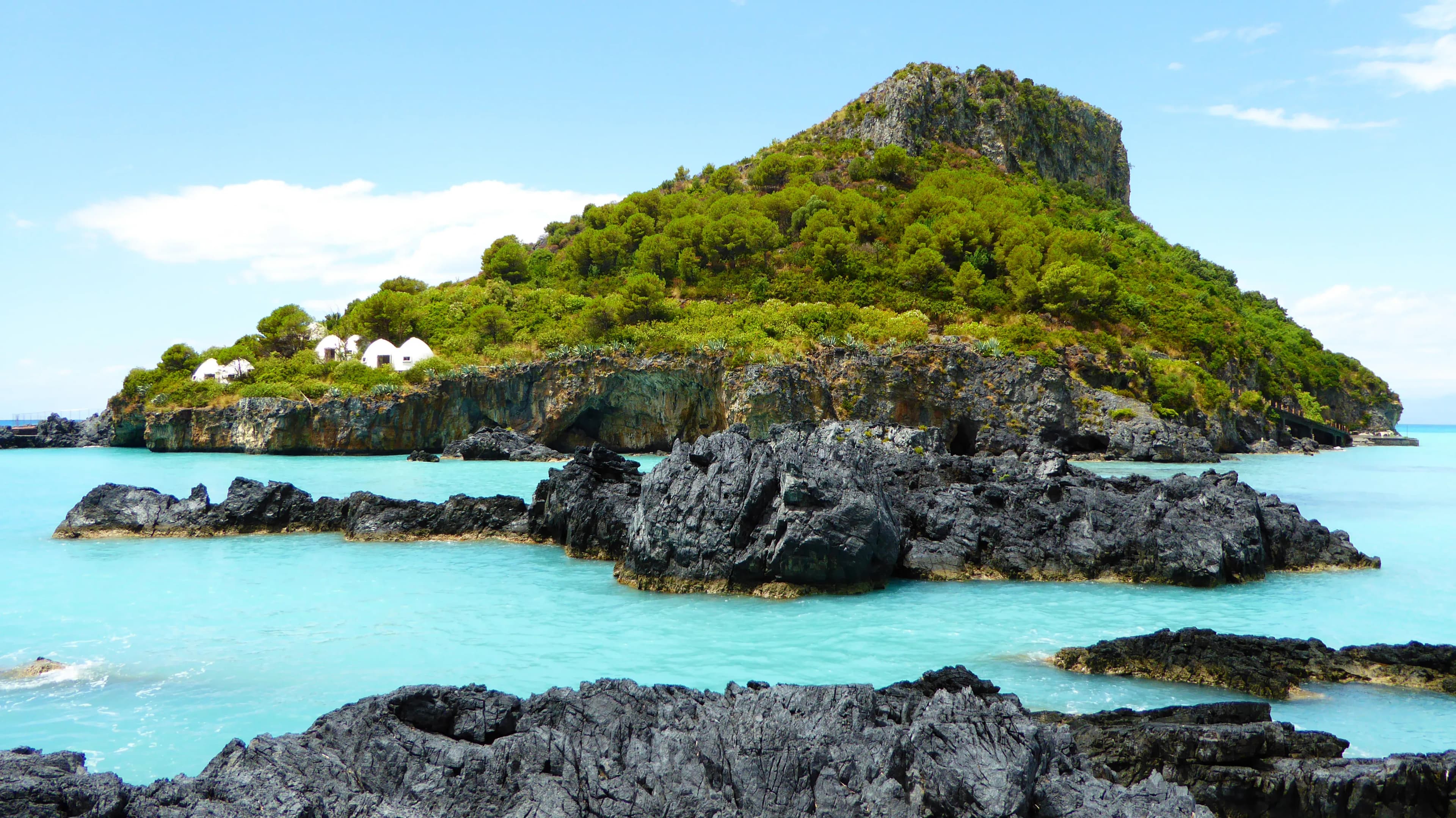
The coast of the upper Tirreno cosentino hides corners of rock and saltwater that require a bit of planning to explore properly. If you head towards Isola di Dino, you'll find deep seabeds, sea caves and watchtowers guarding the coastline. A short distance away, the state road climbs towards mountain villages where the sea disappears from view, replaced by the mountains of Parco Nazionale del Pollino.
A long weekend between Praia a Mare, San Nicola Arcella and the inland area requires a car to get around easily. The months of May, June and September offer mild temperatures and reduced boat traffic, two factors that change the impact of these places compared to the crowds of August. You'll almost always stay on the coast, perhaps choosing places like Hotel Garden or Grand Hotel De Rose, to reduce the distance to the boarding points.
Four days between sea and mountains
Day 1 — Circumnavigation and caves on the water
Morning
Your exploration starts from Spiaggia e Scogliera di Fiuzzi, a dark stretch of volcanic sand and pebbles located in Praia a Mare. From here, kayak rentals and boat tours depart to circumnavigate the island. You should arrive at the public or private car parks before 8:30 in the morning to find a space and set off when the sea is still flat, usually before 11:00. Your first entry is into the Grotta Azzurra dell'Isola di Dino, up to 12 metres deep. The water takes on bright colours thanks to the light filtering from the bottom.
Afternoon
Continuing your navigation around the main rock, you'll reach the Grotta del Leone, which takes about 20 minutes to cross by sea; it takes its name from a submerged rock that resembles the profile of a feline. The circumnavigation continues towards the Grotta del Monaco, whose walls fade into emerald green around anthropomorphic rock formations, and ends at the Grotta delle Cascate, known for the continuous sound of water on its limestone walls.
Evening
Back on land, stay in the coastal area for your meals. Ristorante La Casetta Bianca in Praia a Mare offers typical coastal dishes and Mediterranean seafood cuisine, wrapping up your first day close to the sea breeze.
Day 2 — Altars in the rock and cliffs
Morning
The second day climbs up to Monte Vingiolo. At 90 metres above sea level, the Santuario della Madonna della Grotta uses three large natural cavities in the mountain to house its rock-hewn structure. Allow about 45-60 minutes to visit the interior spaces and observe the coast from above.
Afternoon
The afternoon is dedicated to exploring the coastline from land. From the coast of Praia a Mare, you can observe the bulk of the sea stack on which the Torre di Fiuzzi stands. It is an ancient coastal watchtower, perched sheer above the sea. A free external visit of half an hour is enough to take it in, especially just before sunset when the light contrasts change.
Evening
With a short drive south, you reach San Nicola Arcella. Ristorante Furano has convenient parking and a large terrace; the dining room mainly serves raw fish and fresh catches from the mar Tirreno, a solid option to stick to the local culinary traditions.
Day 3 — Limestone arches and historic villages
Morning
Access to the Spiaggia dell'Arcomagno must be planned in advance. The rocky path on the Marinella side requires closed trainers, and here too you need to grab a space in the Baia di Marinella car parks by the early hours of the morning. Entry is quota-controlled and requires a ticket of about 4 €, often needing to be booked online. Under the 20-metre-high limestone rock arch, your stay is limited to around 30 minutes to avoid crowding.
Afternoon
Once you leave the water, a ten-minute drive along the SS18 is all it takes to head up to the Borgo Antico di San Nicola Arcella. Known as the Casaletto, it sits at an altitude of 110 metres. Among the stone alleys, you'll spot the bas-reliefs of the Sinapsi Urbane project and the facade of the Chiesa di San Nicola da Tolentino. Protecting the coastal stretch, the Torre Crawford remains visible, a Saracen construction that owes its fame to the periods spent here by gothic writer Francis Marion Crawford.
Evening
Before dinner, the Belvedere di Corso Umberto I offers a terrace overlooking the Golfo di Policastro and the Lucanian coast. In the nearby alleys, Trattoria La Vecchia Guardia prepares homemade pasta dishes rolled on a wire (al ferretto) and Calabrian recipes to be enjoyed on the tables of their panoramic terrace.
Day 4 — The villages of the Pollino
Morning
Your final day pushes the itinerary 12 km inland from the coast. Along winding, hilly roads you reach the Borgo Medievale di Aieta. The paved alleys measure minimal spaces, as in the case of Vico dei Baci, just 52 centimetres wide. Governing the urban layout is the Palazzo Rinascimentale Martirano-Spinelli, an imposing 16th-century noble residence. When the municipality opens the doors, a visit to the interior halls takes three-quarters of an hour.
Afternoon
Still at altitude, but 7 km from the sea, lies the Centro Storico di Tortora. This mountain settlement has its focal point in the Chiesa Madre di San Pietro Apostolo. The halls of the Museo Archeologico di Blanda preserve and organise Lucanian and Roman artefacts recovered in the area.
Evening
You descend again towards San Nicola Arcella, specifically to the San Giorgio area. Trattoria La Quercia relies on a rustic setting with an outdoor garden, leaving seafood behind to serve meat-based dishes, mature cheeses, cured meats and traditional meats typical of the Calabrian inland tradition.
Practical notes for getting around
- A car is essential. It only takes ten minutes on the SS18 between Praia a Mare and San Nicola Arcella, but for the high-altitude villages like Aieta you have to tackle twenty minutes of winding roads.
- Sea explorations around the island and its caves should be done in the morning, before 11:00, when the water is flat and there are still few boats around.
- Entry to the small beach of the Arcomagno is time-limited to half an hour and requires a ticket of about 4 €. It's advisable to buy it in advance and walk the path from Marinella wearing trainers.
- Parking at Fiuzzi or Baia di Marinella gets complicated early on. Arriving before 9:00 guarantees a spot close to the sea access points and prevents long uphill walks.
- If you're looking for a balanced climate and clean waters, you would do well to aim for the months of May, June and September, when even hiking requires less effort compared to the peak days of August.
Where to base yourself
A four-star hotel on the seafront, equipped with a swimming pool and direct beach access a short distance from the island.
View on Booking →A family-run beachfront property, with windows opening onto the close-up proportions of the Dino rock.
View on Booking →An adults-only boutique hotel surrounded by greenery, featuring open views of the island.
View on Booking →