

The salty sea breeze drifts through the narrow alleys of Ortigia, blending with the scent of fresh bread and fried fish from the market stalls. Siracusa calls for an unhurried pace, without the urge to tick off dozens of stops on a map. It is best to plan your trip for late spring, between May and June, to coincide with the classical performances at the Teatro Greco, or in early autumn to enjoy pleasant temperatures before the ancient stone turns scorching hot in the midday sun.
The city is distinctly split into two parts. On one side lies the island, pedestrianised and closed to traffic, where fresh spring water meets the sea and baroque churches rest upon ancient Doric columns. On the other side are the mainland quarters, where Greek and early Christian remains emerge from the limestone, telling a story best explored in the open-air archaeological parks. The ideal approach is to balance your days between the white stone streets and the historic ruins, perhaps choosing a base such as Palazzo Artemide so you can easily stroll around on foot in the evening.
How to plan your three-day stay
Day 1 — Entering Ortigia
Morning
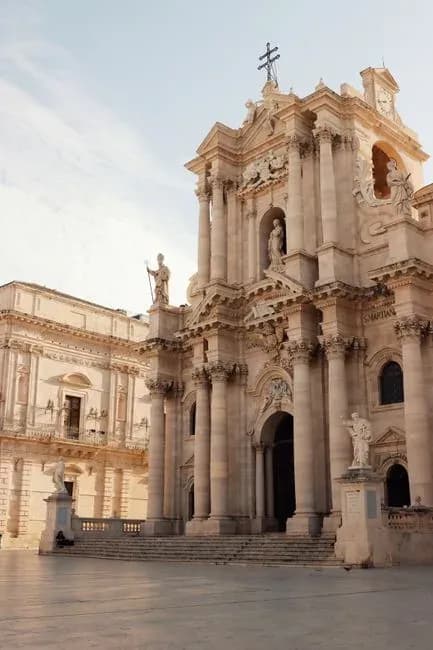
Begin by stepping onto the pedestrian island of Ortigia. As soon as you cross the access bridges into Largo XXV Luglio, you will find yourself in front of the Tempio di Apollo. It is the oldest Doric stone temple in all of Sicilia; 20 to 30 minutes is plenty to take it in. From here, the streets narrow before opening onto Piazza Duomo e Cattedrale della Natività di Maria Santissima, the baroque heart of the island. The building's unique character is clear from its outer walls, as the cathedral physically incorporates the ancient Doric columns of the Tempio di Atena. Allow around 45 minutes to visit the interior and explore the piazza.
Afternoon
Around midday, Ortigia's historic market fills up quickly. For lunch, Caseificio Borderi is a celebrated deli counter where enormous gourmet paninis and platters of artisan cheeses are assembled before your eyes, though you should factor in a bit of a queue. The afternoon continues along the island's western shoreline. Heading towards the Fonte Aretusa, you will find a freshwater spring right beside the sea where wild papyrus grows, a spot steeped in the Greek myth of Arethusa and Alpheus. It is the best place to pause and take in the view as sunset approaches.
Evening
Come evening, the lights transform the white stone palazzi. For dinner, head into Vicolo Zuccalà to find Osteria da Mariano, a trattoria focusing on traditional local first courses, not least its famous Penne al Mariano. After eating, it is well worth walking past the Tempio di Apollo once more, as the evening illumination throws its ancient lines into sharp, striking relief.
Day 2 — The mainland and antiquity
Morning
On your second day, make your way to the mainland districts. You can either walk for about 25 to 30 minutes from Ortigia or hop on one of the electric city shuttle buses. Spend the morning in the Santa Lucia/Tyche area to explore the Museo Archeologico Regionale Paolo Orsi. As one of the largest archaeological museums in Europe, it houses treasures spanning from prehistory through the Greek and Roman eras; it is a dense collection that requires at least two hours.
Afternoon
Moving towards the San Giovanni district, head underground into the Catacombe di San Giovanni e Cripta di San Marciano. This early Christian network is topped by a roofless open-air basilica; the guided tour lasts about 45 minutes and is mandatory, so book well in advance. Later, as the sun begins to dip, make your way into the Parco Archeologico della Neapolis. You will need around half a day to explore it thoroughly, and the late afternoon is the ideal time to avoid the heat while catching the golden light on the ancient stone. Inside, you will find the Teatro Greco and the limestone cavern of the Orecchio di Dionisio, renowned for its extraordinary acoustics and legends of the tyrant Dionysius.
Evening
Returning to the lanes of the historic centre, you have two distinct dining options. A Putia delle Cose Buone is a welcoming spot serving authentic home-cooked dishes, such as caponata and traditional pasta, at very reasonable prices. Alternatively, along Via Dione, Bistrot al Bagatto offers a daily market-driven menu with seafood pasta dishes, putting a fresh spin on classic island flavours right through to its cannolo dessert.
Day 3 — The freshwater pools and the fortress
Morning
Your third day calls for a hire car to head out of the city towards Avola and Cassibile. Your destination is the Riserva Naturale Cavagrande del Cassibile (Laghetti di Avola). This is a dramatic natural canyon, home to a moderate hike that requires proper walking shoes. The trek down to the crystal-clear freshwater pools and back takes half a day in total, allowing between three and four hours to descend, relax, and make the climb back up.
Afternoon
Once back in Siracusa, head to the southern tip of Ortigia to explore Castello Maniace. This fortress dating from the Hohenstaufen era has guarded the entrance to the natural harbour for centuries. Exploring the interior and the ramparts takes about an hour. As with most outdoor heritage sites in southern Italy, it is best to visit in the late afternoon to avoid walking the defensive walls under the direct midday sun.
Evening
For your final dinner, head to the heart of Ortigia for restaurant Don Camillo. A refined, historic venue led by chef-patron Giovanni Guarneri, it is the perfect choice for a gourmet meal built around fresh local seafood, backed by an extensive wine list. Given its reputation, you will need to book a table well ahead of time.
Practical tips for your trip
- Ortigia's historic centre is entirely pedestrianised and best explored on foot. To reach the mainland (Catacombe and Neapolis), allow a 30-minute walk or take the electric city shuttle buses; you only need a hire car for the day trip to Cavagrande.
- Access to Ortigia is governed by a strict ZTL with camera-controlled gates. To avoid fines, leave your car at Parcheggio Talete or Molo Sant'Antonio before crossing the bridges.
- If travelling by campervan, do not approach the bridges to Ortigia due to the narrow streets. The best fully equipped stopovers are Ippocamper on Via Necropoli del Fusco or ClaudCar, both well connected to the centre.
- Before setting off for Cavagrande del Cassibile, check with the forestry service which paths are open, as often only the Carrubbella trail is safely accessible. You will need proper walking boots and plenty of water.
Where to stay in Siracusa
Overlooking the pedestrian seafront, offering charming rooms just a short stroll from the central piazzas.
View on Booking →An elegant, historic hotel set along the city harbour, complete with a large rooftop panoramic terrace.
View on Booking →A B&B and residence tucked away in the ancient Jewish quarter, ideal for those seeking peace and quiet.
View on Booking →