

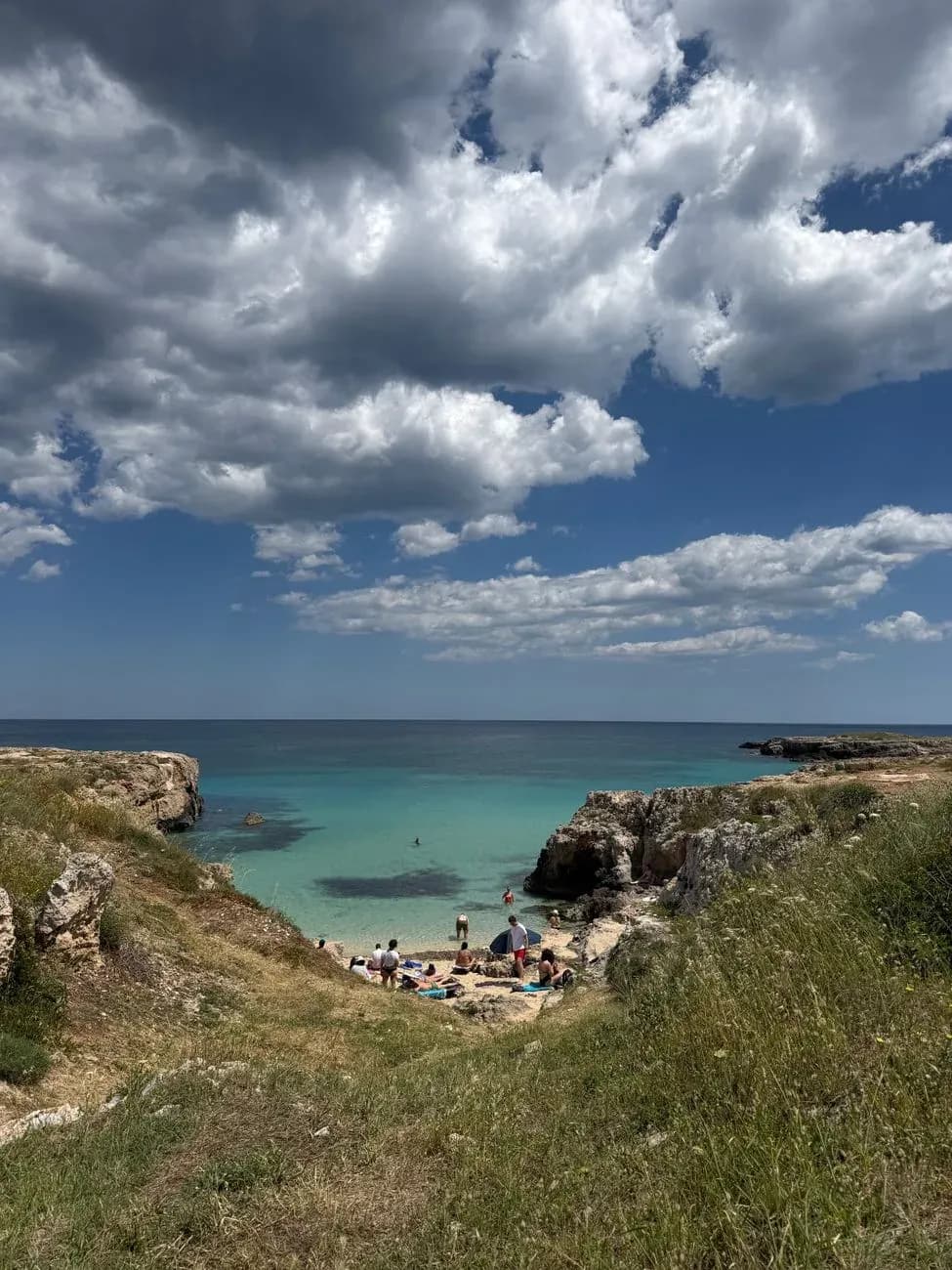
Exploring central Puglia requires careful timing and seasonal planning. Organising a road trip here means moving constantly between compact historic centres and country lanes. The best months for exploring the area and walking along rural trails are May, June, September and October. Tackling the same route in high summer involves a heavy compromise: daytime temperatures frequently exceed 35 degrees Celsius, and the narrow village alleys become severely overcrowded.
Distances between the main towns—such as Polignano, Alberobello, Locorotondo and Ostuni—are very short, typically between fifteen and thirty-five minutes by car. Despite this proximity, hiring a private car is strongly recommended for the entire weekend. Relying on public transport to reach isolated masserie or trailheads is time-consuming and complicates day-to-day travel around the Valle d'Itria unnecessarily.
How to Plan 4 Days Between Hilltop Towns and the Sea
Day 1 — Trulli and the Karst Underworld
Morning
In Alberobello, cars are banned from the historic centre: you will need to leave your vehicle in designated areas like Parcheggio 'Nel Verde' on via Cadore or in the paid blue-line bays. It pays to explore on foot from early morning in Rione Monti, the monumental district where over a thousand trulli climb the hillside; arriving ahead of the tour groups will keep you from getting stuck in the narrow alleys. At the highest point of the district stands the Chiesa di Sant'Antonio da Padova, built in 1927 in the shape of an enormous trullo and free to enter. A short stroll away, Rione Aia Piccola is home to four hundred lived-in, authentic trulli entirely free of commercial shops, making for a much quieter walk. Before lunch, there is time to visit the Trullo Sovrano, the town's only two-storey trullo, now a period house-museum you can tour in thirty to forty-five minutes with an inexpensive ticket.
Afternoon
For lunch, head to via Monte Nero to find Ristorante Il Pinnacolo, set inside an authentic trullo and known for its Pugliese pasta dishes served on a panoramic terrace. In the afternoon, the itinerary takes you towards Castellana Grotte. Entry to the Grotte di Castellana (Grotta Bianca) requires booking online in advance to secure your preferred time slot. The full tour covers three kilometres underground and lasts one hundred minutes. The temperature inside remains constant at 16.5 degrees with high humidity, making non-slip rubber-soled shoes and a sweatshirt essential.
Evening
Head back to Alberobello for dinner. In the historic centre, book a table at Evo Ristorante, a venue with its own kitchen garden that focuses on zero-kilometre ingredients and also offers guided extra virgin olive oil tastings. For the night, many accommodations are set directly inside historic buildings, such as Le Alcove - Luxury Hotel nei Trulli, centrally located in the heart of the village.
Day 2 — Cliffs and Fishing Harbours on the Adriatic
Morning
On day two, drive towards the Adriatic coast. Arriving in Polignano a Mare in the morning lets you catch the direct front light on Lama Monachile, a white pebble cove framed by towering limestone cliffs, right at the foot of an ancient Roman bridge. Walking up from the beach, you enter the dense street network of the Centro Storico di Polignano a Mare. The town is built sheer above the water, dotted with stone stairways and scenic balconies adorned with handwritten poetic verses painted onto the whitewashed walls.
Afternoon
Stop for lunch at Pescaria. The venue is famous for its seafood street food and generously filled rolls featuring fried octopus, tuna tartare and burrata. After eating, stroll along towards the Statua di Domenico Modugno e Lungomare. The bronze monument of the singer-songwriter gazes out to sea from the clifftop, marking the start of a lovely stretch for an afternoon walk. Back in the car, drive south to catch sunset at the Porto Vecchio di Monopoli, a working fishing harbour enclosed by medieval walls, where traditional blue-and-red wooden gozzi bob in the water.
Evening
To round off the day, head back towards Largo Gelso in Polignano. Here, Osteria di Chichibio serves a menu focused on Mediterranean cuisine and raw seafood, just a short stroll from the town promenade.
Day 3 — White Inland Architecture
Morning
Day three brings the itinerary back into the hills. Start at the Centro Storico di Locorotondo, officially listed among the most beautiful villages in Italy. Its defining feature is its circular layout, laced with paved alleys lined by 'cummerse'—whitewashed houses with sharply pitched roofs, adorned with dozens of flower-filled balconies.
Afternoon
Enjoy lunch without moving the car by stepping into Osteria Il Rosone, tucked right into the white stone lanes and specialising in regional classics and local meats. In the afternoon, take the short drive over to the Centro Storico di Cisternino. Its medieval street plan is arranged around bright, airy piazzas and remains remarkably intact. As you wander, you will come across traditional butcher shops with built-in fornelli: charcoal grills fired up in the evening to cook the cuts of meat you select straight from the counter.
Evening
While Cisternino is famous for its casual grilled-meat dinners, driving further south towards Ceglie Messapica brings you to L'Antico Arco. This is an authentic, rustic trattoria renowned locally for hearty portions of handmade orecchiette with cime di rapa. In summer the restaurant sets up tables outside on the piazza, while during the colder months service moves indoors around a roaring central fireplace.
Day 4 — Rural Walks and the Arrival in Ostuni
Morning
The final morning takes you onto the countryside trails, so make sure you set out prepared. Both the Sentiero dell'Acquedotto Pugliese between Ostuni and Martina Franca (an easy, flat path through fragno oaks, vineyards and dry-stone walls) and the Sentiero tra Ostuni e Cisternino (taking about two hours through almond groves and ancient drove roads) have no refreshment stops along the way. Carrying plenty of water and a sun hat is essential for an enjoyable morning walk.
Afternoon
After the walk, those staying out in the countryside—such as at Masseria Trulli e Vigne in Martina Franca or Relais Masseria Serritella—often spend the early afternoon relaxing by the pool. Afterwards, drive to the Centro Storico di Ostuni, famously known as the White City. Tackle the steep whitewashed lanes, skirting the surviving stretches of Aragonese walls on your way up to the late Gothic cathedral. Heading back down leads to Piazza della Libertà e Obelisco di Sant'Oronzo, the main square dominated by the tall Baroque local stone spire dedicated to the town's patron saint.
Evening
A stop in Ostuni's main piazza marks the natural conclusion of your weekend. Spend your final hours among the central cafes before heading back to your car, parked outside the pedestrianised zone, ready for the journey home.
Practical Tips for Your Trip
- A car is by far the most practical option: short journeys between villages take just minutes, whereas relying on public transport to reach masserie or trailheads wastes hours.
- In Alberobello, park in outer lots before hitting the central pedestrian zones; Parcheggio 'Nel Verde' on via Cadore and the blue-line bays offer convenient spaces.
- The microclimate inside the Grotte di Castellana calls for the right gear: with a steady 16.5 degrees and high humidity, long trousers, a sweatshirt and non-slip shoes are a must.
- For four full days on the go enjoying trattorie, street food, parking and entrance fees, budget between €250 and €350 per person, excluding accommodation.
Where to Stay Nearby
Centrally located accommodation with rooms created from the meticulous restoration of genuine trulli.
View on Booking →A country relais surrounded by olive groves near the caves, featuring an outdoor swimming pool.
View on Booking →Rooms set within a rural estate in the valley, offering guests access to its private woodland.
View on Booking →