

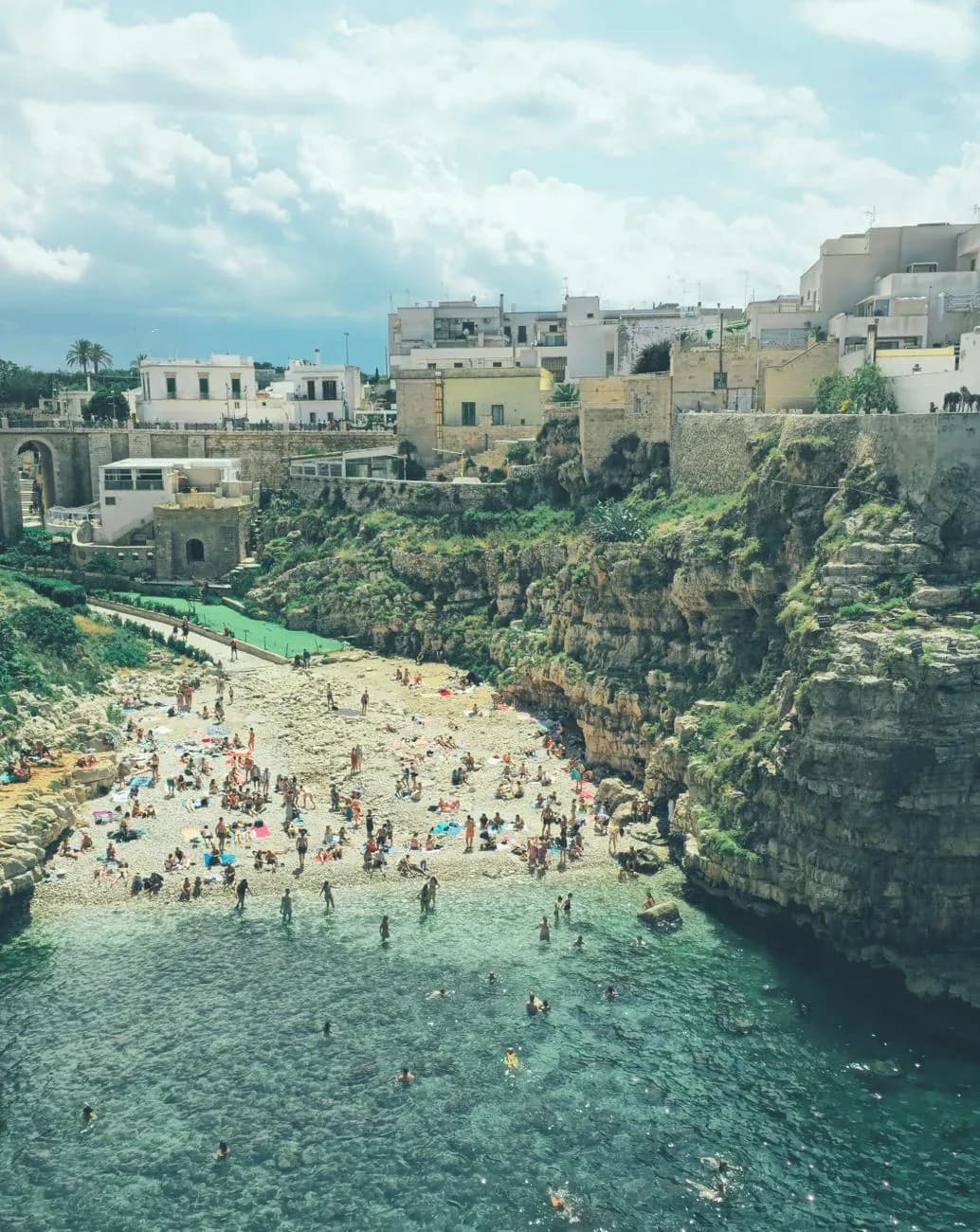
Central Puglia brings together whitewashed historic centres, coastal cliffs and rural landscapes across very short distances. The area's main towns, such as Locorotondo, Martina Franca, Cisternino and Alberobello, sit just ten to twenty minutes' drive from one another. Travellers arriving from further afield often use Bari or Brindisi as their base, both around 50–60 kilometres away. A hire car is by far the most efficient way to cover these distances and plan your sightseeing without having to rely on fixed timetables.
The weather and the seasons make a big difference to how you structure your days. The months from April to June and from September to October bring mild temperatures and manageable crowds. During the peak summer months of July and August, these same narrow streets and coves endure intense heat and heavy footfall that slows every journey down.
This route calls for a practical approach to walking and local traffic rules. The central squares and streets of towns like Ostuni, Polignano, Cisternino and Alberobello are limited traffic zones (ZTL). It is therefore essential to leave your car in the paid council car parks outside the old walls before tackling the uphill climbs on foot.
How to plan your weekend day by day
Day 1 — From the Bari coast to the karst caves
Morning
Your first day begins on the coast. In Polignano a Mare, it pays to arrive early in the morning to see the Spiaggia e Falesia di Lama Monachile. This pebble cove nestled beneath the Ponte Borbonico fills up fast; getting there early lets you beat the crowds, take photos and stroll along the cliffs. From here, make your way into the Centro Storico di Polignano a Mare, a maze of alleyways opening onto balconies perched sheer above the Adriatic. Key landmarks include the Belvedere Santo Stefano and the statue of Domenico Modugno; the walk usually takes one to two hours. For lunch, head to Via Marconi 56 for Pescaria, a seafood street food spot famous for its sandwiches filled with fried octopus and burrata or tuna tartare. Given its popularity, make sure you factor in time to queue at the till.
Afternoon
Leaving the coast behind, the route heads inland towards the town of Castellana Grotte. Here lies the subterranean network of the Grotte di Castellana. The full route covers three kilometres, includes a stop at the Grotta Bianca, and takes about a hundred minutes. To visit, booking your ticket for the Grotte di Castellana online is strongly recommended: it secures your chosen time slot and prevents disappointment if tickets sell out. Inside, the temperature stays at a constant 14°C to 18°C with humidity above 90%, so a sweatshirt and a pair of shoes with non-slip rubber soles are essential.
Evening
Once back above ground, drive up into the hills for the night. In the countryside around Locorotondo, places like Leonardo Trulli Resort or Trulli Caroli offer rooms away from town centres, putting you in an ideal starting position for day two.
Day 2 — Among the trulli and villages of the Valle d'Itria
Morning
Start the day in Alberobello, heading straight for Rione Monti. This district is home to over a thousand trulli perched on the hillside, alongside numerous artisan workshops. The walk takes between one and two hours, and it is best to do it early while the streets are still quiet. A short walk away, Rione Aia Piccola reveals a more residential, tranquil side of town. Its four hundred trulli remain intact and free of tourist shops; 45 minutes is plenty to wander through. Continuing to Piazza Sacramento, you will come across Trullo Sovrano, the only two-storey trullo in town, furnished today with period pieces. A visit to Trullo Sovrano takes around 30–40 minutes, and tickets can be bought on-site or online. For lunch at the foot of Rione Monti, stop at Coppino Cucina Tradizionale, a restaurant set inside a trullo serving orecchiette with cime di rapa and brasciole in tomato sauce.
Afternoon
After lunch, it is just a ten-minute drive to Locorotondo. The Centro Storico e 'Lungomare' panoramico di Locorotondo follows a circular layout, with whitewashed houses topped by pitched roofs known as 'cummerse'. The viewpoint looks straight out over the vineyards and trulli of the Valle d'Itria. Allow around one to two hours to explore, and aim for sunset to catch the finest views across the surrounding countryside.
Evening
For dinner, head over to the town of Cisternino. The Centro Storico di Cisternino retains its whitewashed houses and medieval arches, taking around an hour and a half to wander through. The highlight of the evening is its historic butcher shops with a 'fornello pronto' grill. Rosticceria L'Antico Borgo, in the old centre, is one such spot: choose your gnumeredd, sausages and bombette straight from the counter, which are then grilled over charcoal and served at your table.
Day 3 — Historic architecture between Martina Franca and Ostuni
Morning
Your final day begins in Martina Franca. In Piazza Roma stands the Palazzo Ducale, an imposing 17th-century building with a Baroque facade and frescoed state rooms, now partly used as the town hall. Touring the interior takes about 45 minutes. A short distance away in Piazza Plebiscito, step inside the Basilica di San Martino. This 18th-century church features a grand sculpted facade depicting Saint Martin dividing his cloak; take half an hour to admire the details.
Afternoon
Next, drive on to Ostuni. Reaching the top of the old town, you will find the Cattedrale di Santa Maria Assunta, a 15th-century Romanesque-Gothic church. Its intricately carved 24-ray rose window is the facade's defining feature. Entry to the Cattedrale di Santa Maria Assunta requires a small fee, and opening hours are typically split between 9:00 and 13:00, then 16:00 to 19:00. Walking around this area calls for very comfortable flat shoes, as the slopes are steep and the stone paving can be slippery.
Evening
As evening draws in, make your way down to Piazza della Libertà e Colonna di Sant'Oronzo. The square forms the hub of the old town and is dominated by a 20-metre-high Baroque spire dating from 1771. For your final dinner, head to Osteria del Tempo Perso at Via Gaetano Tanzarella Vitale 47. The restaurant is set inside stone caves in the historic centre, just a short walk from the cathedral. Bear in mind that booking well ahead is essential here.
Practical tips for getting around and visiting
- A hire car makes travelling between the towns of the Valle d'Itria effortless, with drives of just 10–20 minutes between them. The main arrival hubs, Bari and Brindisi, are around 50–60 kilometres away.
- To enjoy mild weather and dodge summer queues in the villages and on the beaches, plan your trip for spring, between April and June, or early autumn.
- Tickets for the Grotre di Castellana should be booked online in advance. The same goes for tables at Ostuni's historic restaurants and Cisternino's grill houses, especially at weekends.
- The historic centres of Ostuni, Polignano, Cisternino and Alberobello are limited traffic zones. You will need to leave your car in the paid car parks outside the old town walls.
- The cave system's high humidity and constant temperature require a sweatshirt and rubber-soled shoes. In the hill towns, smooth stone paving makes flat, comfortable footwear a must.
Where to stay across the local towns
Offers accommodation set inside restored historic trulli, surrounded by peaceful countryside.
View on Booking →A masseria with a swimming pool, offering rooms set partly inside authentic ancient trulli.
View on Booking →Features guest rooms set inside rural trulli, with free on-site parking for guests.
View on Booking →