

There is a reason why you should base yourself in Locorotondo to explore this slice of Puglia: the streets are quieter than in neighbouring towns, the tourist traffic disperses better, and the geographical location allows you to reach nearby villages in a 15-minute drive. Spring and early autumn offer the right temperatures to walk through the fields and contrade. Those travelling in the height of summer face a harsher climate: in that case, walks in the town centre should be limited to the early morning or late afternoon, when the sun goes down and the limestone stops reflecting the heat.
The village rests on a hill overlooking the vineyards of the Valle d'Itria. The urban layout is a closed ring, free of traffic thanks to the central ZTL. This means you will explore entirely on foot. To sleep, the rural area just outside the city ring offers options carved out of local architecture, such as the lodgings at I Trulli di Badi or the rooms at Ottolire Resort. From there, you just need to approach the gates of the ancient city and start your tour.
How to organise your days between villages and contrade
Day 1 — The ancient core and the pointed roofs
Morning
Your first approach to the town begins at the Villa Comunale Giuseppe Garibaldi, located in Piazza Vittorio Emanuele II. This well-kept, shaded garden acts as an antechamber to the village and hosts a panoramic terrace where you can observe the vineyards and trulli scattered in the valley below. From here, you enter the Centro Storico e le Cummerse. Allow about one or two hours to walk the entire network of alleys. The streets form a circular maze, lined with whitewashed facades. The architectural peculiarity is represented by the "cummerse", traditional houses covered by pointed roofs made of chiancarelle, typical local stone slabs. You should do this tour early in the morning, when the alleys are still empty.
Afternoon
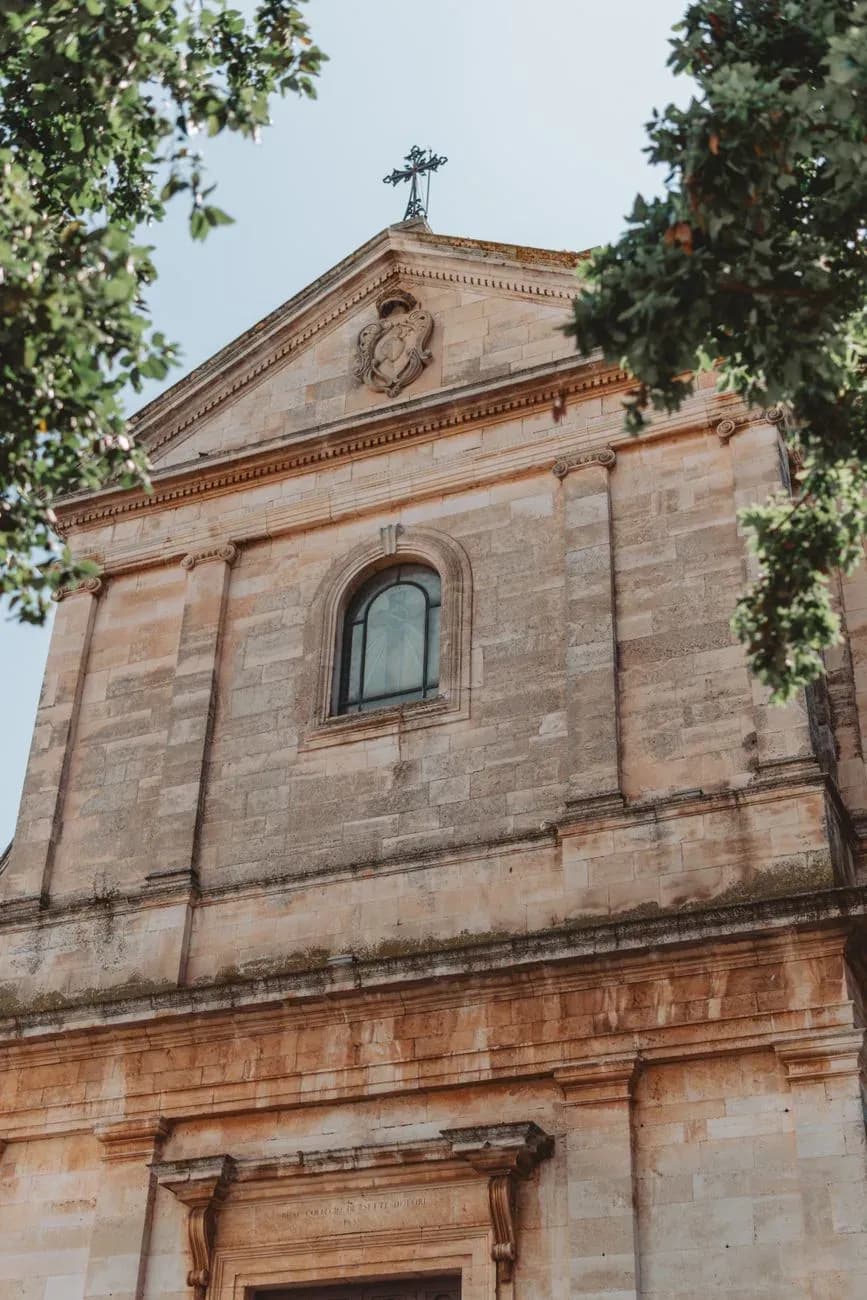
The second part of the day focuses on the historical buildings inside the ring. The Chiesa della Madonna della Greca requires about twenty minutes to visit. It is the religious building with the longest history in the village, dating back to between the 12th and 15th centuries, and inside it preserves sculptures carved in local stone and a Romanesque rose window on the facade. A short distance away you will find the Chiesa Madre di San Giorgio Martire, a massive 19th-century neoclassical building dedicated to the town's patron saint. Inside are 16th-century bas-reliefs, while outside its dome stands out against the rest of the roofs and is visible from the valley floor. Allow about half an hour. Not far away, the route crosses paths with Palazzo Morelli e Torre Civica. The 18th-century palace stands out for its Baroque style, its ornate portal and the long wrought-iron balcony, flanked by the old town clock structure.
Evening
Before dinner, move towards the Belvedere di Via Nardelli (Il Lungomare). Residents call this pedestrian walkway running along the ridge by this name, because the open view over the valley is reminiscent of looking out to sea. It is the exact spot to pause at sunset or for an aperitivo. For dinner, simply walk back a few metres into the ancient heart to Via Dura, where you will find the Ristorante U Curdunn. The restaurant serves fresh pasta and traditional dishes at honest prices.
Day 2 — Dry stone architecture and Baroque facades
Morning
A car becomes necessary for your second day. Drive for about ten minutes west to the Trulli di Alberobello (Rione Monti e Aia Piccola). This UNESCO site attracts massive streams of visitors due to its famous dry stone architecture. The only solution to observe the districts without ending up blocked by the crowds is to arrive early in the morning. The walk among the stone cones lasts two or three hours at most. Once the tour is complete, you retrieve your car and leave the town before the car parks fill up completely.
Afternoon
Drive for another ten minutes, this time towards the Centro Storico Barocco di Martina Franca. The urban fabric changes completely: the town is known for its elegance and Rococo buildings. This cultural stop will keep you busy for about a couple of hours, the time needed to walk between the Palazzo Ducale, the Basilica di San Martino and the richly decorated facades that line the main squares.
Evening
Return to Locorotondo to spend the evening among the white stone alleys. Dinner is at the Osteria Il Rosone, a restaurant specialising in revisited zero-kilometre Apulian recipes. Tables are few and weekend attendance is high, so you must secure your spot by calling a few days in advance.
Day 3 — The dirt cycle path and the fornello pronto
Morning
The morning requires comfortable clothing and a move towards Contrada Figazzano. This is where the explorable section of the Ciclovia dell'Acquedotto Pugliese (Tratto Figazzano - Ceglie) begins. It is a dirt cycle and pedestrian path, bordered by dry stone walls and Mediterranean scrub. Being entirely flat, the itinerary can also be done by e-bike or walking without any particular prior training. The route takes between two and four hours, depending on your pace. During the excursion you will encounter the Ponte della Cecca e Canale di Pirro, a historical canal bridge of the water system, located at over four hundred metres of altitude, which acts as an observation point over the pastures and the contrade.
Afternoon
Once the walk is over and you are back in the car, you need about a 15-minute drive to reach the Borgo Bianco di Cisternino. The town unfolds through a network of narrow, snow-white alleys and is famous throughout the area for its butcher shops equipped with a fornello pronto, where the meat is chosen at the counter and cooked on the spot. A tour of the centre takes between one and two hours, and is perfect to do in the late afternoon.
Evening
For your last dinner, return to the perimeter of Locorotondo. You can opt for the Trattoria Al Vecchio Arco, known for its local starters and homemade orecchiette (again, you should book a table in advance). Alternatively, move to Via Dottor Guarnieri to the restaurant Ai Tre Santi, which has outdoor tables overlooking the whitewashed walls and serves a menu focused on meats and local products.
Practical tips for transport and stops
- You absolutely need a car: the centres of Alberobello, Cisternino and Martina Franca are only a ten or fifteen-minute drive from each other, making journeys short but impossible to manage smoothly without your own vehicle.
- The entire historic centre of Locorotondo is pedestrianised and protected by a ZTL. You must leave your car in the car parks arranged along the outer ring, looking for a space in the area of Porta Napoli or in Piazza Mitrano, and then proceed on foot.
- Those intending to travel along the Ciclovia dell'Acquedotto starting from Contrada Figazzano will find a flat, dirt surface. It is a route without gradients, easily tackled by anyone and suitable for renting pedal-assisted bicycles.
- If you are travelling in summer or during the weekends, the evening tourist influx into Locorotondo's venues fills up tables quickly. You should always book dinner a few days in advance to avoid missing out on the trattorie in the centre.
Where to sleep in the surrounding area
An authentic property located in the surrounding countryside, with rooms created inside traditional trulli and surrounded by a garden.
View on Booking →Ancient trulli and dry stone walls restored and transformed into a rural resort with meticulous attention to detail, located outside the town centre.
View on Booking →A trulli complex equipped with a swimming pool and outdoor green space, located a short distance from the historic centre which can be reached on foot.
View on Booking →