

Planning a weekend in this Campanian city takes a bit of strategy to tie together the coastline, the modern squares, and the hilly heights. The period between April and June, or early autumn from September to October, offers the finest conditions. During these months, the temperatures let you linger on the beach without enduring the summer heat, while skipping the heavy winter crowds drawn by the Luci d'Artista festival. Logistically, it is all very straightforward: the centro storico di Salerno and the harbourfront are entirely flat and easily explored on foot.
Dining costs remain lower than in neighbouring towns: expect an average of €35-€50 per person per day for meals. The city also serves as a strategic base to avoid the heavy traffic of the state road. By choosing a central spot like Hotel Montestella or Albergo Del Centro Storico, you are just minutes from the piers where ferries depart directly for the Costiera Amalfitana.
How to plan your days in the city
Day 1 — From the Duomo to the botanical terraces
Morning
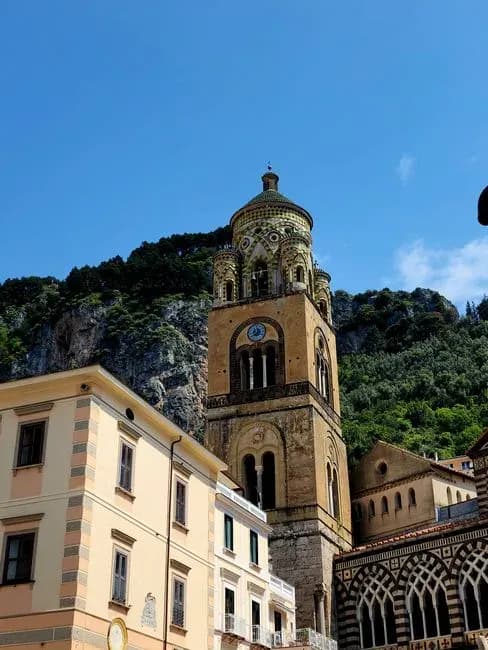
Spend the first part of your day in the upper reaches of the historic centre. The Cattedrale di Salerno (Duomo di San Matteo) is best appreciated in the morning; allow about an hour to take in the Romanesque-Norman architecture, the quadriporticus, and to head down into the baroque crypt where the relics of the Apostle Matthew are kept. A short walk away, still amidst the maze of ancient alleys, lies the Complesso Monumentale di San Pietro a Corte. It is well worth joining the roughly 45-minute guided tour to understand the site's rich historical layers, featuring a Roman thermal hypogeum topped by the only surviving Lombard royal palace with a palatine chapel.
Afternoon
Heading into the Plaium Montis district in the early afternoon, make your way to the Giardino della Minerva. Admission costs €6 and a visit takes between an hour and an hour and a half. This was the first botanical garden in Europe linked to the Scuola Medica Salernitana, built across a series of terraces looking out towards the gulf. Once down from the terraces, move on to the Rione Fornelle e Muri d'Autore. You can explore this old working-class neighbourhood on a free 45-minute self-guided walk, admiring street art murals and reading the poetry of Alfonso Gatto painted on the walls.
Evening
For dinner, stay within the alleyways of the historic centre, specifically in Vicolo della Neve. Here you will find Ristorante Pizzeria Vicolo della Neve, a historic venue operating since the twentieth century. The menu features deeply traditional local dishes such as stuffed spleen (milza), candele alla genovese, parmigiana, and wood-fired pizza. Book well ahead for weekend evenings to secure a table.
Day 2 — Seaside architecture and coastal strolls
Morning
Focus your morning on the lower part of the centre. Set aside around half an hour to explore the Chiesa di San Giorgio, renowned for its lavish fresco cycles by Angelo Solimena. Before the heat builds up, take a leisurely pause at the Villa Comunale di Salerno. Its nineteenth-century avenues, planted with rare and exotic flora around the Fontana del Tullio, offer welcome shade. For lunch, head over to nearby Via Roma to Gli Esposito Pizzeria, a venue serving excellent Campanian fried specialities and contemporary canotto-style pizzas with puffed crusts.
Afternoon
Begin the afternoon at Molo Manfredi with the Stazione Marittima di Zaha Hadid. The terminal, designed with sweeping, fluid lines reminiscent of an oyster shell, warrants a 30 to 45-minute visit and serves as the main ferry hub. From here, it is just a short stroll to Spiaggia di Santa Teresa. This urban beach features wooden sundecks, access ramps, and an open-air bar, making it a favourite local spot to unwind by the sea and catch the sunset.
Evening
Continue your evening along the adjacent seafront. Stroll through Piazza della Libertà e Crescent, a vast open plaza looking out across the water, framed by the sweeping semicircular building designed by Ricardo Bofill. From here, Lungomare Trieste begins: an avenue lined with palm trees stretching for nearly three kilometres. For dinner, head towards Borgo Sant'Anna al Porto in Via Santa Teresa. Your destination is Pizzeria Resilienza, known for its slow-proved doughs and zero-kilometre ingredients sourced from regional heritage producers.
Day 3 — Castle panoramas and fresh seafood
Morning
Ease into your third day at a gentler pace, taking time for some shopping or a pleasant wander along Corso Garibaldi. Right on this street you will find Pescheria, a restaurant featuring an open fishmonger's counter. It is your best bet for a lunch of raw seafood, the day's catch, and the classic tuna genovese, all while staying central and close to the sea.
Afternoon
After lunch, begin the trip up Colle Bonadies. Your destination is the Castello di Arechi, a fortress of Lombard origin set roughly 300 metres above sea level. Allow between an hour and a half and two hours to tour the interior medieval museum and take in the sweeping views over the Golfo di Salerno. Walking up is quite a strenuous climb due to the steep gradient; the most practical option is urban bus line 19 from the station, or alternatively a taxi.
Evening
Back down at sea level, your final dinner takes you once more into the historic centre. The perfect spot to round off the weekend is Suscettibile Salerno, a restaurant dedicated to Cilento-style seafood cooking. The venue offers tasting menus focused on local catches reimagined into signature gourmet dishes.
Practical planning tips
- You won't need a car to move between the historic quarters, seafront squares, and the promenade. Distances take at most 10 to 15 minutes on foot over completely flat terrain. The only time you will need transport is for the ascent to the Castello di Arechi: catch bus line 19 from the station or take a taxi.
- Almost the entire central area is closed to traffic as a ZTL (limited traffic zone). If you arrive by car, use the large perimeter car parks: the underground facility below Piazza della Libertà serves the pier area, while Piazza della Concordia offers a generous open-air car park near the railway station.
- Base yourself in the city to keep spending significantly lower than in the Amalfi coast villages. Pizzerias charge between €7 and €10, while trattorie range from €25 to €35 per person. To secure a table at the traditional restaurants on Saturdays and Sundays, always call ahead a few days in advance.
- Frequent ferries depart daily from Molo Manfredi for Amalfi and Positano. Travelling by boat allows you to bypass entirely the heavy vehicle traffic that regularly gridlocks the coastal road.
Where to stay
A four-star hotel set within the pedestrianised Corso Vittorio Emanuele, 400 metres from the sea.
View on Booking →A large hotel situated right on the seafront promenade, ideal for sweeping water views.
View on Booking →Located on Via Roma, offering a central position just a short walk from the Villa Comunale.
View on Booking →